 Français
 English
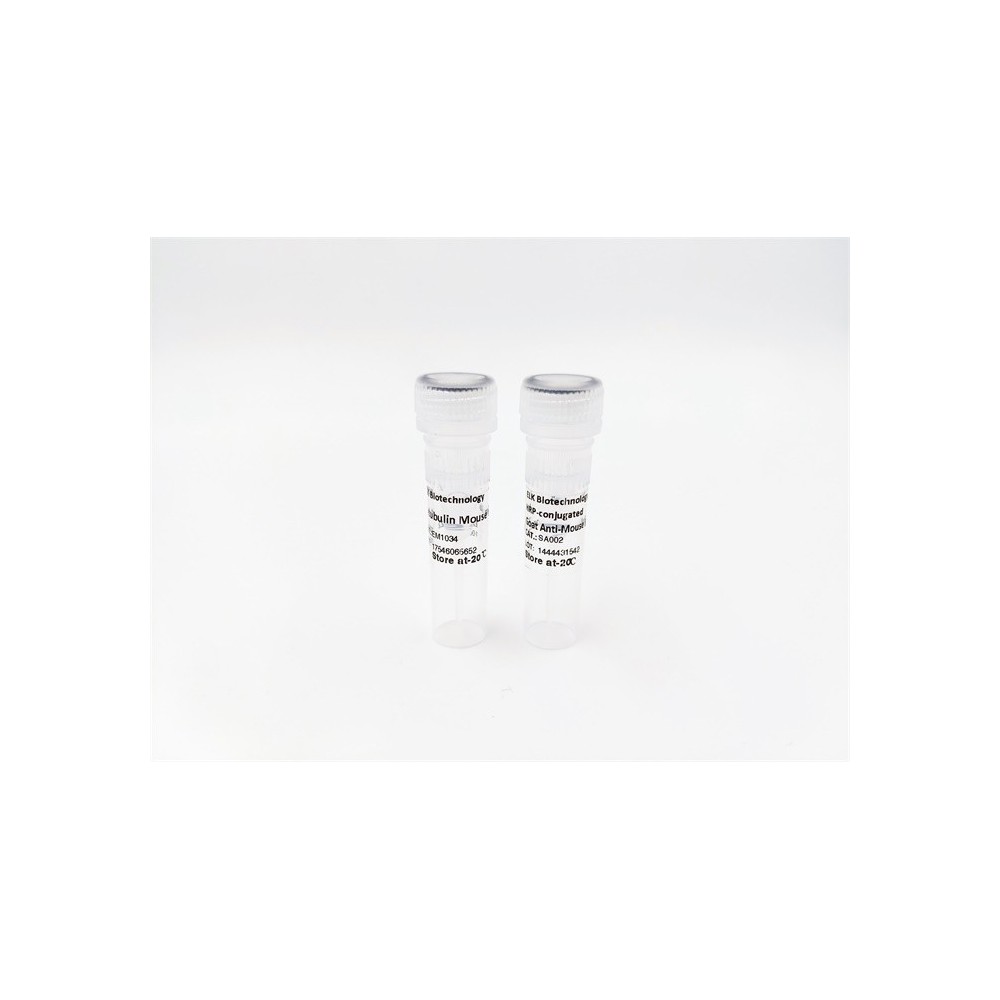

| ELK.No | ES5398 |
| Product name | TNAP rabbit pAb |
| Reactivity | Human;Mouse;Rat |
| Applications | WB;ELISA |
| Other name | ALPL; Alkaline phosphatase; tissue-nonspecific isozyme; AP-TNAP; TNSALP; Alkaline phosphatase liver/bone/kidney isozyme |
| Size | 50μL |
| Unit price ($) | 148 |
| Human gene ID | 249 |
| Human Swiss-Prot | P05186 |
| Source | Rabbit |
| Isotype | IgG |
| Target | TNAP |
| Fields | >>Thiamine metabolism;>>Folate biosynthesis;>>Metabolic pathways;>>Biosynthesis of cofactors |
| Gene name | ALPL |
| Protein name | Alkaline phosphatase tissue-nonspecific isozyme |
| Human gene link | View Human Gene |
| Human Swiss link | View Human Swiss-Prot |
| Mouse gene ID | 11647 |
| Mouse gene link | View Mouse Gene |
| Mouse Swiss-Prot | P09242 |
| Mouse Swiss link | View Mouse Swiss-Prot |
| Rat gene ID | 25586 |
| Rat gene link | View Rat Gene |
| Rat Swiss-Prot | P08289 |
| Rat Swiss link | View Rat Swiss-Prot |
| Immunogen | The antiserum was produced against synthesized peptide derived from human ALPL. AA range:201-250 |
| Specificity | TNAP Polyclonal Antibody detects endogenous levels of TNAP protein. |
| Formulation | Liquid in PBS containing 50% glycerol, 0.5% BSA and 0.02% sodium azide. |
| Clonality | Polyclonal |
| Dilution | Western Blot: 1/500 - 1/2000. ELISA: 1/40000. Not yet tested in other applications. |
| Purification | The antibody was affinity-purified from rabbit antiserum by affinity-chromatography using epitope-specific immunogen. |
| Concentration | 1 mg/ml |
| Storage stability | -20°C/1 year |
| Molecular Weight (Da) | |
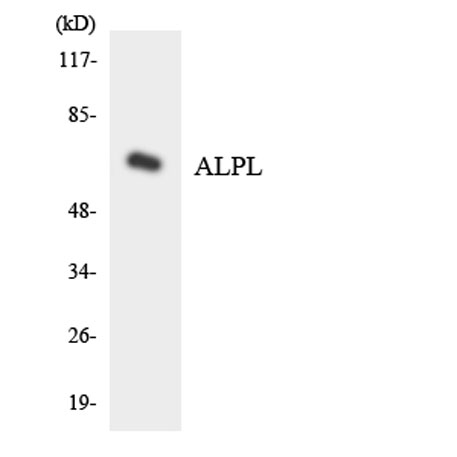
| Observed band (KD) | 70kD |
| Background | This gene encodes a member of the alkaline phosphatase family of proteins. There are at least four distinct but related alkaline phosphatases: intestinal, placental, placental-like, and liver/bone/kidney (tissue non-specific). The first three are located together on chromosome 2, while the tissue non-specific form is located on chromosome 1. The product of this gene is a membrane bound glycosylated enzyme that is not expressed in any particular tissue and is, therefore, referred to as the tissue-nonspecific form of the enzyme. Alternative splicing results in multiple transcript variants, at least one of which encodes a preproprotein that is proteolytically processed to generate the mature enzyme. This enzyme may play a role in bone mineralization. Mutations in this gene have been linked to hypophosphatasia, a disorder that is characterized by hypercalcemia and skeletal defects. [prov |
| Function | catalytic activity:A phosphate monoester + H(2)O = an alcohol + phosphate.,cofactor:Binds 1 magnesium ion.,cofactor:Binds 2 zinc ions.,disease:Defects in ALPL are a cause of hypophosphatasia adult type (hypophosphatasia) [MIM:146300].,disease:Defects in ALPL are a cause of hypophosphatasia childhood (hypophosphatasia) [MIM:241510].,disease:Defects in ALPL are a cause of hypophosphatasia infantile (hypophosphatasia) [MIM:241500]; an inherited metabolic bone disease characterized by defective skeletal mineralization. Four hypophosphatasia forms are distinguished, depending on the age of onset: perinatal, infantile, childhood and adult type. The perinatal form is the most severe and is almost always fatal. Patients with only premature loss of deciduous teeth, but with no bone disease are regarded as having odontohypophosphatasia (odonto).,function:This isozyme may play a role in skeletal mi |
| Subcellular location | Cell membrane ; Lipid-anchor, GPI-anchor . Extracellular vesicle membrane ; Lipid-anchor, GPI-anchor . Mitochondrion membrane ; Lipid-anchor, GPI-anchor . Mitochondrion intermembrane space . Localizes to special class of extracellular vesicles, named matrix vesicles (MVs), which are released by osteogenic cells. Localizes to the mitochondria of thermogenic fat cells: tethered to mitochondrial membranes via a GPI-anchor and probably resides in the mitochondrion intermembrane space. . |
| Expression | Brain,Cerebellum,Liver,Lymphoma,Osteosarcoma,Peripheral nerve,Semin |

Use collapsible tabs for more detailed information that will help customers make a purchasing decision.
Ex: Shipping and return policies, size guides, and other common questions.