 Français
 English

| ELK.No | ES5410 |
| Product name | Gastrin rabbit pAb |
| Reactivity | Human;Mouse;Rat |
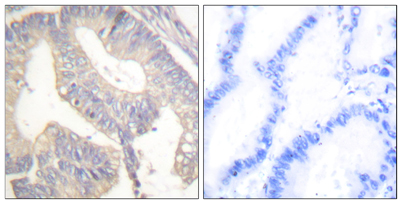
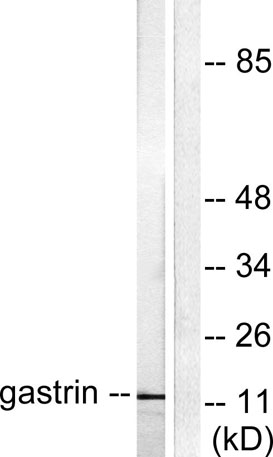
| Applications | WB;IHC;IF;ELISA |
| Other name | GAST; GAS; Gastrin |
| Size | 50μL |
| Unit price ($) | 148 |
| Human gene ID | 2520 |
| Human Swiss-Prot | P01350 |
| Source | Rabbit |
| Isotype | IgG |
| Target | Gastrin |
| Fields | >>Gastric acid secretion |
| Gene name | GAST |
| Protein name | Gastrin |
| Human gene link | View Human Gene |
| Human Swiss link | View Human Swiss-Prot |
| Mouse gene ID | 14459 |
| Mouse gene link | View Mouse Gene |
| Mouse Swiss-Prot | P48757 |
| Mouse Swiss link | View Mouse Swiss-Prot |
| Rat gene ID | 25320 |
| Rat gene link | View Rat Gene |
| Rat Swiss-Prot | P04563 |
| Rat Swiss link | View Rat Swiss-Prot |
| Immunogen | The antiserum was produced against synthesized peptide derived from human Gastrin. AA range:52-101 |
| Specificity | Gastrin Polyclonal Antibody detects endogenous levels of Gastrin protein. |
| Formulation | Liquid in PBS containing 50% glycerol, 0.5% BSA and 0.02% sodium azide. |
| Clonality | Polyclonal |
| Dilution | Western Blot: 1/500 - 1/2000. Immunohistochemistry: 1/100 - 1/300. Immunofluorescence: 1/200 - 1/1000. ELISA: 1/10000. Not yet tested in other applications. |
| Purification | The antibody was affinity-purified from rabbit antiserum by affinity-chromatography using epitope-specific immunogen. |
| Concentration | 1 mg/ml |
| Storage stability | -20°C/1 year |
| Molecular Weight (Da) | |
| Observed band (KD) | 12kD |
| Background | Gastrin is a hormone whose main function is to stimulate secretion of hydrochloric acid by the gastric mucosa, which results in gastrin formation inhibition. This hormone also acts as a mitogenic factor for gastrointestinal epithelial cells. Gastrin has two biologically active peptide forms, G34 and G17. [provided by RefSeq, Jul 2008], |
| Function | function:Gastrin stimulates the stomach mucosa to produce and secrete hydrochloric acid and the pancreas to secrete its digestive enzymes. It also stimulates smooth muscle contraction and increases blood circulation and water secretion in the stomach and intestine.,online information:Gastrin entry,PTM:Sulfation enhances proteolytic processing, and blocks peptide degradation. Levels of sulfation differ between proteolytically-cleaved gastrins. Thus, gastrin-6 is almost 73% sulfated, whereas the larger gastrins are less than 50% sulfated. Sulfation levels are also tissue-specific.,PTM:Two different processing pathways probably exist in antral G-cells. In the dominant pathway progastrin is cleaved at three sites resulting in two major bioactive gastrins, gastrin-34 and gastrin-17. In the putative alternative pathway, progastrin may be processed only at the most C-terminal dibasic site resul |
| Subcellular location | Secreted. |
| Expression | Gastric mucosa, |


Use collapsible tabs for more detailed information that will help customers make a purchasing decision.
Ex: Shipping and return policies, size guides, and other common questions.