 Français
 English
GATA-4 (phospho Ser262) rabbit pAb
AO-06-ES5482-50

| ELK.No | ES5482 |
| Product name | GATA-4 (phospho Ser262) rabbit pAb |
| Reactivity | Human;Mouse;Rat |
| Applications | WB;IF;ELISA |
| Other name | GATA4; Transcription factor GATA-4; GATA-binding factor 4 |
| Size | 50μL |
| Unit price ($) | 148 |
| Human gene ID | 2626 |
| Human Swiss-Prot | P43694 |
| Source | Rabbit |
| Isotype | IgG |
| Target | GATA-4 |
| Fields | >>cGMP-PKG signaling pathway;>>Cellular senescence;>>Tight junction;>>Thyroid hormone signaling pathway |
| Gene name | GATA4 |
| Protein name | Transcription factor GATA-4 |
| Human gene link | View Human Gene |
| Human Swiss link | View Human Swiss-Prot |
| Mouse gene ID | 14463 |
| Mouse gene link | View Mouse Gene |
| Mouse Swiss-Prot | Q08369 |
| Mouse Swiss link | View Mouse Swiss-Prot |
| Rat gene ID | 54254 |
| Rat gene link | View Rat Gene |
| Rat Swiss-Prot | P46152 |
| Rat Swiss link | View Rat Swiss-Prot |
| Immunogen | The antiserum was produced against synthesized peptide derived from human GATA4 around the phosphorylation site of Ser262. AA range:228-277 |
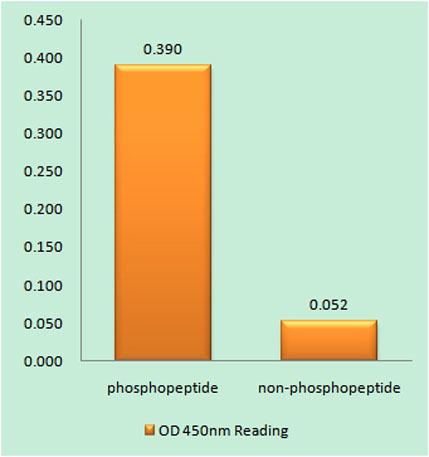
| Specificity | Phospho-GATA-4 (S262) Polyclonal Antibody detects endogenous levels of GATA-4 protein only when phosphorylated at S262. |
| Formulation | Liquid in PBS containing 50% glycerol, 0.5% BSA and 0.02% sodium azide. |
| Clonality | Polyclonal |
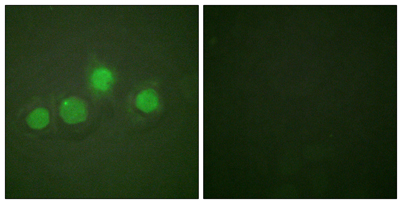
| Dilution | Western Blot: 1/500 - 1/2000. Immunofluorescence: 1/200 - 1/1000. ELISA: 1/5000. Not yet tested in other applications. |
| Purification | The antibody was affinity-purified from rabbit antiserum by affinity-chromatography using epitope-specific immunogen. |
| Concentration | 1 mg/ml |
| Storage stability | -20°C/1 year |
| Molecular Weight (Da) | |
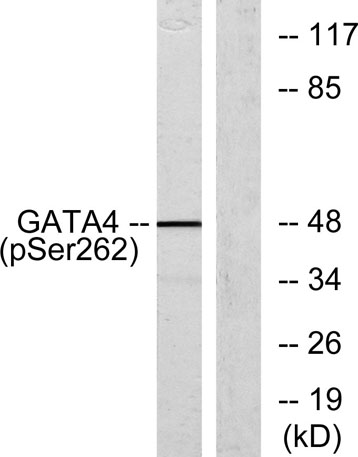
| Observed band (KD) | 48kD |
| Background | This gene encodes a member of the GATA family of zinc-finger transcription factors. Members of this family recognize the GATA motif which is present in the promoters of many genes. This protein is thought to regulate genes involved in embryogenesis and in myocardial differentiation and function, and is necessary for normal testicular development. Mutations in this gene have been associated with cardiac septal defects. Additionally, alterations in gene expression have been associated with several cancer types. Alternative splicing results in multiple transcript variants. [provided by RefSeq, Apr 2015], |
| Function | disease:Defects in GATA4 are the cause of atrial septal defect type 2 (ASD2) [MIM:607941]. ASD2 is a congenital heart malformation characterized by incomplete closure of the wall between the atria resulting in blood flow from the left to the right atria. ASD2 patients show other heart abnormalities including ventricular and atrioventricular septal defects, pulmonary valve thickening or insufficiency of the cardiac valves. ASD2 is not associated with defects in the cardiac conduction system or non-cardiac abnormalities.,function:Transcriptional activator. Binds to the consensus sequence 5'-AGATAG-3'. Acts as a transcriptional activator of ANF in cooperation with NKX2-5.,similarity:Contains 2 GATA-type zinc fingers.,subunit:Interacts with ZNF260 (By similarity). Interacts with the homeobox domain of NKX2-5 through its C-terminal zinc finger. Also interacts with JARID2 which represses its a |
| Subcellular location | Nucleus . |
| Expression | Heart,Lung, |

Use collapsible tabs for more detailed information that will help customers make a purchasing decision.
Ex: Shipping and return policies, size guides, and other common questions.