 Français
 English
Connexin 43 (phospho Tyr265) rabbit pAb
AO-06-ES5521-50

| ELK.No | ES5521 |
| Product name | Connexin 43 (phospho Tyr265) rabbit pAb |
| Reactivity | Human;Mouse;Rat |
| Applications | WB;ELISA |
| Other name | GJA1; GJAL; Gap junction alpha-1 protein; Connexin-43; Cx43; Gap junction 43 kDa heart protein |
| Size | 50μL |
| Unit price ($) | 148 |
| Human gene ID | 2697 |
| Human Swiss-Prot | P17302 |
| Source | Rabbit |
| Isotype | IgG |
| Target | Connexin 43 |
| Fields | >>Gap junction;>>Arrhythmogenic right ventricular cardiomyopathy |
| Gene name | GJA1 |
| Protein name | Gap junction alpha-1 protein |
| Human gene link | View Human Gene |
| Human Swiss link | View Human Swiss-Prot |
| Mouse gene ID | 14609 |
| Mouse gene link | View Mouse Gene |
| Mouse Swiss-Prot | P23242 |
| Mouse Swiss link | View Mouse Swiss-Prot |
| Rat gene ID | 24392 |
| Rat gene link | View Rat Gene |
| Rat Swiss-Prot | P08050 |
| Rat Swiss link | View Rat Swiss-Prot |
| Immunogen | Synthesized phospho-peptide around the phosphorylation site of human Connexin 43 (phospho Ser265) |
| Specificity | Phospho-Connexin 43 (S265) Polyclonal Antibody detects endogenous levels of Connexin 43 protein only when phosphorylated at S265. |
| Formulation | Liquid in PBS containing 50% glycerol, 0.5% BSA and 0.02% sodium azide. |
| Clonality | Polyclonal |
| Dilution | Western Blot: 1/500 - 1/2000. ELISA: 1/10000. Not yet tested in other applications. |
| Purification | The antibody was affinity-purified from rabbit antiserum by affinity-chromatography using epitope-specific immunogen. |
| Concentration | 1 mg/ml |
| Storage stability | -20°C/1 year |
| Molecular Weight (Da) | |
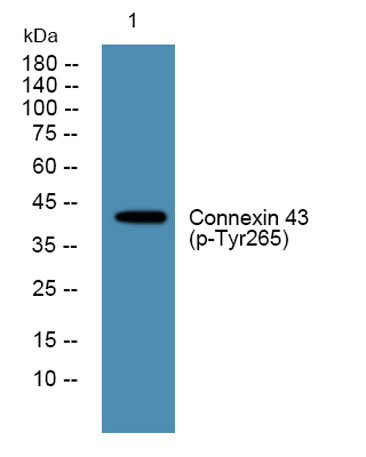
| Observed band (KD) | 43kD |
| Background | This gene is a member of the connexin gene family. The encoded protein is a component of gap junctions, which are composed of arrays of intercellular channels that provide a route for the diffusion of low molecular weight materials from cell to cell. The encoded protein is the major protein of gap junctions in the heart that are thought to have a crucial role in the synchronized contraction of the heart and in embryonic development. A related intronless pseudogene has been mapped to chromosome 5. Mutations in this gene have been associated with oculodentodigital dysplasia, autosomal recessive craniometaphyseal dysplasia and heart malformations. [provided by RefSeq, May 2014], |
| Function | caution:PubMed:11741837 reported 2 mutations (Phe-11 and Ala-24) linked to non-syndromic autosomal recessive deafness (DFNBG). These mutations have subsequently been shown (PubMed:12457340) to involve the pseudogene of connexin-43 located on chromosome 5.,caution:PubMed:7715640 reported a mutation Pro-364 linked to congenital heart diseases. This was later shown (PubMed:8873667) to be an artifact.,disease:Defects in GJA1 are a cause of hypoplastic left heart syndrome (HLHS) [MIM:241550]. HLHS refers to the abnormal development of the left-sided cardiac structures, resulting in obstruction to blood flow from the left ventricular outflow tract. In addition, the syndrome includes underdevelopment of the left ventricle, aorta, and aortic arch, as well as mitral atresia or stenosis.,disease:Defects in GJA1 are the cause of autosomal dominant oculodentodigital dysplasia (ODDD) [MIM:164200]; al |
| Subcellular location | Cell membrane ; Multi-pass membrane protein . Cell junction, gap junction . Endoplasmic reticulum . Localizes at the intercalated disk (ICD) in cardiomyocytes and the proper localization at ICD is dependent on TMEM65. . |
| Expression | Expressed in the heart and fetal cochlea. |

Use collapsible tabs for more detailed information that will help customers make a purchasing decision.
Ex: Shipping and return policies, size guides, and other common questions.