 Français
 English

| ELK.No | ES5573 |
| Product name | PR48 rabbit pAb |
| Reactivity | Human;Rat;Mouse; |
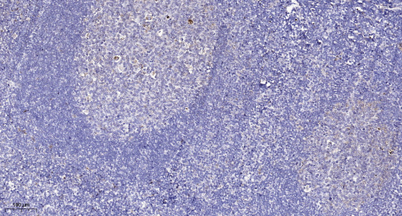
| Applications | WB;IHC |
| Other name | PPP2R3B; PPP2R3L; Serine/threonine-protein phosphatase 2A regulatory subunit B'' subunit beta; PP2A subunit B isoform PR48; Protein phosphatase 2A 48 kDa regulatory subunit |
| Size | 50μL |
| Unit price ($) | 148 |
| Human gene ID | 28227 |
| Human Swiss-Prot | Q9Y5P8 |
| Source | Rabbit |
| Isotype | IgG |
| Target | PR48 |
| Fields | >>mRNA surveillance pathway;>>Sphingolipid signaling pathway;>>PI3K-Akt signaling pathway;>>AMPK signaling pathway;>>Adrenergic signaling in cardiomyocytes;>>Dopaminergic synapse;>>Human papillomavirus infection |
| Gene name | PPP2R3B |
| Protein name | Serine/threonine-protein phosphatase 2A regulatory subunit B'' subunit beta |
| Human gene link | View Human Gene |
| Human Swiss link | View Human Swiss-Prot |
| Mouse gene ID | |
| Mouse gene link | |
| Mouse Swiss-Prot | |
| Mouse Swiss link | |
| Rat gene ID | |
| Rat gene link | |
| Rat Swiss-Prot | |
| Rat Swiss link | |
| Immunogen | The antiserum was produced against synthesized peptide derived from human PPP2R3B. AA range:364-413 |
| Specificity | PR48 Polyclonal Antibody detects endogenous levels of PR48 protein. |
| Formulation | Liquid in PBS containing 50% glycerol, 0.5% BSA and 0.02% sodium azide. |
| Clonality | Polyclonal |
| Dilution | WB 1:500-2000;IHC-p 1:50-300 |
| Purification | The antibody was affinity-purified from rabbit antiserum by affinity-chromatography using epitope-specific immunogen. |
| Concentration | 1 mg/ml |
| Storage stability | -20°C/1 year |
| Molecular Weight (Da) | |
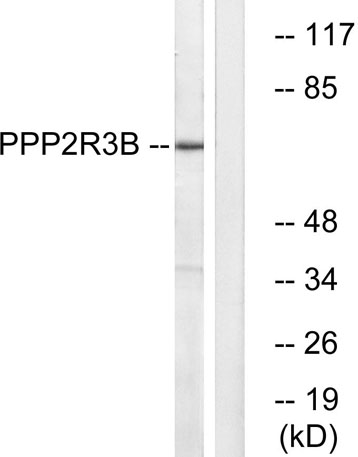
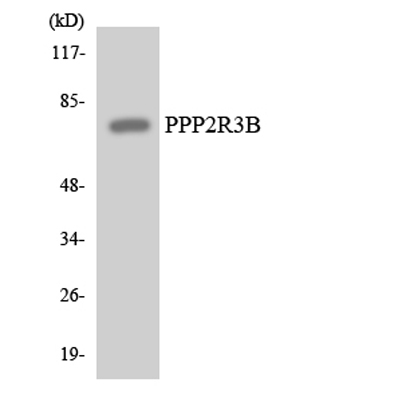
| Observed band (KD) | 70kD |
| Background | Protein phosphatase 2 (formerly named type 2A) is one of the four major Ser/Thr phosphatases and is implicated in the negative control of cell growth and division. Protein phosphatase 2 holoenzymes are heterotrimeric proteins composed of a structural subunit A, a catalytic subunit C, and a regulatory subunit B. The regulatory subunit is encoded by a diverse set of genes that have been grouped into the B/PR55, B'/PR61, and B''/PR72 families. These different regulatory subunits confer distinct enzymatic specificities and intracellular localizations to the holozenzyme. The product of this gene belongs to the B'' family. The B'' family has been further divided into subfamilies. The product of this gene belongs to the beta subfamily of regulatory subunit B''. [provided by RefSeq, Apr 2010], |
| Function | function:The B regulatory subunit might modulate substrate selectivity and catalytic activity, and also might direct the localization of the catalytic enzyme to a particular subcellular compartment.,miscellaneous:The gene encoding for this protein is located in the pseudoautosomal region 1 (PAR1) of X and Y chromosomes.,similarity:Contains 1 EF-hand domain.,subunit:PP2A consists of a common heterodimeric core enzyme, composed of a 36 kDa catalytic subunit (subunit C) and a 65 kDa constant regulatory subunit (PR65 or subunit A), that associates with a variety of regulatory subunits. Proteins that associate with the core dimer include three families of regulatory subunits B (the R2/B/PR55/B55, R3/B''/PR72/PR130/PR59 and R5/B'/B56 families), the 48 kDa variable regulatory subunit, viral proteins, and cell signaling molecules. Interacts with N-terminal region of CDC6., |
| Subcellular location | Nucleus . |
| Expression | Brain,Placenta,Testis, |

Use collapsible tabs for more detailed information that will help customers make a purchasing decision.
Ex: Shipping and return policies, size guides, and other common questions.