 Français
 English

| ELK.No | ES5609 |
| Product name | Dok-7 rabbit pAb |
| Reactivity | Human;Mouse |
| Applications | WB;IHC;IF;ELISA |
| Other name | DOK7; C4orf25; Protein Dok-7; Downstream of tyrosine kinase 7 |
| Size | 50μL |
| Unit price ($) | 148 |
| Human gene ID | 285489 |
| Human Swiss-Prot | Q18PE1 |
| Source | Rabbit |
| Isotype | IgG |
| Target | Dok-7 |
| Fields | |
| Gene name | DOK7 |
| Protein name | Protein Dok-7 |
| Human gene link | View Human Gene |
| Human Swiss link | View Human Swiss-Prot |
| Mouse gene ID | 231134 |
| Mouse gene link | View Mouse Gene |
| Mouse Swiss-Prot | Q18PE0 |
| Mouse Swiss link | View Mouse Swiss-Prot |
| Rat gene ID | |
| Rat gene link | |
| Rat Swiss-Prot | |
| Rat Swiss link | |
| Immunogen | The antiserum was produced against synthesized peptide derived from human DOK7. AA range:10-59 |
| Specificity | Dok-7 Polyclonal Antibody detects endogenous levels of Dok-7 protein. |
| Formulation | Liquid in PBS containing 50% glycerol, 0.5% BSA and 0.02% sodium azide. |
| Clonality | Polyclonal |
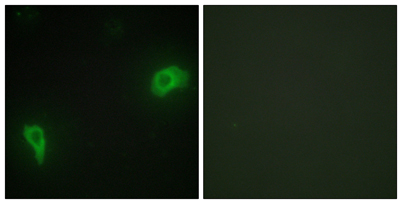
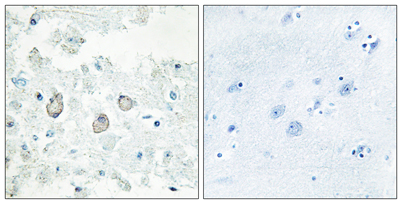
| Dilution | Western Blot: 1/500 - 1/2000. Immunohistochemistry: 1/100 - 1/300. Immunofluorescence: 1/200 - 1/1000. ELISA: 1/20000. Not yet tested in other applications. |
| Purification | The antibody was affinity-purified from rabbit antiserum by affinity-chromatography using epitope-specific immunogen. |
| Concentration | 1 mg/ml |
| Storage stability | -20°C/1 year |
| Molecular Weight (Da) | |
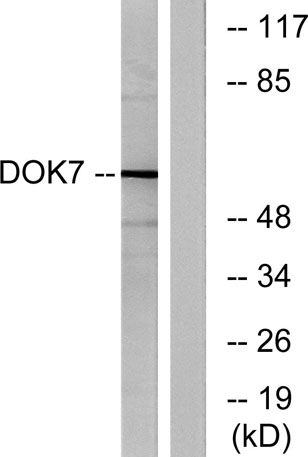
| Observed band (KD) | 60kD |
| Background | docking protein 7(DOK7) Homo sapiens The protein encoded by this gene is essential for neuromuscular synaptogenesis. The protein functions in aneural activation of muscle-specific receptor kinase, which is required for postsynaptic differentiation, and in the subsequent clustering of the acetylcholine receptor in myotubes. This protein can also induce autophosphorylation of muscle-specific receptor kinase. Mutations in this gene are a cause of familial limb-girdle myasthenia autosomal recessive, which is also known as congenital myasthenic syndrome type 1B. Alternative splicing results in multiple transcript variants. [provided by RefSeq, Sep 2009], |
| Function | disease:Defects in DOK7 are the cause of familial limb-girdle myasthenia autosomal recessive (LGM) [MIM:254300]; also called congenital myasthenic syndrome type 1B or CMS1B. LGM is a congenital myasthenic syndrome characterized by a typical 'limb girdle' pattern of muscle weakness with small, simplified neuromuscular junctions but normal acetylcholine receptor and acetylcholinesterase function.,function:Probable muscle-intrinsic activator of MUSK that plays an essential role in neuromuscular synaptogenesis. Acts in aneural activation of MUSK and subsequent acetylcholine receptor (AchR) clustering in myotubes. Induces autophosphorylation of MUSK.,similarity:Contains 1 IRS-type PTB domain.,similarity:Contains 1 PH domain.,subcellular location:Accumulates at neuromuscular junctions.,subunit:Interacts with the cytoplasmic part of MUSK.,tissue specificity:Preferentiall eypressed in skeletal m |
| Subcellular location | Cell membrane ; Peripheral membrane protein . Cell junction, synapse . Accumulates at neuromuscular junctions. . |
| Expression | Preferentially expressed in skeletal muscle and heart. Present in thigh muscle, diaphragm and heart but not in the liver or spleen (at protein level). |

Use collapsible tabs for more detailed information that will help customers make a purchasing decision.
Ex: Shipping and return policies, size guides, and other common questions.