 Français
 English
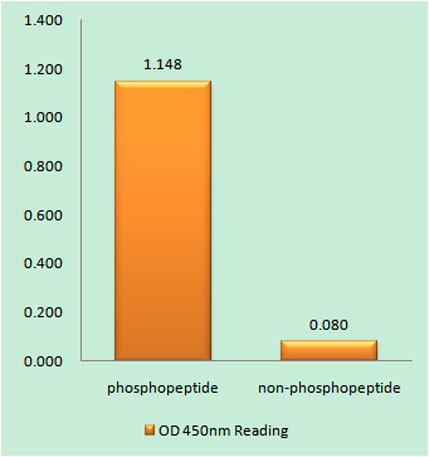
GRB10 (phospho Tyr67) rabbit pAb
AO-06-ES5631-100

| ELK.No | ES5631 |
| Product name | GRB10 (phospho Tyr67) rabbit pAb |
| Reactivity | Human;Rat;Mouse; |
| Applications | WB;IHC;IF;ELISA |
| Other name | GRB10; GRBIR; KIAA0207; Growth factor receptor-bound protein 10; GRB10 adapter protein; Insulin receptor-binding protein Grb-IR |
| Size | 100μL |
| Unit price ($) | 248 |
| Human gene ID | 2887 |
| Human Swiss-Prot | Q13322 |
| Source | Rabbit |
| Isotype | IgG |
| Target | GRB10 |
| Fields | >>mTOR signaling pathway |
| Gene name | GRB10 |
| Protein name | Growth factor receptor-bound protein 10 |
| Human gene link | View Human Gene |
| Human Swiss link | View Human Swiss-Prot |
| Mouse gene ID | |
| Mouse gene link | |
| Mouse Swiss-Prot | Q60760 |
| Mouse Swiss link | View Mouse Swiss-Prot |
| Rat gene ID | |
| Rat gene link | |
| Rat Swiss-Prot | |
| Rat Swiss link | |
| Immunogen | The antiserum was produced against synthesized peptide derived from human GRB10 around the phosphorylation site of Tyr67. AA range:33-82 |
| Specificity | Phospho-GRB10 (Y67) Polyclonal Antibody detects endogenous levels of GRB10 protein only when phosphorylated at Y67. |
| Formulation | Liquid in PBS containing 50% glycerol, 0.5% BSA and 0.02% sodium azide. |
| Clonality | Polyclonal |
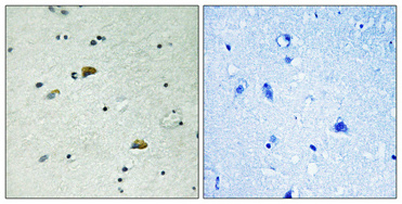
| Dilution | Western Blot: 1/500 - 1/2000. Immunohistochemistry: 1/100 - 1/300. Immunofluorescence: 1/200 - 1/1000. ELISA: 1/20000. Not yet tested in other applications. |
| Purification | The antibody was affinity-purified from rabbit antiserum by affinity-chromatography using epitope-specific immunogen. |
| Concentration | 1 mg/ml |
| Storage stability | -20°C/1 year |
| Molecular Weight (Da) | |
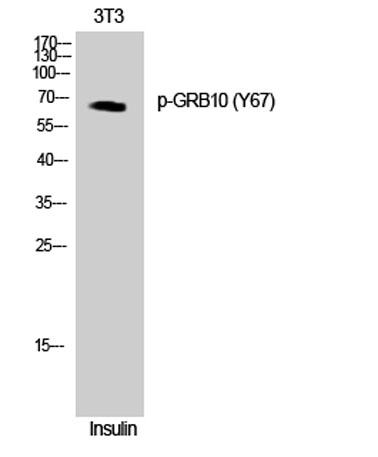
| Observed band (KD) | 67kD |
| Background | The product of this gene belongs to a small family of adapter proteins that are known to interact with a number of receptor tyrosine kinases and signaling molecules. This gene encodes a growth factor receptor-binding protein that interacts with insulin receptors and insulin-like growth-factor receptors. Overexpression of some isoforms of the encoded protein inhibits tyrosine kinase activity and results in growth suppression. This gene is imprinted in a highly isoform- and tissue-specific manner, with expression observed from the paternal allele in the brain, and from the maternal allele in the placental trophoblasts. Alternatively spliced transcript variants encoding different isoforms have been identified. [provided by RefSeq, Oct 2010], |
| Function | alternative products:Additional isoforms seem to exist,function:Plays a functional role in insulin and IGF-I signaling. May serve to positively link the insulin and IGF-I receptors to an uncharacterized mitogenic signaling pathway. Interacts with the cytoplasmic domain of the autophosphorylated insulin receptor which is then inhibited. The interaction is mediated by the SH2 domain. Also binds activated platelet-derived growth factor receptor and epidermal growth factor receptor.,similarity:Belongs to the GRB7/10/14 family.,similarity:Contains 1 PH domain.,similarity:Contains 1 Ras-associating domain.,similarity:Contains 1 SH2 domain.,subunit:Interacts with GIGYF1/PERQ1 and GIGYF2/TNRC15.,tissue specificity:Highly expressed in skeletal muscle., |
| Subcellular location | Cytoplasm . When complexed with NEDD4 and IGF1R, follows IGF1R internalization, remaining associated with early endosomes. Uncouples from IGF1R-containing endosomes before the sorting of the receptor to the lysosomal compartment (By similarity). . |
| Expression | Widely expressed in fetal and adult tissues, including fetal and postnatal liver, lung, kidney, skeletal muscle, heart, spleen, skin and brain. |

Use collapsible tabs for more detailed information that will help customers make a purchasing decision.
Ex: Shipping and return policies, size guides, and other common questions.