 Français
 English
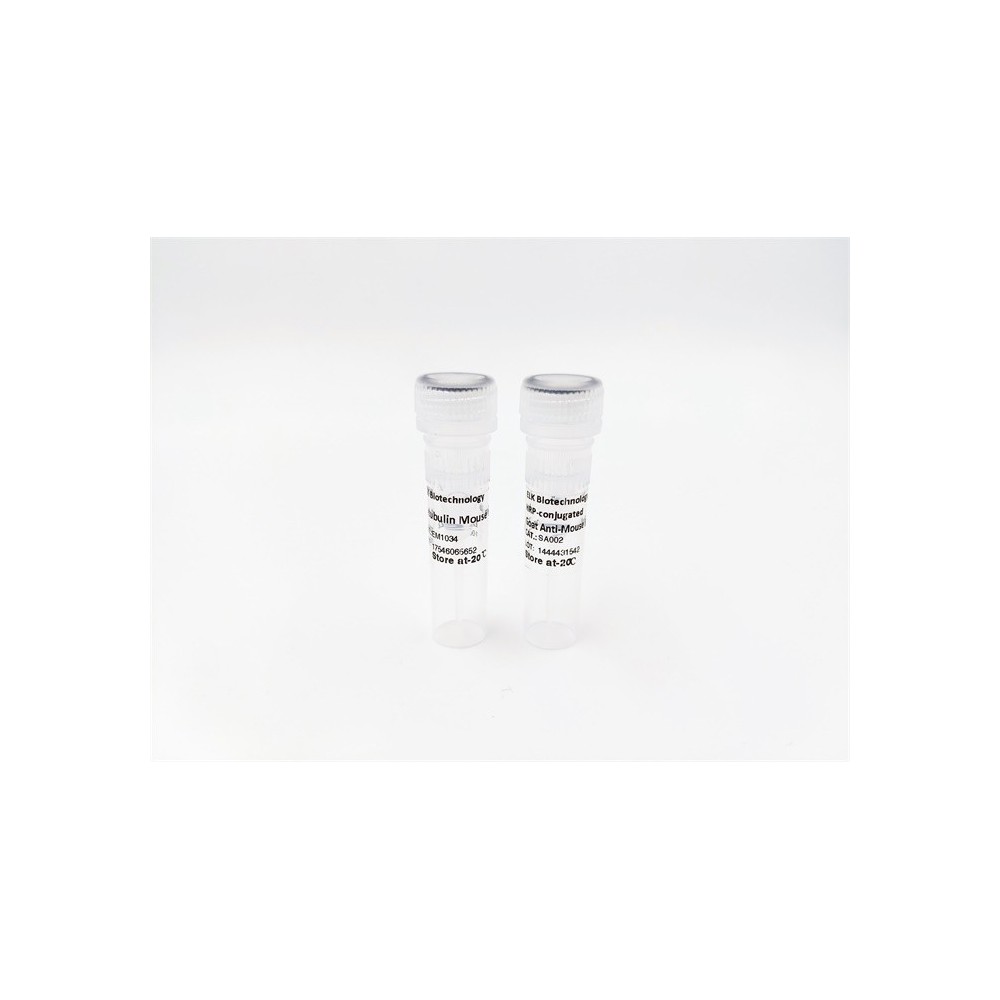
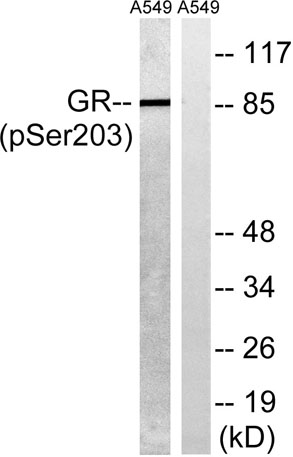
GR (phospho Ser203) rabbit pAb
AO-06-ES5663-100

| ELK.No | ES5663 |
| Product name | GR (phospho Ser203) rabbit pAb |
| Reactivity | Human;Mouse |
| Applications | WB;ELISA |
| Other name | NR3C1; GRL; Glucocorticoid receptor; GR; Nuclear receptor subfamily 3 group C member 1 |
| Size | 100μL |
| Unit price ($) | 248 |
| Human gene ID | 2908 |
| Human Swiss-Prot | P04150 |
| Source | Rabbit |
| Isotype | IgG |
| Target | GR |
| Fields | >>Neuroactive ligand-receptor interaction |
| Gene name | NR3C1 |
| Protein name | Glucocorticoid receptor |
| Human gene link | View Human Gene |
| Human Swiss link | View Human Swiss-Prot |
| Mouse gene ID | |
| Mouse gene link | |
| Mouse Swiss-Prot | P06537 |
| Mouse Swiss link | View Mouse Swiss-Prot |
| Rat gene ID | |
| Rat gene link | |
| Rat Swiss-Prot | |
| Rat Swiss link | |
| Immunogen | The antiserum was produced against synthesized peptide derived from human GR around the phosphorylation site of Ser203. AA range:171-220 |
| Specificity | Phospho-GR (S203) Polyclonal Antibody detects endogenous levels of GR protein only when phosphorylated at S203. |
| Formulation | Liquid in PBS containing 50% glycerol, 0.5% BSA and 0.02% sodium azide. |
| Clonality | Polyclonal |
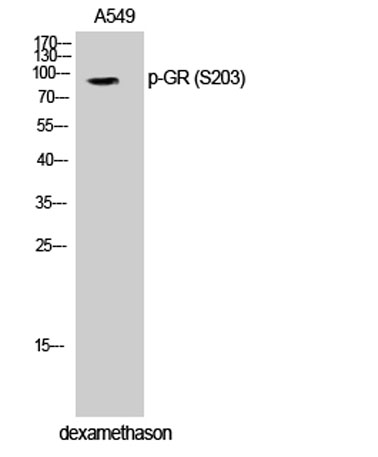
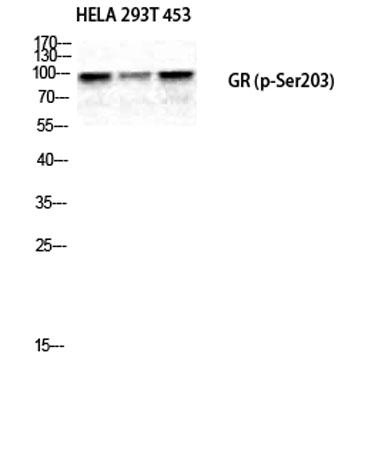
| Dilution | Western Blot: 1/500 - 1/2000. ELISA: 1/10000. Not yet tested in other applications. |
| Purification | The antibody was affinity-purified from rabbit antiserum by affinity-chromatography using epitope-specific immunogen. |
| Concentration | 1 mg/ml |
| Storage stability | -20°C/1 year |
| Molecular Weight (Da) | |
| Observed band (KD) | 86kD |
| Background | This gene encodes glucocorticoid receptor, which can function both as a transcription factor that binds to glucocorticoid response elements in the promoters of glucocorticoid responsive genes to activate their transcription, and as a regulator of other transcription factors. This receptor is typically found in the cytoplasm, but upon ligand binding, is transported into the nucleus. It is involved in inflammatory responses, cellular proliferation, and differentiation in target tissues. Mutations in this gene are associated with generalized glucocorticoid resistance. Alternative splicing of this gene results in transcript variants encoding either the same or different isoforms. Additional isoforms resulting from the use of alternate in-frame translation initiation sites have also been described, and shown to be functional, displaying diverse cytoplasm-to-nucleus trafficking pat |
| Function | alternative products:At least 4 isoforms, Alpha (shown here), Alpha-B, Beta and Beta-B, are produced by alternative initiation at Met-1 and Met-27. The existence of isoform Alpha and isoform Alpha-B has been proved by mutagenesis. As the sequence environment of the 2 potential ATG initiator codons is the same for the other altrnatively spliced isoforms, alternative initiation of translation could also occur on these transcripts. Additional isoforms seem to exist,disease:Defects in NR3C1 are a cause of glucocorticoid resistance [MIM:138040]; also known as cortisol resistance. It is a hypertensive, hyperandrogenic disorder characterized by increased serum cortisol concentrations. Inheritance is autosomal dominant.,domain:Composed of three domains: a modulating N-terminal domain, a DNA-binding domain and a C-terminal steroid-binding domain.,function:Receptor for glucocorticoids (GC). Has a |
| Subcellular location | [Isoform Alpha]: Cytoplasm . Nucleus . Mitochondrion . Cytoplasm, cytoskeleton, spindle . Cytoplasm, cytoskeleton, microtubule organizing center, centrosome . After ligand activation, translocates from the cytoplasm to the nucleus. In the presence of NR1D1 shows a time-dependent subcellular localization, localizing to the cytoplasm at ZT8 and to the nucleus at ZT20 (By similarity). Lacks this diurnal pattern of localization in the absence of NR1D1, localizing to both nucleus and the cytoplasm at ZT8 and ZT20 (By similarity). .; [Isoform Beta]: Nucleus . Cytoplasm . Expressed predominantly in the nucleus with some expression also detected in the cytoplasm. .; [Isoform Alpha-B]: Nucleus . Cytoplasm . After ligand activation, translocates from the cytoplasm to the nucleus. . |
| Expression | Widely expressed including bone, stomach, lung, liver, colon, breast, ovary, pancreas and kidney (PubMed:25847991). In the heart, detected in left and right atria, left and right ventricles, aorta, apex, intraventricular septum, and atrioventricular node as well as whole adult and fetal heart (PubMed:10902803). ; [Isoform Beta]: Widely expressed including brain, bone marrow, thymus, spleen, liver, kidney, pancreas, lung, fat, skeletal muscle, heart, placenta and blood leukocytes. ; [Isoform Alpha-2]: Widely expressed. |

Use collapsible tabs for more detailed information that will help customers make a purchasing decision.
Ex: Shipping and return policies, size guides, and other common questions.