 Français
 English
Rac GAP1 (phospho Ser387) rabbit pAb
AO-06-ES5676-50

| ELK.No | ES5676 |
| Product name | Rac GAP1 (phospho Ser387) rabbit pAb |
| Reactivity | Human;Mouse;Rat;Monkey |
| Applications | WB;IHC;IF;ELISA |
| Other name | RACGAP1; KIAA1478; MGCRACGAP; Rac GTPase-activating protein 1; Male germ cell RacGap; MgcRacGAP; Protein CYK4 homolg; CYK4; HsCYK-4 |
| Size | 50μL |
| Unit price ($) | 148 |
| Human gene ID | 29127 |
| Human Swiss-Prot | Q9H0H5 |
| Source | Rabbit |
| Isotype | IgG |
| Target | Rac GAP1 |
| Fields | |
| Gene name | RACGAP1 |
| Protein name | Rac GTPase-activating protein 1 |
| Human gene link | View Human Gene |
| Human Swiss link | View Human Swiss-Prot |
| Mouse gene ID | 26934 |
| Mouse gene link | View Mouse Gene |
| Mouse Swiss-Prot | Q9WVM1 |
| Mouse Swiss link | View Mouse Swiss-Prot |
| Rat gene ID | |
| Rat gene link | |
| Rat Swiss-Prot | |
| Rat Swiss link | |
| Immunogen | The antiserum was produced against synthesized peptide derived from human GTPase Activating Protein around the phosphorylation site of Ser387. AA range:353-402 |
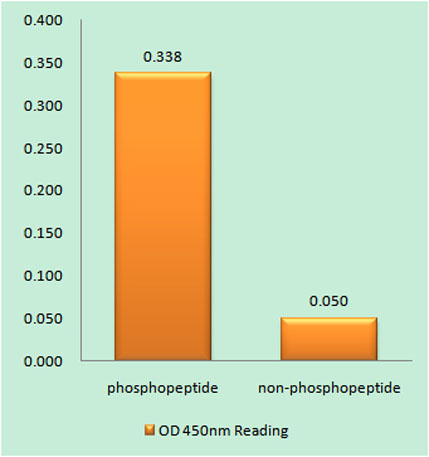
| Specificity | Phospho-Rac GAP1 (S387) Polyclonal Antibody detects endogenous levels of Rac GAP1 protein only when phosphorylated at S387. |
| Formulation | Liquid in PBS containing 50% glycerol, 0.5% BSA and 0.02% sodium azide. |
| Clonality | Polyclonal |
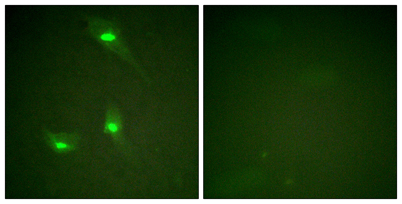
| Dilution | Western Blot: 1/500 - 1/2000. Immunohistochemistry: 1/100 - 1/300. Immunofluorescence: 1/200 - 1/1000. ELISA: 1/20000. Not yet tested in other applications. |
| Purification | The antibody was affinity-purified from rabbit antiserum by affinity-chromatography using epitope-specific immunogen. |
| Concentration | 1 mg/ml |
| Storage stability | -20°C/1 year |
| Molecular Weight (Da) | |
| Observed band (KD) | 72kD |
| Background | This gene encodes a GTPase-activating protein (GAP) that is a compoment of the centralspindlin complex. This protein binds activated forms of Rho GTPases and stimulates GTP hydrolysis, which results in negative regulation of Rho-mediated signals. This protein plays a regulatory role in cytokinesis, cell growth, and differentiation. Alternatively spliced transcript variants have been found for this gene. There is a pseudogene for this gene on chromosome 12. [provided by RefSeq, Feb 2016], |
| Function | domain:The coiled coil region is indispensible for localization to the midbody during cytokinesis.,function:Essential for the early stages of embryogenesis and may play a role in the microtubule-dependent steps in cytokinesis. Plays key roles in controlling cell growth and differentiation of hematopoietic cells through mechanisms other than regulating Rac GTPase activity. Also involved in the regulation of growth-related processes in adipocytes and myoblasts. May be involved in regulating spermatogenesis and in the RACGAP1 pathway in neuronal proliferation. Shows strong GAP (GTPase activation) activity towards CDC42 and RAC1 and less towards RHOA. Required for initiation of cleavage furrow ingression by regulating ECT2 and for assembly of the contractile ring. May play a role in regulating cortical activity through RHOA during cytokinesis. May participate in the regulation of sulfate tra |
| Subcellular location | Nucleus . Cytoplasm. Cytoplasm, cytoskeleton, spindle . Cytoplasmic vesicle, secretory vesicle, acrosome. Cleavage furrow. Midbody, Midbody ring . Cell membrane; Peripheral membrane protein; Cytoplasmic side. Colocalizes with RND2 in Golgi-derived proacrosomal vesicles and the acrosome (By similarity). During interphase, localized to the nucleus and cytoplasm along with microtubules, in anaphase, is redistributed to the central spindle and, in telophase and cytokinesis, to the midbody ring, also called Flemming body. Colocalizes with RHOA at the myosin contractile ring during cytokinesis. Colocalizes with ECT2 to the mitotic spindles during anaphase/metaphase, the cleavage furrow during telophase and at the midbody at the end of cytokinesis. Colocalizes with Cdc42 to spindle microtubules f |
| Expression | Highly expressed in testis, thymus and placenta. Expressed at lower levels in spleen and peripheral blood lymphocytes. In testis, expression is restricted to germ cells with the highest levels of expression found in spermatocytes. Expression is regulated in a cell cycle-dependent manner and peaks during G2/M phase. |

Use collapsible tabs for more detailed information that will help customers make a purchasing decision.
Ex: Shipping and return policies, size guides, and other common questions.