 Français
 English
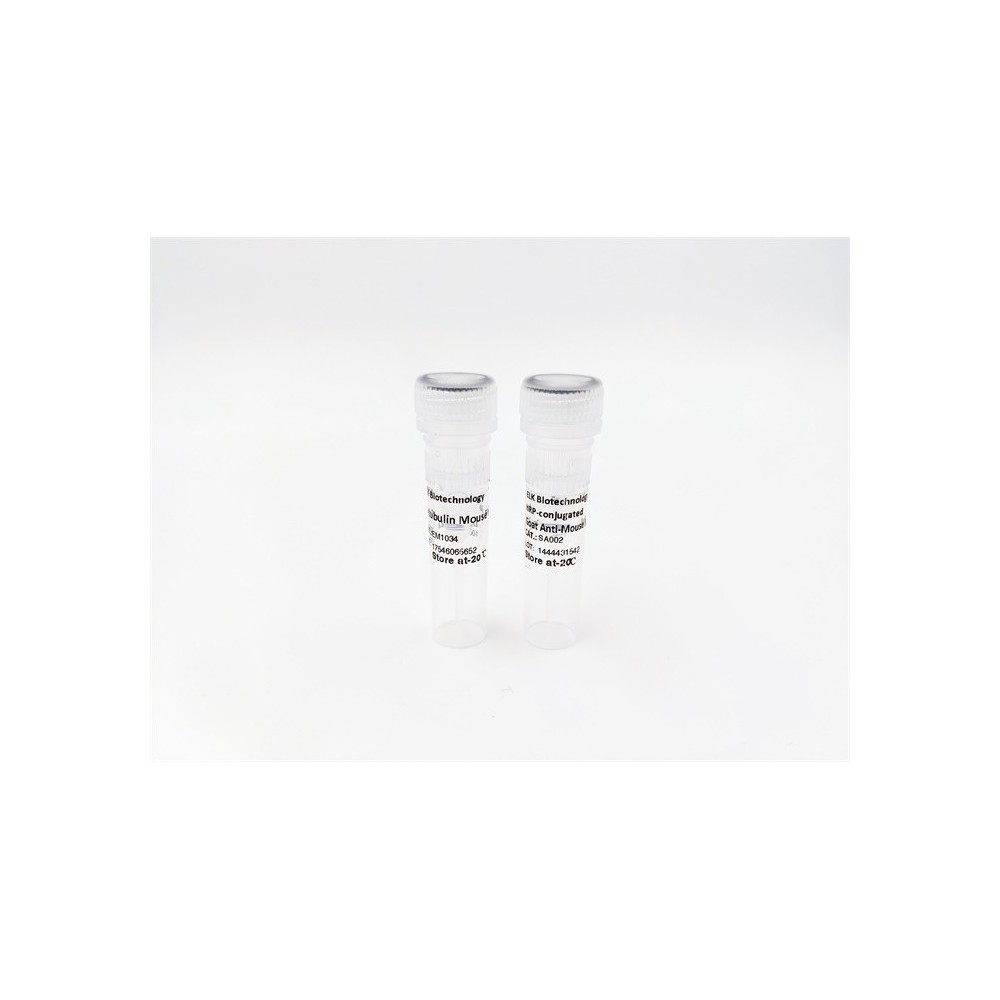

| ELK.No | ES5679 |
| Product name | mGluR7 rabbit pAb |
| Reactivity | Human;Mouse;Rat |
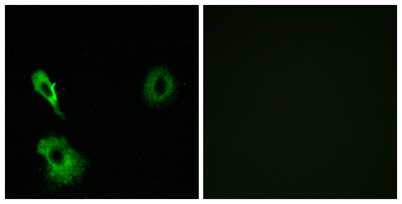
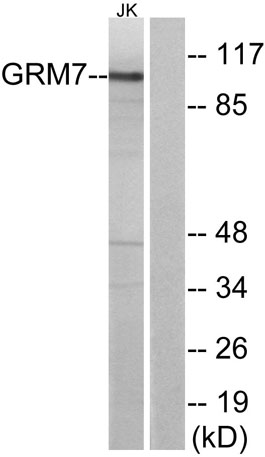
| Applications | WB;ELISA;IHC |
| Other name | GRM7; GPRC1G; MGLUR7; Metabotropic glutamate receptor 7; mGluR7 |
| Size | 50μL |
| Unit price ($) | 148 |
| Human gene ID | 2917 |
| Human Swiss-Prot | Q14831 |
| Source | Rabbit |
| Isotype | IgG |
| Target | mGluR7 |
| Fields | >>Phospholipase D signaling pathway;>>Neuroactive ligand-receptor interaction;>>Glutamatergic synapse |
| Gene name | GRM7 |
| Protein name | Metabotropic glutamate receptor 7 |
| Human gene link | View Human Gene |
| Human Swiss link | View Human Swiss-Prot |
| Mouse gene ID | 108073 |
| Mouse gene link | View Mouse Gene |
| Mouse Swiss-Prot | Q68ED2 |
| Mouse Swiss link | View Mouse Swiss-Prot |
| Rat gene ID | 81672 |
| Rat gene link | View Rat Gene |
| Rat Swiss-Prot | P35400 |
| Rat Swiss link | View Rat Swiss-Prot |
| Immunogen | The antiserum was produced against synthesized peptide derived from human GRM7. AA range:351-400 |
| Specificity | mGluR7 Polyclonal Antibody detects endogenous levels of mGluR7 protein. |
| Formulation | Liquid in PBS containing 50% glycerol, 0.5% BSA and 0.02% sodium azide. |
| Clonality | Polyclonal |
| Dilution | WB 1:500-2000;IHC-p 1:50-300; ELISA 2000-20000 |
| Purification | The antibody was affinity-purified from rabbit antiserum by affinity-chromatography using epitope-specific immunogen. |
| Concentration | 1 mg/ml |
| Storage stability | -20°C/1 year |
| Molecular Weight (Da) | |
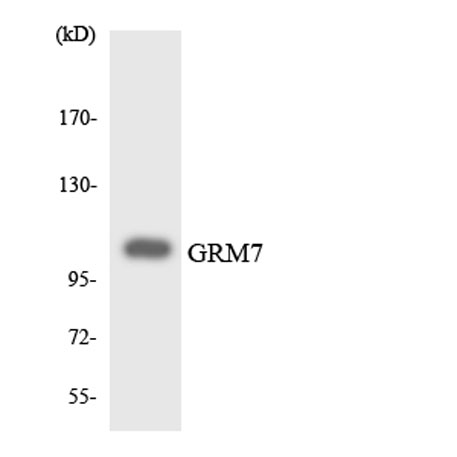
| Observed band (KD) | 102kD |
| Background | glutamate metabotropic receptor 7(GRM7) Homo sapiens L-glutamate is the major excitatory neurotransmitter in the central nervous system, and it activates both ionotropic and metabotropic glutamate receptors. Glutamatergic neurotransmission is involved in most aspects of normal brain function and can be perturbed in many neuropathologic conditions. The metabotropic glutamate receptors are a family of G protein-coupled receptors that have been divided into three groups on the basis of sequence homology, putative signal transduction mechanisms, and pharmacologic properties. Group I includes GRM1 and GRM5, and these receptors have been shown to activate phospholipase C. Group II includes GRM2 and GRM3, while Group III includes GRM4, GRM6, GRM7 and GRM8. Group II and III receptors are linked to the inhibition of the cyclic AMP cascade but differ in their agonist selectivities. Multiple transcript variants encoding different isoforms have been found |
| Function | function:Receptor for glutamate. The activity of this receptor is mediated by a G-protein that inhibits adenylate cyclase activity.,similarity:Belongs to the G-protein coupled receptor 3 family.,subunit:Interacts with PICK1.,tissue specificity:Expressed in many areas of the brain, especially in the cerebral cortex, hippocampus, and cerebellum. Expression of GRM7 isoforms in non-neuronal tissues appears to be restricted to isoform 3 and isoform 4., |
| Subcellular location | Cell membrane ; Multi-pass membrane protein . |
| Expression | Expressed in many areas of the brain, especially in the cerebral cortex, hippocampus, and cerebellum. Expression of GRM7 isoforms in non-neuronal tissues appears to be restricted to isoform 3 and isoform 4. |

Use collapsible tabs for more detailed information that will help customers make a purchasing decision.
Ex: Shipping and return policies, size guides, and other common questions.