 Français
 English
Histone H3.3 (phospho Ser31) rabbit pAb
AO-06-ES5717-50

| ELK.No | ES5717 |
| Product name | Histone H3.3 (phospho Ser31) rabbit pAb |
| Reactivity | Human;Mouse;Rat |
| Applications | IHC;IF;ELISA |
| Other name | H3F3A; H3.3A; H3F3; PP781; H3F3B; H3.3B; Histone H3.3 |
| Size | 50μL |
| Unit price ($) | 148 |
| Human gene ID | 3020/3021 |
| Human Swiss-Prot | P84243 |
| Source | Rabbit |
| Isotype | IgG |
| Target | Histone H3.3 |
| Fields | >>Neutrophil extracellular trap formation;>>Alcoholism;>>Shigellosis;>>Transcriptional misregulation in cancer;>>Systemic lupus erythematosus |
| Gene name | H3F3A |
| Protein name | Histone H3.3 |
| Human gene link | View Human Gene |
| Human Swiss link | View Human Swiss-Prot |
| Mouse gene ID | 15078 |
| Mouse gene link | View Mouse Gene |
| Mouse Swiss-Prot | P84244 |
| Mouse Swiss link | View Mouse Swiss-Prot |
| Rat gene ID | 1.00362e+008 |
| Rat gene link | View Rat Gene |
| Rat Swiss-Prot | P84245 |
| Rat Swiss link | View Rat Swiss-Prot |
| Immunogen | The antiserum was produced against synthesized peptide derived from human Histone H3.3 around the phosphorylation site of Ser31. AA range:16-65 |
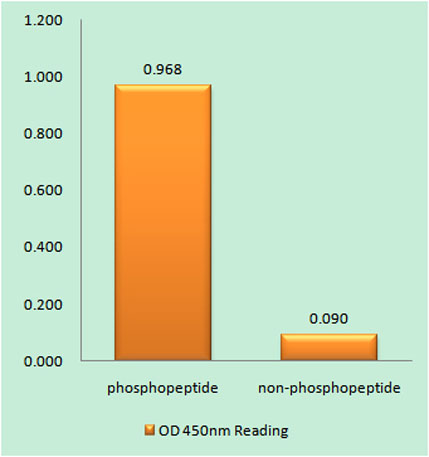
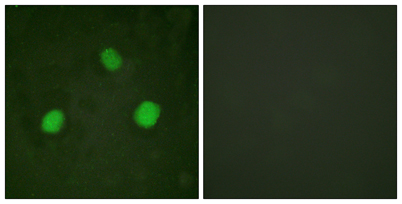
| Specificity | Phospho-Histone H3.3 (S31) Polyclonal Antibody detects endogenous levels of Histone H3.3 protein only when phosphorylated at S31. |
| Formulation | Liquid in PBS containing 50% glycerol, 0.5% BSA and 0.02% sodium azide. |
| Clonality | Polyclonal |
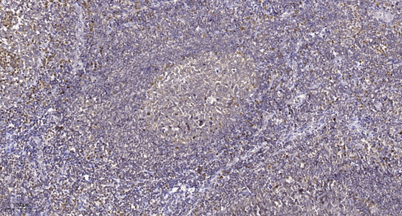
| Dilution | Immunohistochemistry: 1/100 - 1/300. Immunofluorescence: 1/200 - 1/1000. ELISA: 1/20000. Not yet tested in other applications. |
| Purification | The antibody was affinity-purified from rabbit antiserum by affinity-chromatography using epitope-specific immunogen. |
| Concentration | 1 mg/ml |
| Storage stability | -20°C/1 year |
| Molecular Weight (Da) | 15kD |
| Observed band (KD) | |
| Background | Histones are basic nuclear proteins that are responsible for the nucleosome structure of the chromosomal fiber in eukaryotes. Two molecules of each of the four core histones (H2A, H2B, H3, and H4) form an octamer, around which approximately 146 bp of DNA is wrapped in repeating units, called nucleosomes. The linker histone, H1, interacts with linker DNA between nucleosomes and functions in the compaction of chromatin into higher order structures. This gene contains introns and its mRNA is polyadenylated, unlike most histone genes. The protein encoded is a replication-independent member of the histone H3 family. [provided by RefSeq, Jul 2008], |
| Function | developmental stage:Expressed throughout the cell cycle independently of DNA synthesis.,function:Variant histone H3 which replaces conventional H3 in a wide range of nucleosomes in active genes. Constitutes the predominant form of histone H3 in non-dividing cells and is incorporated into chromatin independently of DNA synthesis. Deposited at sites of nucleosomal displacement throughout transcribed genes, suggesting that it represents an epigenetic imprint of transcriptionally active chromatin. Nucleosomes wrap and compact DNA into chromatin, limiting DNA accessibility to the cellular machineries which require DNA as a template. Histones thereby play a central role in transcription regulation, DNA repair, DNA replication and chromosomal stability. DNA accessibility is regulated via a complex set of post-translational modifications of histones, also called histone code, and nucleosome remo |
| Subcellular location | Nucleus. Chromosome. |
| Expression | Bone marrow,Brain,Colon,Epithelium,Eye,Fibroblast,Lung,Muscle,Retina,Spinal |

Use collapsible tabs for more detailed information that will help customers make a purchasing decision.
Ex: Shipping and return policies, size guides, and other common questions.