 Français
 English
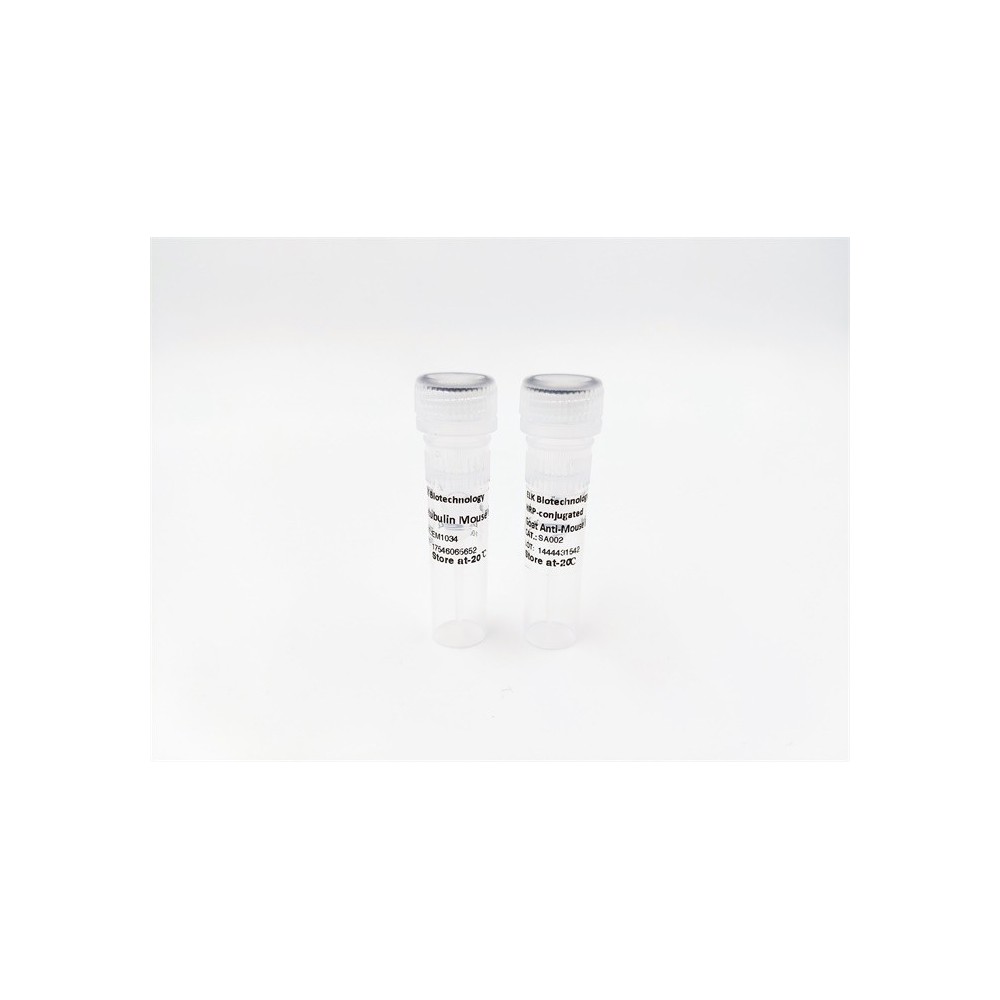

| ELK.No | ES5827 |
| Product name | IFI-16 rabbit pAb |
| Reactivity | Human;Rat;Mouse; |
| Applications | WB;ELISA |
| Other name | IFI16; IFNGIP1; Gamma-interferon-inducible protein 16; Ifi-16; Interferon-inducible myeloid differentiation transcriptional activator |
| Size | 50μL |
| Unit price ($) | 148 |
| Human gene ID | 3428 |
| Human Swiss-Prot | Q16666 |
| Source | Rabbit |
| Isotype | IgG |
| Target | IFI-16 |
| Fields | >>NOD-like receptor signaling pathway |
| Gene name | IFI16 |
| Protein name | Gamma-interferon-inducible protein 16 |
| Human gene link | View Human Gene |
| Human Swiss link | View Human Swiss-Prot |
| Mouse gene ID | |
| Mouse gene link | |
| Mouse Swiss-Prot | |
| Mouse Swiss link | |
| Rat gene ID | |
| Rat gene link | |
| Rat Swiss-Prot | |
| Rat Swiss link | |
| Immunogen | The antiserum was produced against synthesized peptide derived from human IFI16. AA range:731-780 |
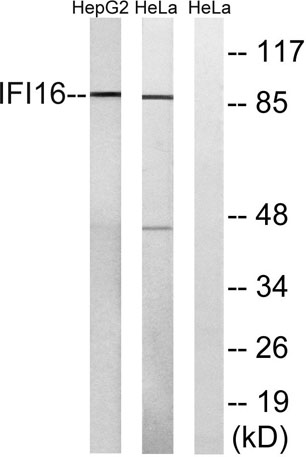
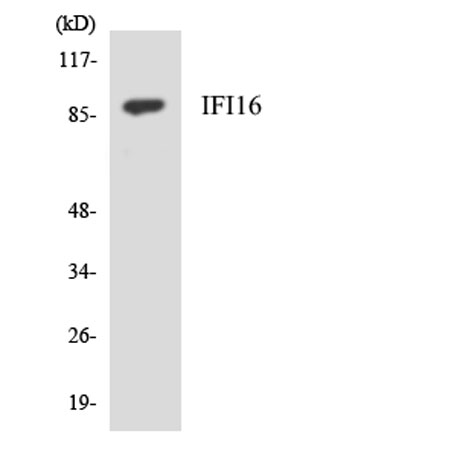
| Specificity | IFI-16 Polyclonal Antibody detects endogenous levels of IFI-16 protein. |
| Formulation | Liquid in PBS containing 50% glycerol, 0.5% BSA and 0.02% sodium azide. |
| Clonality | Polyclonal |
| Dilution | Western Blot: 1/500 - 1/2000. ELISA: 1/40000. Not yet tested in other applications. |
| Purification | The antibody was affinity-purified from rabbit antiserum by affinity-chromatography using epitope-specific immunogen. |
| Concentration | 1 mg/ml |
| Storage stability | -20°C/1 year |
| Molecular Weight (Da) | |
| Observed band (KD) | 88kD |
| Background | This gene encodes a member of the HIN-200 (hematopoietic interferon-inducible nuclear antigens with 200 amino acid repeats) family of cytokines. The encoded protein contains domains involved in DNA binding, transcriptional regulation, and protein-protein interactions. The protein localizes to the nucleoplasm and nucleoli, and interacts with p53 and retinoblastoma-1. It modulates p53 function, and inhibits cell growth in the Ras/Raf signaling pathway. Alternatively spliced transcript variants encoding different isoforms have been found for this gene. [provided by RefSeq, Apr 2011], |
| Function | function:May function as a transcriptional repressor. Could have a role in the regulation of hematopoeitic differentiation through activation of unknown target genes. Controls cellular proliferation by modulating the functions of cell cycle regulatory factors including p53/TP53 and the retinoblastoma protein. May be involved in the senescence of prostate epithelial cells.,induction:Strongly induced by gamma interferon and, to a lesser extent, by alpha interferon. In HL-60 cells, maximum induction by gamma-interferon occurs within 12 hours whereas, for alpha-interferon, only 10-fold induction was observed after 36 hours. Induced in vitro by dimethylsulfoxide, retinoic acid and 1,25 dihydroxyvitamin D3.,PTM:Isoform 3 seems to show a minor degree of complex carbohydrate addition.,PTM:Phosphorylated on Ser and Thr.,sequence caution:Intron retention.,similarity:Belongs to the HIN-200 family., |
| Subcellular location | Nucleus. Cytoplasm. Cellular distribution is dependent on the acetylation status of the multipartite nuclear localization signal (NLS); NLS acetylation promotes cytoplasmic localization. Localizes in the nucleus during human herpes simplex virus 1 (HHV-1) infection. |
| Expression | Expressed in peripheral blood leukocytes, fibroblasts and lymphoid cells. Present in myeloid precursors (CD34+) and throughout monocyte development, but its expression is down-regulated in erythroid and polymorphonuclear precursor cells. Present in prostate, ovary and breast (at protein level). |

Use collapsible tabs for more detailed information that will help customers make a purchasing decision.
Ex: Shipping and return policies, size guides, and other common questions.