 Français
 English

| ELK.No | ES5847 |
| Product name | ApoE rabbit pAb |
| Reactivity | Human;Rat;Mouse; |
| Applications | WB;ELISA |
| Other name | APOE; Apolipoprotein E; Apo-E |
| Size | 50μL |
| Unit price ($) | 148 |
| Human gene ID | 348 |
| Human Swiss-Prot | P02649 |
| Source | Rabbit |
| Isotype | IgG |
| Target | ApoE |
| Fields | >>Cholesterol metabolism;>>Alzheimer disease |
| Gene name | APOE |
| Protein name | Apolipoprotein E |
| Human gene link | View Human Gene |
| Human Swiss link | View Human Swiss-Prot |
| Mouse gene ID | |
| Mouse gene link | |
| Mouse Swiss-Prot | P08226 |
| Mouse Swiss link | View Mouse Swiss-Prot |
| Rat gene ID | |
| Rat gene link | |
| Rat Swiss-Prot | |
| Rat Swiss link | |
| Immunogen | Synthesized peptide derived from the Internal region of human ApoE. |
| Specificity | ApoE Polyclonal Antibody detects endogenous levels of ApoE protein. |
| Formulation | Liquid in PBS containing 50% glycerol, 0.5% BSA and 0.02% sodium azide. |
| Clonality | Polyclonal |
| Dilution | Western Blot: 1/500 - 1/2000. ELISA: 1/10000. Not yet tested in other applications. |
| Purification | The antibody was affinity-purified from rabbit antiserum by affinity-chromatography using epitope-specific immunogen. |
| Concentration | 1 mg/ml |
| Storage stability | -20°C/1 year |
| Molecular Weight (Da) | |
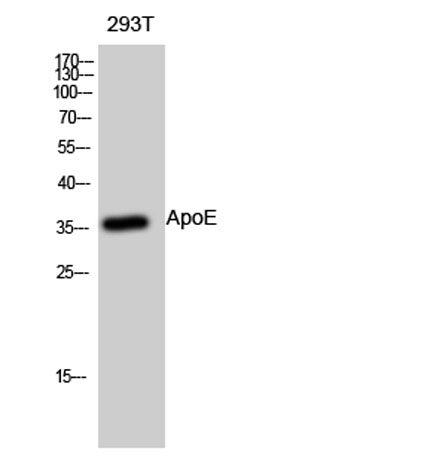
| Observed band (KD) | 36kD |
| Background | The protein encoded by this gene is a major apoprotein of the chylomicron. It binds to a specific liver and peripheral cell receptor, and is essential for the normal catabolism of triglyceride-rich lipoprotein constituents. This gene maps to chromosome 19 in a cluster with the related apolipoprotein C1 and C2 genes. Mutations in this gene result in familial dysbetalipoproteinemia, or type III hyperlipoproteinemia (HLP III), in which increased plasma cholesterol and triglycerides are the consequence of impaired clearance of chylomicron and VLDL remnants. [provided by RefSeq, Jun 2016], |
| Function | disease:Defects in APOE are a cause of hyperlipoproteinemia type III [MIM:107741]; also known as familial dysbetalipoproteinemia. Individuals with hyperlipoproteinemia type III, are clinically characterized by xanthomas, yellowish lipid deposits in the palmar crease, or less specific on tendons and on elbows. The disorder rarely manifests before the third decade in men. In women, it is usually expressed only after the menopause. The vast majority of the patients are homozygous for APOE*2 alleles. More severe cases of hyperlipoproteinemia type III have also been observed in individuals heterozygous for rare APOE variants. The influence of APOE on lipid levels is often suggested to have major implications for the risk of coronary artery disease (CAD). Individuals carrying the common APOE*4 variant are at higher risk of CAD.,disease:Defects in APOE are a cause of lipoprotein glomerulopathy |
| Subcellular location | Secreted . Secreted, extracellular space . Secreted, extracellular space, extracellular matrix . In the plasma, APOE is associated with chylomicrons, chylomicrons remnants, VLDL, LDL and HDL lipoproteins (PubMed:1911868, PubMed:8340399). Lipid poor oligomeric APOE is associated with the extracellular matrix in a calcium- and heparan-sulfate proteoglycans-dependent manner (PubMed:9488694). Lipidation induces the release from the extracellular matrix (PubMed:9488694). . |
| Expression | Produced by several tissues and cell types and mainly found associated with lipid particles in the plasma, the interstitial fluid and lymph (PubMed:25173806). Mainly synthesized by liver hepatocytes (PubMed:25173806). Significant quantities are also produced in brain, mainly by astrocytes and glial cells in the cerebral cortex, but also by neurons in frontal cortex and hippocampus (PubMed:3115992, PubMed:10027417). It is also expressed by cells of the peripheral nervous system (PubMed:10027417, PubMed:25173806). Also expressed by adrenal gland, testis, ovary, skin, kidney, spleen and adipose tissue and macrophages in various tissues (PubMed:25173806). |

Use collapsible tabs for more detailed information that will help customers make a purchasing decision.
Ex: Shipping and return policies, size guides, and other common questions.