 Français
 English
IL-4Rα (phospho Tyr497) rabbit pAb
AO-06-ES5879-50

| ELK.No | ES5879 |
| Product name | IL-4Rα (phospho Tyr497) rabbit pAb |
| Reactivity | Human;Mouse |
| Applications | WB;IHC;IF;ELISA |
| Other name | IL4R; IL4RA; 582J2.1; Interleukin-4 receptor subunit alpha; IL-4 receptor subunit alpha; IL-4R subunit alpha; IL-4R-alpha; IL-4RA; CD antigen CD124 |
| Size | 50μL |
| Unit price ($) | 148 |
| Human gene ID | 3566 |
| Human Swiss-Prot | P24394 |
| Source | Rabbit |
| Isotype | IgG |
| Target | IL-4R/CD124 |
| Fields | >>Cytokine-cytokine receptor interaction;>>PI3K-Akt signaling pathway;>>JAK-STAT signaling pathway;>>Hematopoietic cell lineage;>>Th1 and Th2 cell differentiation;>>Th17 cell differentiation;>>Pathways in cancer;>>Inflammatory bowel disease |
| Gene name | IL4R |
| Protein name | Interleukin-4 receptor subunit alpha |
| Human gene link | View Human Gene |
| Human Swiss link | View Human Swiss-Prot |
| Mouse gene ID | 16190 |
| Mouse gene link | View Mouse Gene |
| Mouse Swiss-Prot | P16382 |
| Mouse Swiss link | View Mouse Swiss-Prot |
| Rat gene ID | |
| Rat gene link | |
| Rat Swiss-Prot | |
| Rat Swiss link | |
| Immunogen | The antiserum was produced against synthesized peptide derived from human IL-4R/CD124 around the phosphorylation site of Tyr497. AA range:463-512 |
| Specificity | Phospho-IL-4Rα (Y497) Polyclonal Antibody detects endogenous levels of IL-4Rα protein only when phosphorylated at Y497. |
| Formulation | Liquid in PBS containing 50% glycerol, 0.5% BSA and 0.02% sodium azide. |
| Clonality | Polyclonal |
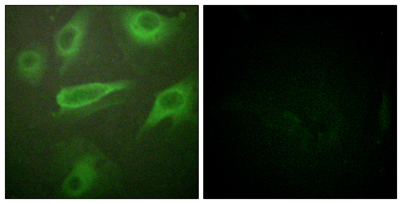
| Dilution | Western Blot: 1/500 - 1/2000. Immunohistochemistry: 1/100 - 1/300. Immunofluorescence: 1/200 - 1/1000. ELISA: 1/5000. Not yet tested in other applications. |
| Purification | The antibody was affinity-purified from rabbit antiserum by affinity-chromatography using epitope-specific immunogen. |
| Concentration | 1 mg/ml |
| Storage stability | -20°C/1 year |
| Molecular Weight (Da) | |
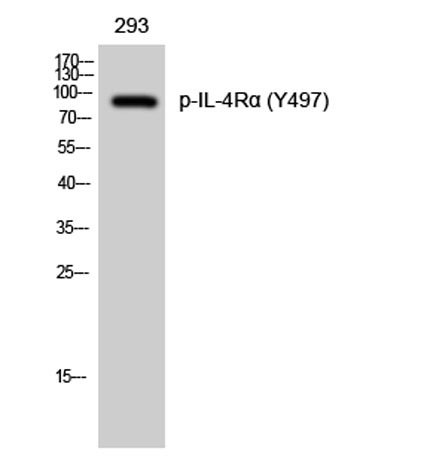
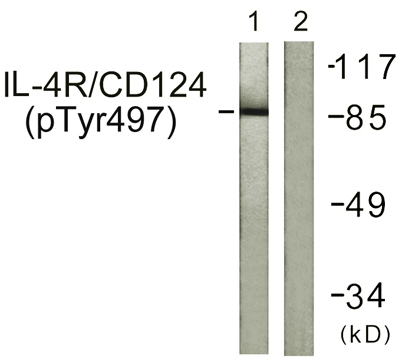
| Observed band (KD) | 90kD |
| Background | This gene encodes the alpha chain of the interleukin-4 receptor, a type I transmembrane protein that can bind interleukin 4 and interleukin 13 to regulate IgE production. The encoded protein also can bind interleukin 4 to promote differentiation of Th2 cells. A soluble form of the encoded protein can be produced by proteolysis of the membrane-bound protein, and this soluble form can inhibit IL4-mediated cell proliferation and IL5 upregulation by T-cells. Allelic variations in this gene have been associated with atopy, a condition that can manifest itself as allergic rhinitis, sinusitus, asthma, or eczema. Polymorphisms in this gene are also associated with resistance to human immunodeficiency virus type-1 infection. Alternate splicing results in multiple transcript variants. [provided by RefSeq, Apr 2012], |
| Function | domain:Contains 1 copy of a cytoplasmic motif that is referred to as the immunoreceptor tyrosine-based inhibitor motif (ITIM). This motif is involved in modulation of cellular responses. The phosphorylated ITIM motif can bind the SH2 domain of several SH2-containing phosphatases.,domain:The box 1 motif is required for JAK interaction and/or activation.,domain:The extracellular domain represents the IL4 binding protein (IL4BP).,domain:The WSXWS motif appears to be necessary for proper protein folding and thereby efficient intracellular transport and cell-surface receptor binding.,function:Receptor for both interleukin 4 and interleukin 13. Couples to the JAK1/2/3-STAT6 pathway. The IL4 response is involved in promoting Th2 differentiation. The IL4/IL13 responses are involved in regulating IgE production and, chemokine and mucus production at sites of allergic inflammmation. In certain cel |
| Subcellular location | Cell membrane; Single-pass type I membrane protein.; [Isoform 2]: Secreted. |
| Expression | Isoform 1 and isoform 2 are highly expressed in activated T-cells. |

Use collapsible tabs for more detailed information that will help customers make a purchasing decision.
Ex: Shipping and return policies, size guides, and other common questions.