 Français
 English
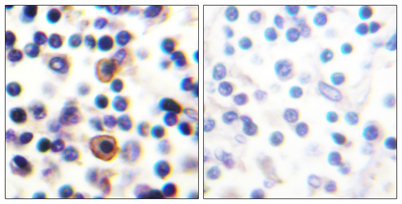
IL-9R (phospho Ser519) rabbit pAb
AO-06-ES5889-100

| ELK.No | ES5889 |
| Product name | IL-9R (phospho Ser519) rabbit pAb |
| Reactivity | Human;Rat;Mouse; |
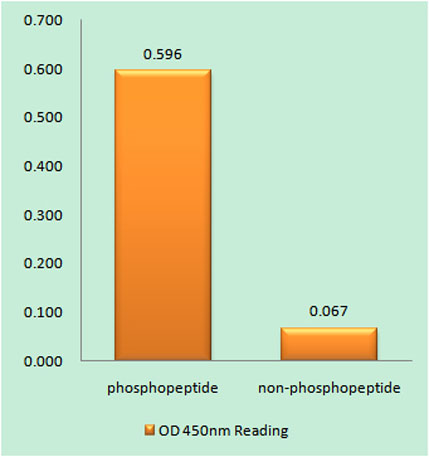
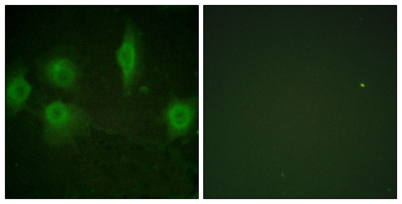
| Applications | WB;IHC;IF;ELISA |
| Other name | IL9R; Interleukin-9 receptor; IL-9 receptor; IL-9R; CD antigen CD129 |
| Size | 100μL |
| Unit price ($) | 248 |
| Human gene ID | 3581 |
| Human Swiss-Prot | Q01113 |
| Source | Rabbit |
| Isotype | IgG |
| Target | IL-9R |
| Fields | >>Cytokine-cytokine receptor interaction;>>JAK-STAT signaling pathway;>>Hematopoietic cell lineage |
| Gene name | IL9R |
| Protein name | Interleukin-9 receptor |
| Human gene link | View Human Gene |
| Human Swiss link | View Human Swiss-Prot |
| Mouse gene ID | |
| Mouse gene link | |
| Mouse Swiss-Prot | Q01114 |
| Mouse Swiss link | View Mouse Swiss-Prot |
| Rat gene ID | |
| Rat gene link | |
| Rat Swiss-Prot | |
| Rat Swiss link | |
| Immunogen | The antiserum was produced against synthesized peptide derived from human IL-9R around the phosphorylation site of Ser519. AA range:472-521 |
| Specificity | Phospho-IL-9R (S519) Polyclonal Antibody detects endogenous levels of IL-9R protein only when phosphorylated at S519. |
| Formulation | Liquid in PBS containing 50% glycerol, 0.5% BSA and 0.02% sodium azide. |
| Clonality | Polyclonal |
| Dilution | Western Blot: 1/500 - 1/2000. Immunohistochemistry: 1/100 - 1/300. Immunofluorescence: 1/200 - 1/1000. ELISA: 1/20000. Not yet tested in other applications. |
| Purification | The antibody was affinity-purified from rabbit antiserum by affinity-chromatography using epitope-specific immunogen. |
| Concentration | 1 mg/ml |
| Storage stability | -20°C/1 year |
| Molecular Weight (Da) | |
| Observed band (KD) | 57kD |
| Background | The protein encoded by this gene is a cytokine receptor that specifically mediates the biological effects of interleukin 9 (IL9). The functional IL9 receptor complex requires this protein as well as the interleukin 2 receptor, gamma (IL2RG), a common gamma subunit shared by the receptors of many different cytokines. The ligand binding of this receptor leads to the activation of various JAK kinases and STAT proteins, which connect to different biologic responses. This gene is located at the pseudoautosomal regions of X and Y chromosomes. Genetic studies suggested an association of this gene with the development of asthma. Multiple pseudogenes on chromosome 9, 10, 16, and 18 have been described. Alternatively spliced transcript variants have been found for this gene. [provided by RefSeq, Jul 2008], |
| Function | domain:The box 1 motif is required for JAK interaction and/or activation.,domain:The WSXWS motif appears to be necessary for proper protein folding and thereby efficient intracellular transport and cell-surface receptor binding.,function:This is a receptor for interleukin-9.,miscellaneous:The gene encoding for this protein is located in the pseudoautosomal region 2 (PAR2) of X and Y chromosomes.,similarity:Belongs to the type I cytokine receptor family. Type 4 subfamily.,similarity:Contains 1 fibronectin type-III domain., |
| Subcellular location | Cell membrane; Single-pass type I membrane protein. Secreted. |
| Expression | Melanoma, |

Use collapsible tabs for more detailed information that will help customers make a purchasing decision.
Ex: Shipping and return policies, size guides, and other common questions.