 Français
 English
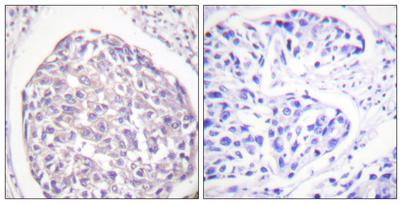
Insulin R (phospho Tyr1355) rabbit pAb
AO-06-ES5908-50

| ELK.No | ES5908 |
| Product name | Insulin R (phospho Tyr1355) rabbit pAb |
| Reactivity | Human;Rat;Mouse; |
| Applications | WB;IHC;IF;ELISA |
| Other name | INSR; Insulin receptor; IR; CD antigen CD220 |
| Size | 50μL |
| Unit price ($) | 148 |
| Human gene ID | 3643 |
| Human Swiss-Prot | P06213 |
| Source | Rabbit |
| Isotype | IgG |
| Target | Insulin R |
| Fields | >>MAPK signaling pathway;>>Ras signaling pathway;>>Rap1 signaling pathway;>>cGMP-PKG signaling pathway;>>HIF-1 signaling pathway;>>FoxO signaling pathway;>>Phospholipase D signaling pathway;>>mTOR signaling pathway;>>PI3K-Akt signaling pathway;>>AMPK signaling pathway;>>Longevity regulating pathway;>>Longevity regulating pathway - multiple species;>>Adherens junction;>>Insulin signaling pathway;>>Ovarian steroidogenesis;>>Regulation of lipolysis in adipocytes;>>Type II diabetes mellitus;>>Insulin resistance;>>Non-alcoholic fatty liver disease;>>Aldosterone-regulated sodium reabsorption;>>Alzheimer disease;>>Diabetic cardiomyopathy |
| Gene name | INSR |
| Protein name | Insulin receptor |
| Human gene link | View Human Gene |
| Human Swiss link | View Human Swiss-Prot |
| Mouse gene ID | |
| Mouse gene link | |
| Mouse Swiss-Prot | P15208 |
| Mouse Swiss link | View Mouse Swiss-Prot |
| Rat gene ID | |
| Rat gene link | |
| Rat Swiss-Prot | |
| Rat Swiss link | |
| Immunogen | The antiserum was produced against synthesized peptide derived from human IR around the phosphorylation site of Tyr1355. AA range:1326-1375 |
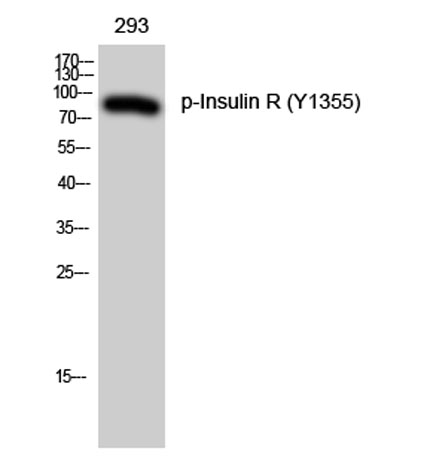
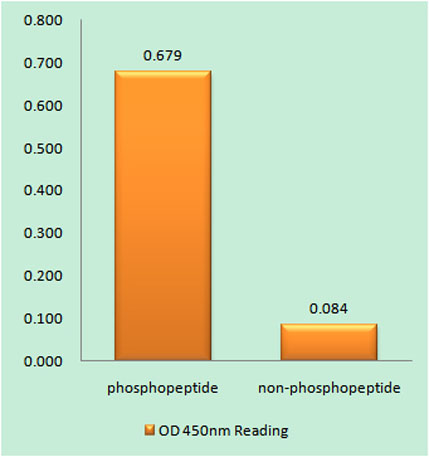
| Specificity | Phospho-Insulin R (Y1355) Polyclonal Antibody detects endogenous levels of Insulin R protein only when phosphorylated at Y1355. |
| Formulation | Liquid in PBS containing 50% glycerol, 0.5% BSA and 0.02% sodium azide. |
| Clonality | Polyclonal |
| Dilution | Western Blot: 1/500 - 1/2000. Immunohistochemistry: 1/100 - 1/300. ELISA: 1/10000. Not yet tested in other applications. |
| Purification | The antibody was affinity-purified from rabbit antiserum by affinity-chromatography using epitope-specific immunogen. |
| Concentration | 1 mg/ml |
| Storage stability | -20°C/1 year |
| Molecular Weight (Da) | |
| Observed band (KD) | 95kD |
| Background | This gene encodes a member of the receptor tyrosine kinase family of proteins. The encoded preproprotein is proteolytically processed to generate alpha and beta subunits that form a heterotetrameric receptor. Binding of insulin or other ligands to this receptor activates the insulin signaling pathway, which regulates glucose uptake and release, as well as the synthesis and storage of carbohydrates, lipids and protein. Mutations in this gene underlie the inherited severe insulin resistance syndromes including type A insulin resistance syndrome, Donohue syndrome and Rabson-Mendenhall syndrome. Alternative splicing results in multiple transcript variants. [provided by RefSeq, Oct 2015], |
| Function | catalytic activity:ATP + a [protein]-L-tyrosine = ADP + a [protein]-L-tyrosine phosphate.,disease:Defects in INSR are the cause of familial hyperinsulinemic hypoglycemia 5 (HHF5) [MIM:609968]. Familial hyperinsulinemic hypoglycemia [MIM:256450], also referred to as congenital hyperinsulinism, nesidioblastosis, or persistent hyperinsulinemic hypoglycemia of infancy (PPHI), is the most common cause of persistent hypoglycemia in infancy and is due to defective negative feedback regulation of insulin secretion by low glucose levels.,disease:Defects in INSR are the cause of insulin resistance (Ins resistance) [MIM:125853].,disease:Defects in INSR are the cause of insulin-resistant diabetes mellitus with acanthosis nigricans type A (IRAN type A) [MIM:610549]. This syndrome is characterized by the association of severe insulin resistance (manifested by marked hyperinsulinemia and a failure to r |
| Subcellular location | Cell membrane ; Single-pass type I membrane protein . Late endosome . Lysosome . Binding of insulin to INSR induces internalization and lysosomal degradation of the receptor, a means for down-regulating this signaling pathway after stimulation. In the presence of SORL1, internalized INSR molecules are redirected back to the cell surface, thereby preventing their lysosomal catabolism and strengthening insulin signal reception. . |
| Expression | Isoform Long and isoform Short are predominantly expressed in tissue targets of insulin metabolic effects: liver, adipose tissue and skeletal muscle but are also expressed in the peripheral nerve, kidney, pulmonary alveoli, pancreatic acini, placenta vascular endothelium, fibroblasts, monocytes, granulocytes, erythrocytes and skin. Isoform Short is preferentially expressed in fetal cells such as fetal fibroblasts, muscle, liver and kidney. Found as a hybrid receptor with IGF1R in muscle, heart, kidney, adipose tissue, skeletal muscle, hepatoma, fibroblasts, spleen and placenta (at protein level). Overexpressed in several tumors, including breast, colon, lung, ovary, and thyroid carcinomas. |

Use collapsible tabs for more detailed information that will help customers make a purchasing decision.
Ex: Shipping and return policies, size guides, and other common questions.