 Français
 English

| ELK.No | ES6007 |
| Product name | KIR3.4 rabbit pAb |
| Reactivity | Human;Rat;Mouse; |
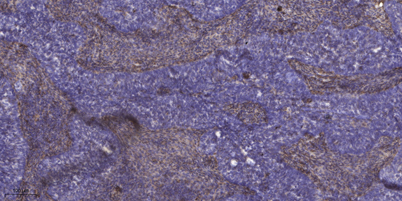
| Applications | WB;IHC |
| Other name | KCNJ5; GIRK4; G protein-activated inward rectifier potassium channel 4; GIRK-4; Cardiac inward rectifier; CIR; Heart KATP channel; Inward rectifier K(+) channel Kir3.4; IRK-4; KATP-1; Potassium channel; inwardly rectifying subfamily J membe |
| Size | 100μL |
| Unit price ($) | 248 |
| Human gene ID | 3762 |
| Human Swiss-Prot | P48544 |
| Source | Rabbit |
| Isotype | IgG |
| Target | KIR3.4 |
| Fields | >>Circadian entrainment;>>Retrograde endocannabinoid signaling;>>Serotonergic synapse;>>Dopaminergic synapse;>>Estrogen signaling pathway;>>Oxytocin signaling pathway;>>Aldosterone synthesis and secretion;>>GnRH secretion;>>Morphine addiction |
| Gene name | KCNJ5 |
| Protein name | G protein-activated inward rectifier potassium channel 4 |
| Human gene link | View Human Gene |
| Human Swiss link | View Human Swiss-Prot |
| Mouse gene ID | |
| Mouse gene link | |
| Mouse Swiss-Prot | P48545 |
| Mouse Swiss link | View Mouse Swiss-Prot |
| Rat gene ID | |
| Rat gene link | |
| Rat Swiss-Prot | |
| Rat Swiss link | |
| Immunogen | The antiserum was produced against synthesized peptide derived from human KCNJ5. AA range:370-419 |
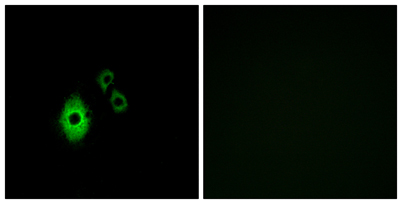
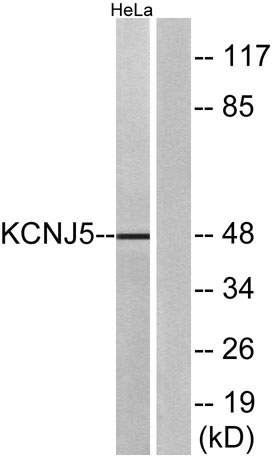
| Specificity | KIR3.4 Polyclonal Antibody detects endogenous levels of KIR3.4 protein. |
| Formulation | Liquid in PBS containing 50% glycerol, 0.5% BSA and 0.02% sodium azide. |
| Clonality | Polyclonal |
| Dilution | WB 1:500-2000;IHC-p 1:50-300 |
| Purification | The antibody was affinity-purified from rabbit antiserum by affinity-chromatography using epitope-specific immunogen. |
| Concentration | 1 mg/ml |
| Storage stability | -20°C/1 year |
| Molecular Weight (Da) | |
| Observed band (KD) | 48kD |
| Background | Potassium channels are present in most mammalian cells, where they participate in a wide range of physiologic responses. The protein encoded by this gene is an integral membrane protein and inward-rectifier type potassium channel. The encoded protein, which has a greater tendency to allow potassium to flow into a cell rather than out of a cell, is controlled by G-proteins. It may associate with two other G-protein-activated potassium channels to form a heteromultimeric pore-forming complex. [provided by RefSeq, Jul 2008], |
| Function | function:This potassium channel is controlled by G proteins. Inward rectifier potassium channels are characterized by a greater tendency to allow potassium to flow into the cell rather than out of it. Their voltage dependence is regulated by the concentration of extracellular potassium; as external potassium is raised, the voltage range of the channel opening shifts to more positive voltages. The inward rectification is mainly due to the blockage of outward current by internal magnesium. Can be blocked by external barium.,similarity:Belongs to the inward rectifier-type potassium channel family.,subunit:May associate with GIRK1 and GIRK2 to form a G-protein-activated heteromultimer pore-forming unit. The resulting inward current is much larger.,tissue specificity:Islets, exocrine pancreas and heart., |
| Subcellular location | Membrane ; Multi-pass membrane protein . |
| Expression | Islets, exocrine pancreas and heart. Expressed in the adrenal cortex, particularly the zona glomerulosa. |

Use collapsible tabs for more detailed information that will help customers make a purchasing decision.
Ex: Shipping and return policies, size guides, and other common questions.