 Français
 English
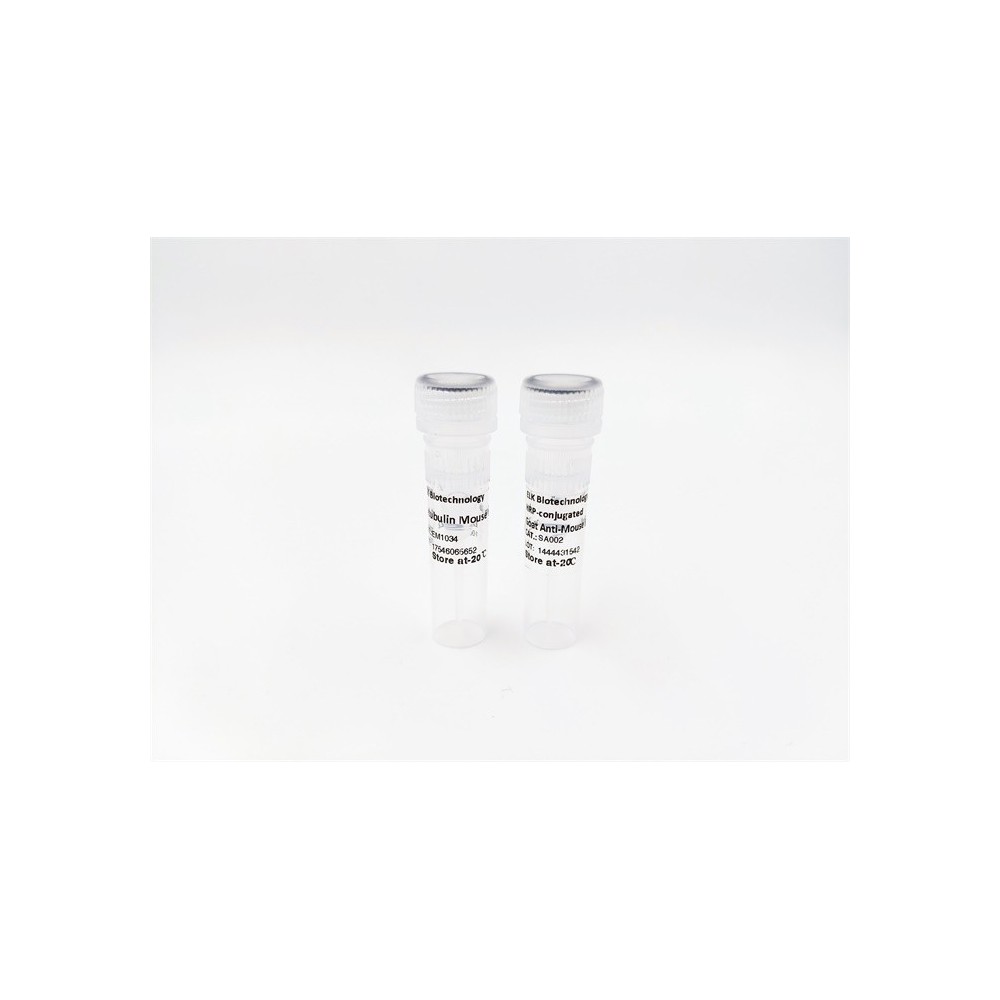

| ELK.No | ES6026 |
| Product name | CD159a rabbit pAb |
| Reactivity | Human;Rat;Mouse; |
| Applications | WB;ELISA |
| Other name | KLRC1; NKG2A; NKG2-A/NKG2-B type II integral membrane protein; CD159 antigen-like family member A; NK cell receptor A; NKG2-A/B-activating NK receptor; CD antigen CD159a |
| Size | 100μL |
| Unit price ($) | 248 |
| Human gene ID | 3821 |
| Human Swiss-Prot | P26715 |
| Source | Rabbit |
| Isotype | IgG |
| Target | CD159a |
| Fields | >>Antigen processing and presentation;>>Natural killer cell mediated cytotoxicity;>>Graft-versus-host disease |
| Gene name | KLRC1 |
| Protein name | NKG2-A/NKG2-B type II integral membrane protein |
| Human gene link | View Human Gene |
| Human Swiss link | View Human Swiss-Prot |
| Mouse gene ID | |
| Mouse gene link | |
| Mouse Swiss-Prot | |
| Mouse Swiss link | |
| Rat gene ID | |
| Rat gene link | |
| Rat Swiss-Prot | |
| Rat Swiss link | |
| Immunogen | The antiserum was produced against synthesized peptide derived from human KLRC1. AA range:1-50 |
| Specificity | CD159a Polyclonal Antibody detects endogenous levels of CD159a protein. |
| Formulation | Liquid in PBS containing 50% glycerol, 0.5% BSA and 0.02% sodium azide. |
| Clonality | Polyclonal |
| Dilution | Western Blot: 1/500 - 1/2000. ELISA: 1/40000. Not yet tested in other applications. |
| Purification | The antibody was affinity-purified from rabbit antiserum by affinity-chromatography using epitope-specific immunogen. |
| Concentration | 1 mg/ml |
| Storage stability | -20°C/1 year |
| Molecular Weight (Da) | |
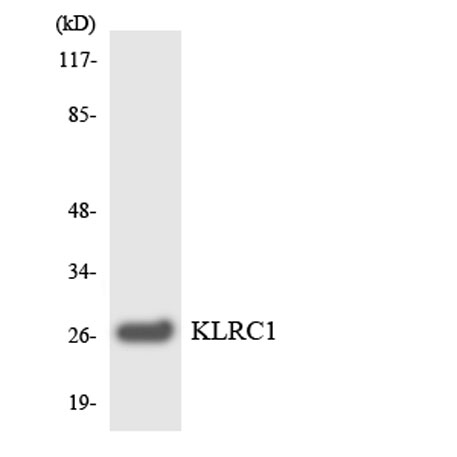
| Observed band (KD) | 28kD |
| Background | Natural killer (NK) cells are lymphocytes that can mediate lysis of certain tumor cells and virus-infected cells without previous activation. They can also regulate specific humoral and cell-mediated immunity. The protein encoded by this gene belongs to the killer cell lectin-like receptor family, also called NKG2 family, which is a group of transmembrane proteins preferentially expressed in NK cells. This family of proteins is characterized by the type II membrane orientation and the presence of a C-type lectin domain. This protein forms a complex with another family member, KLRD1/CD94, and has been implicated in the recognition of the MHC class I HLA-E molecules in NK cells. The genes of NKG2 family members form a killer cell lectin-like receptor gene cluster on chromosome 12. Multiple alternatively spliced transcript variants encoding distinct isoforms have been observed. [provide |
| Function | function:Plays a role as a receptor for the recognition of MHC class I HLA-E molecules by NK cells and some cytotoxic T-cells.,online information:NKG-2A,similarity:Contains 1 C-type lectin domain.,subunit:Can form disulfide-bonded heterodimer with CD94.,tissue specificity:Natural killer cells., |
| Subcellular location | Cell membrane ; Single-pass type II membrane protein . |
| Expression | Predominantly expressed in NK cells (at protein level) (PubMed:9430220, PubMed:9485206, PubMed:20952657). Expressed in intraepithelial CD8-positive T cell subsets with higher frequency in gamma-delta T cells than alpha-beta T cells (at protein level) (PubMed:18064301). Expressed in memory gamma-delta T cells (at protein level) (PubMed:20952657). Restricted to a subset of memory/effector CD8-positive alpha-beta T cells (at protein level) (PubMed:12387742). Expressed in intratumoral NK and CD8-positive T cells (PubMed:30503213). Expressed in melanoma-specific cytotoxic T cell clones (at protein level) (PubMed:9485206). KLRD1-KLRC1 and KLRD1-KLRC2 are differentially expressed in NK and T cell populations, with only minor subsets expressing both receptor complexes (at protein level) (PubMed:20 |

Use collapsible tabs for more detailed information that will help customers make a purchasing decision.
Ex: Shipping and return policies, size guides, and other common questions.