 Français
 English

| ELK.No | ES6239 |
| Product name | MGST1 rabbit pAb |
| Reactivity | Human;Mouse; |
| Applications | WB;IHC |
| Other name | MGST1; GST12; MGST; Microsomal glutathione S-transferase 1; Microsomal GST-1; Microsomal GST-I |
| Size | 100μL |
| Unit price ($) | 248 |
| Human gene ID | 4257 |
| Human Swiss-Prot | P10620 |
| Source | Rabbit |
| Isotype | IgG |
| Target | MGST1 |
| Fields | >>Glutathione metabolism;>>Metabolism of xenobiotics by cytochrome P450;>>Drug metabolism - cytochrome P450;>>Drug metabolism - other enzymes;>>Metabolic pathways;>>Platinum drug resistance;>>Pathways in cancer;>>Chemical carcinogenesis - DNA adducts;>>Chemical carcinogenesis - receptor activation;>>Chemical carcinogenesis - reactive oxygen species;>>Hepatocellular carcinoma;>>Fluid shear stress and atherosclerosis |
| Gene name | MGST1 |
| Protein name | Microsomal glutathione S-transferase 1 |
| Human gene link | View Human Gene |
| Human Swiss link | View Human Swiss-Prot |
| Mouse gene ID | |
| Mouse gene link | |
| Mouse Swiss-Prot | Q91VS7 |
| Mouse Swiss link | View Mouse Swiss-Prot |
| Rat gene ID | |
| Rat gene link | |
| Rat Swiss-Prot | |
| Rat Swiss link | |
| Immunogen | The antiserum was produced against synthesized peptide derived from human MGST1. AA range:42-91 |
| Specificity | MGST1 Polyclonal Antibody detects endogenous levels of MGST1 protein. |
| Formulation | Liquid in PBS containing 50% glycerol, 0.5% BSA and 0.02% sodium azide. |
| Clonality | Polyclonal |
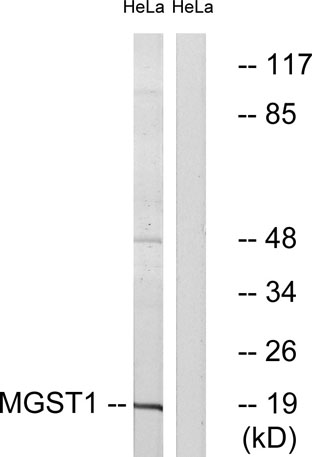
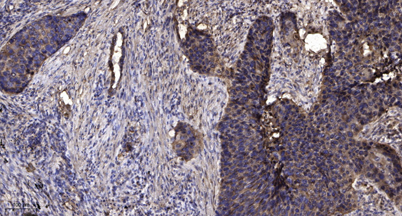
| Dilution | WB 1:500-2000;IHC-p 1:50-300 |
| Purification | The antibody was affinity-purified from rabbit antiserum by affinity-chromatography using epitope-specific immunogen. |
| Concentration | 1 mg/ml |
| Storage stability | -20°C/1 year |
| Molecular Weight (Da) | |
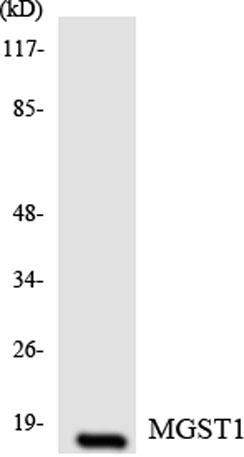
| Observed band (KD) | 18kD |
| Background | The MAPEG (Membrane Associated Proteins in Eicosanoid and Glutathione metabolism) family consists of six human proteins, two of which are involved in the production of leukotrienes and prostaglandin E, important mediators of inflammation. Other family members, demonstrating glutathione S-transferase and peroxidase activities, are involved in cellular defense against toxic, carcinogenic, and pharmacologically active electrophilic compounds. This gene encodes a protein that catalyzes the conjugation of glutathione to electrophiles and the reduction of lipid hydroperoxides. This protein is localized to the endoplasmic reticulum and outer mitochondrial membrane where it is thought to protect these membranes from oxidative stress. Several transcript variants, some non-protein coding and some protein coding, have been found for this gene. [provided by RefSeq, May 2012], |
| Function | catalytic activity:RX + glutathione = HX + R-S-glutathione.,enzyme regulation:Activated by N-ethylmaleimide, except in the testis.,function:Conjugation of reduced glutathione to a wide number of exogenous and endogenous hydrophobic electrophiles. Has a wide substrate specificity.,similarity:Belongs to the MAPEG family.,subunit:Homotrimer.,tissue specificity:Highly expressed in liver., |
| Subcellular location | Microsome . Mitochondrion outer membrane ; Peripheral membrane protein . Endoplasmic reticulum membrane ; Multi-pass membrane protein . |
| Expression | Highly expressed in liver. |

Use collapsible tabs for more detailed information that will help customers make a purchasing decision.
Ex: Shipping and return policies, size guides, and other common questions.