 Français
 English
MRE11 (phospho Ser264) rabbit pAb
AO-06-ES6268-50

| ELK.No | ES6268 |
| Product name | MRE11 (phospho Ser264) rabbit pAb |
| Reactivity | Human;Mouse;Rat |
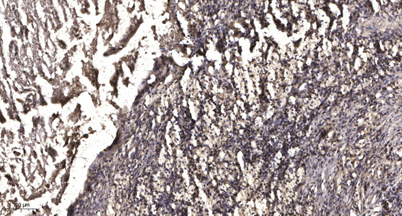
| Applications | WB;ELISA;IHC |
| Other name | MRE11A; HNGS1; MRE11; Double-strand break repair protein MRE11A; Meiotic recombination 11 homolog 1; MRE11 homolog 1; Meiotic recombination 11 homolog A; MRE11 homolog A |
| Size | 50μL |
| Unit price ($) | 148 |
| Human gene ID | 4361 |
| Human Swiss-Prot | P49959 |
| Source | Rabbit |
| Isotype | IgG |
| Target | MRE11 |
| Fields | >>Homologous recombination;>>Non-homologous end-joining;>>Cellular senescence |
| Gene name | MRE11A |
| Protein name | Double-strand break repair protein MRE11A |
| Human gene link | View Human Gene |
| Human Swiss link | View Human Swiss-Prot |
| Mouse gene ID | 17535 |
| Mouse gene link | View Mouse Gene |
| Mouse Swiss-Prot | Q61216 |
| Mouse Swiss link | View Mouse Swiss-Prot |
| Rat gene ID | 64046 |
| Rat gene link | View Rat Gene |
| Rat Swiss-Prot | Q9JIM0 |
| Rat Swiss link | View Rat Swiss-Prot |
| Immunogen | The antiserum was produced against synthesized peptide derived from human MRE11 around the phosphorylation site of Ser264. AA range:230-279 |
| Specificity | Phospho-MRE11 (S264) Polyclonal Antibody detects endogenous levels of MRE11 protein only when phosphorylated at S264. |
| Formulation | Liquid in PBS containing 50% glycerol, 0.5% BSA and 0.02% sodium azide. |
| Clonality | Polyclonal |
| Dilution | WB 1:500-2000;IHC-p 1:50-300; ELISA 2000-20000 |
| Purification | The antibody was affinity-purified from rabbit antiserum by affinity-chromatography using epitope-specific immunogen. |
| Concentration | 1 mg/ml |
| Storage stability | -20°C/1 year |
| Molecular Weight (Da) | |
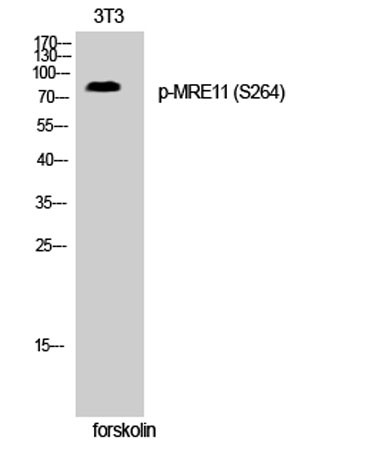
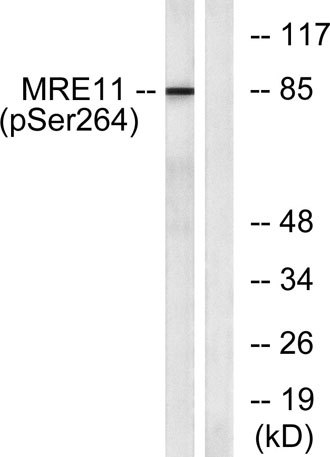
| Observed band (KD) | 80kD |
| Background | This gene encodes a nuclear protein involved in homologous recombination, telomere length maintenance, and DNA double-strand break repair. By itself, the protein has 3' to 5' exonuclease activity and endonuclease activity. The protein forms a complex with the RAD50 homolog; this complex is required for nonhomologous joining of DNA ends and possesses increased single-stranded DNA endonuclease and 3' to 5' exonuclease activities. In conjunction with a DNA ligase, this protein promotes the joining of noncomplementary ends in vitro using short homologies near the ends of the DNA fragments. This gene has a pseudogene on chromosome 3. Alternative splicing of this gene results in two transcript variants encoding different isoforms. [provided by RefSeq, Jul 2008], |
| Function | cofactor:Manganese.,disease:Defects in MRE11A are a cause of ataxia telangiectasia-like disorder (ATLD) [MIM:604391]. ATLD is a disease with the same clinical feature than ataxia-telangiectasia but with a somewhat milder clinical course.,disease:Defects in MRE11A may be a cause of breast cancer.,function:Component of the MRN complex, which plays a central role in double-strand break (DSB) repair, DNA recombination, maintenance of telomere integrity and meiosis. The complex possesses single-strand endonuclease activity and double-strand-specific 3'-5' exonuclease activity, which are provided by MRE11A. RAD50 may be required to bind DNA ends and hold them in close proximity. This could facilitate searches for short or long regions of sequence homology in the recombining DNA templates, and may also stimulate the activity of DNA ligases and/or restrict the nuclease activity of MRE11A to prev |
| Subcellular location | Nucleus . Chromosome, telomere . Chromosome . Localizes to discrete nuclear foci after treatment with genotoxic agents. . |
| Expression | Bladder,Brain,Epithelium,Lung, |

Use collapsible tabs for more detailed information that will help customers make a purchasing decision.
Ex: Shipping and return policies, size guides, and other common questions.