 Français
 English
IRP-1 (phospho Ser711) rabbit pAb
AO-06-ES6388-100

| ELK.No | ES6388 |
| Product name | IRP-1 (phospho Ser711) rabbit pAb |
| Reactivity | Human;Mouse;Rat;Monkey |
| Applications | WB;IHC;IF;ELISA |
| Other name | ACO1; IREB1; Cytoplasmic aconitate hydratase; Aconitase; Citrate hydro-lyase; Ferritin repressor protein; Iron regulatory protein 1; IRP1; Iron-responsive element-binding protein 1; IRE-BP 1 |
| Size | 100μL |
| Unit price ($) | 248 |
| Human gene ID | 48 |
| Human Swiss-Prot | P21399 |
| Source | Rabbit |
| Isotype | IgG |
| Target | IRP-1 |
| Fields | >>Citrate cycle (TCA cycle);>>Glyoxylate and dicarboxylate metabolism;>>Metabolic pathways;>>Carbon metabolism;>>2-Oxocarboxylic acid metabolism;>>Biosynthesis of amino acids |
| Gene name | ACO1 |
| Protein name | Cytoplasmic aconitate hydratase |
| Human gene link | View Human Gene |
| Human Swiss link | View Human Swiss-Prot |
| Mouse gene ID | 11428 |
| Mouse gene link | View Mouse Gene |
| Mouse Swiss-Prot | P28271 |
| Mouse Swiss link | View Mouse Swiss-Prot |
| Rat gene ID | 50655 |
| Rat gene link | View Rat Gene |
| Rat Swiss-Prot | Q63270 |
| Rat Swiss link | View Rat Swiss-Prot |
| Immunogen | The antiserum was produced against synthesized peptide derived from human IREB1 around the phosphorylation site of Ser711. AA range:681-730 |
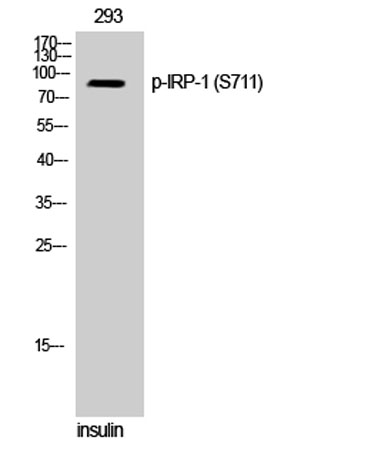
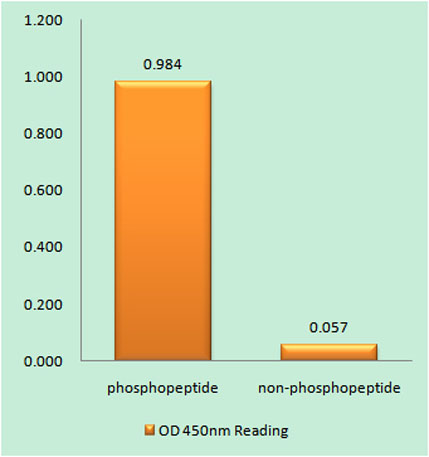
| Specificity | Phospho-IRP-1 (S711) Polyclonal Antibody detects endogenous levels of IRP-1 protein only when phosphorylated at S711. |
| Formulation | Liquid in PBS containing 50% glycerol, 0.5% BSA and 0.02% sodium azide. |
| Clonality | Polyclonal |
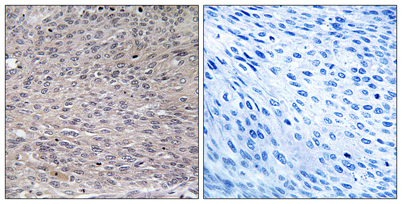
| Dilution | Western Blot: 1/500 - 1/2000. Immunohistochemistry: 1/100 - 1/300. ELISA: 1/10000. Not yet tested in other applications. |
| Purification | The antibody was affinity-purified from rabbit antiserum by affinity-chromatography using epitope-specific immunogen. |
| Concentration | 1 mg/ml |
| Storage stability | -20°C/1 year |
| Molecular Weight (Da) | |
| Observed band (KD) | 85kD |
| Background | The protein encoded by this gene is a bifunctional, cytosolic protein that functions as an essential enzyme in the TCA cycle and interacts with mRNA to control the levels of iron inside cells. When cellular iron levels are high, this protein binds to a 4Fe-4S cluster and functions as an aconitase. Aconitases are iron-sulfur proteins that function to catalyze the conversion of citrate to isocitrate. When cellular iron levels are low, the protein binds to iron-responsive elements (IREs), which are stem-loop structures found in the 5' UTR of ferritin mRNA, and in the 3' UTR of transferrin receptor mRNA. When the protein binds to IRE, it results in repression of translation of ferritin mRNA, and inhibition of degradation of the otherwise rapidly degraded transferrin receptor mRNA. The encoded protein has been identified as a moonlighting protein based on its ability to perform mechanistically distinct |
| Function | catalytic activity:Citrate = isocitrate.,cofactor:Binds 1 4Fe-4S cluster per subunit.,function:Binds to iron-responsive elements (IRES), which are stem-loop structures found in the 5'-UTR of ferritin, and delta aminolevulinic acid synthase mRNAs, and in the 3'-UTR of transferrin receptor mRNA. Binding to the IRE element in ferritin results in the repression of its mRNA translation. Binding of the protein to the transferrin receptor mRNA inhibits the degradation of this otherwise rapidly degraded mRNA. This protein also expresses aconitase activity.,online information:Aconitase entry,similarity:Belongs to the aconitase/IPM isomerase family., |
| Subcellular location | Cytoplasm, cytosol . |
| Expression | Brain,Brain astrocytoma,Uterus, |

Use collapsible tabs for more detailed information that will help customers make a purchasing decision.
Ex: Shipping and return policies, size guides, and other common questions.