 Français
 English

| ELK.No | ES6437 |
| Product name | GPR143 rabbit pAb |
| Reactivity | Human;Mouse |
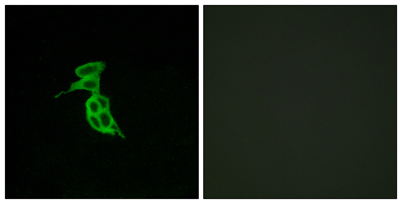
| Applications | IF;ELISA |
| Other name | GPR143; OA1; G-protein coupled receptor 143; Ocular albinism type 1 protein |
| Size | 100μL |
| Unit price ($) | 248 |
| Human gene ID | 4935 |
| Human Swiss-Prot | P51810 |
| Source | Rabbit |
| Isotype | IgG |
| Target | GPR143 |
| Fields | |
| Gene name | GPR143 |
| Protein name | G-protein coupled receptor 143 |
| Human gene link | View Human Gene |
| Human Swiss link | View Human Swiss-Prot |
| Mouse gene ID | 18241 |
| Mouse gene link | View Mouse Gene |
| Mouse Swiss-Prot | P70259 |
| Mouse Swiss link | View Mouse Swiss-Prot |
| Rat gene ID | |
| Rat gene link | |
| Rat Swiss-Prot | |
| Rat Swiss link | |
| Immunogen | The antiserum was produced against synthesized peptide derived from human GPR143. AA range:151-200 |
| Specificity | GPR143 Polyclonal Antibody detects endogenous levels of GPR143 protein. |
| Formulation | Liquid in PBS containing 50% glycerol, 0.5% BSA and 0.02% sodium azide. |
| Clonality | Polyclonal |
| Dilution | Immunofluorescence: 1/200 - 1/1000. ELISA: 1/10000. Not yet tested in other applications. |
| Purification | The antibody was affinity-purified from rabbit antiserum by affinity-chromatography using epitope-specific immunogen. |
| Concentration | 1 mg/ml |
| Storage stability | -20°C/1 year |
| Molecular Weight (Da) | 44kD |
| Observed band (KD) | |
| Background | This gene encodes a protein that binds to heterotrimeric G proteins and is targeted to melanosomes in pigment cells. This protein is thought to be involved in intracellular signal transduction mechanisms. Mutations in this gene cause ocular albinism type 1, also referred to as Nettleship-Falls type ocular albinism, a severe visual disorder. A related pseudogene has been identified on chromosome Y. [provided by RefSeq, Dec 2009], |
| Function | disease:Defects in GPR143 are the cause of ocular albinism type 1 (OA1) [MIM:300500]; also known as Nettleship-Falls type ocular albinism. OA1 is an X-linked disorder characterized by severe impairment of visual acuity, retinal hypopigmentation and the presence of macromelanosomes.,function:Not known; binds heterotrimeric G proteins.,online information:GPR143 mutations,online information:Retina International's Scientific Newsletter,similarity:Belongs to the G-protein coupled receptor OA family.,subcellular location:Targeted to intracellular organelles, namely the melanosomes in pigment cells.,tissue specificity:Exclusively expressed in pigment cells., |
| Subcellular location | Melanosome membrane ; Multi-pass membrane protein . Lysosome membrane ; Multi-pass membrane protein . Apical cell membrane ; Multi-pass membrane protein . Distributed throughout the endo-melanosomal system but most of endogenous protein is localized in unpigmented stage II melanosomes. Its expression on the apical cell membrane is sensitive to tyrosine (PubMed:18828673). . |
| Expression | Expressed at high levels in the retina, including the retinal pigment epithelium (RPE), and in melanocytes. Weak expression is observed in brain and adrenal gland. |

Use collapsible tabs for more detailed information that will help customers make a purchasing decision.
Ex: Shipping and return policies, size guides, and other common questions.