 Français
 English
Relaxin Receptor 3 rabbit pAb
AO-06-ES6513-100

| ELK.No | ES6513 |
| Product name | Relaxin Receptor 3 rabbit pAb |
| Reactivity | Human;Mouse;Rat |
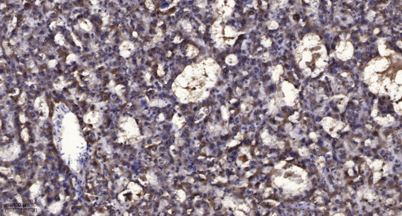
| Applications | WB;IHC |
| Other name | RXFP3; RLN3R1; SALPR; Relaxin-3 receptor 1; RLN3 receptor 1; G protein-coupled receptor SALPR; G-protein coupled receptor GPCR135; Relaxin family peptide receptor 3; Somatostatin- and angiotensin-like peptide receptor |
| Size | 100μL |
| Unit price ($) | 248 |
| Human gene ID | 51289 |
| Human Swiss-Prot | Q9NSD7 |
| Source | Rabbit |
| Isotype | IgG |
| Target | Relaxin Receptor 3 |
| Fields | >>Neuroactive ligand-receptor interaction;>>Relaxin signaling pathway |
| Gene name | RXFP3 |
| Protein name | Relaxin-3 receptor 1 |
| Human gene link | View Human Gene |
| Human Swiss link | View Human Swiss-Prot |
| Mouse gene ID | 239336 |
| Mouse gene link | View Mouse Gene |
| Mouse Swiss-Prot | Q8BGE9 |
| Mouse Swiss link | View Mouse Swiss-Prot |
| Rat gene ID | |
| Rat gene link | |
| Rat Swiss-Prot | |
| Rat Swiss link | |
| Immunogen | The antiserum was produced against synthesized peptide derived from human RXFP3. AA range:161-210 |
| Specificity | Relaxin Receptor 3 Polyclonal Antibody detects endogenous levels of Relaxin Receptor 3 protein. |
| Formulation | Liquid in PBS containing 50% glycerol, 0.5% BSA and 0.02% sodium azide. |
| Clonality | Polyclonal |
| Dilution | WB 1:500-2000;IHC-p 1:50-300 |
| Purification | The antibody was affinity-purified from rabbit antiserum by affinity-chromatography using epitope-specific immunogen. |
| Concentration | 1 mg/ml |
| Storage stability | -20°C/1 year |
| Molecular Weight (Da) | |
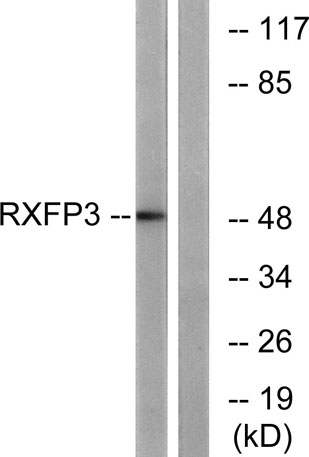
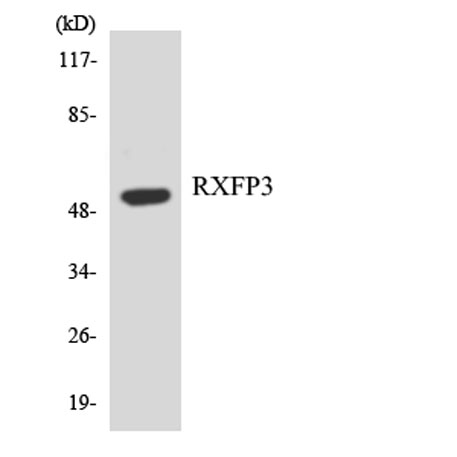
| Observed band (KD) | 51kD |
| Background | function:Receptor for relaxin-3. Binding of the ligand inhibit cAMP accumulation.,similarity:Belongs to the G-protein coupled receptor 1 family.,tissue specificity:Expressed predominantly in brain regions. Highest expression in substantia nigra and pituitary, followed by hippocampus, spinal cord, amygdala, caudate nucleus and corpus callosum, quite low level in cerebellum. In peripheral tissues, relatively high levels in adrenal glands, low levels in pancreas, salivary gland, placenta, mammary gland and testis., |
| Function | function:Receptor for relaxin-3. Binding of the ligand inhibit cAMP accumulation.,similarity:Belongs to the G-protein coupled receptor 1 family.,tissue specificity:Expressed predominantly in brain regions. Highest expression in substantia nigra and pituitary, followed by hippocampus, spinal cord, amygdala, caudate nucleus and corpus callosum, quite low level in cerebellum. In peripheral tissues, relatively high levels in adrenal glands, low levels in pancreas, salivary gland, placenta, mammary gland and testis., |
| Subcellular location | Cell membrane; Multi-pass membrane protein. |
| Expression | Expressed predominantly in brain regions. Highest expression in substantia nigra and pituitary, followed by hippocampus, spinal cord, amygdala, caudate nucleus and corpus callosum, quite low level in cerebellum. In peripheral tissues, relatively high levels in adrenal glands, low levels in pancreas, salivary gland, placenta, mammary gland and testis. |

Use collapsible tabs for more detailed information that will help customers make a purchasing decision.
Ex: Shipping and return policies, size guides, and other common questions.