 Français
 English

| ELK.No | ES6578 |
| Product name | PGD rabbit pAb |
| Reactivity | Human;Mouse;Rat |
| Applications | WB;IHC;IF;ELISA |
| Other name | PGD; PGDH; 6-phosphogluconate dehydrogenase; decarboxylating |
| Size | 100μL |
| Unit price ($) | 248 |
| Human gene ID | 5226 |
| Human Swiss-Prot | P52209 |
| Source | Rabbit |
| Isotype | IgG |
| Target | PGD |
| Fields | >>Pentose phosphate pathway;>>Glutathione metabolism;>>Metabolic pathways;>>Carbon metabolism |
| Gene name | PGD |
| Protein name | 6-phosphogluconate dehydrogenase decarboxylating |
| Human gene link | View Human Gene |
| Human Swiss link | View Human Swiss-Prot |
| Mouse gene ID | 110208 |
| Mouse gene link | View Mouse Gene |
| Mouse Swiss-Prot | Q9DCD0 |
| Mouse Swiss link | View Mouse Swiss-Prot |
| Rat gene ID | 1.0036e+008 |
| Rat gene link | View Rat Gene |
| Rat Swiss-Prot | P85968 |
| Rat Swiss link | View Rat Swiss-Prot |
| Immunogen | The antiserum was produced against synthesized peptide derived from human PGD. AA range:71-120 |
| Specificity | PGD Polyclonal Antibody detects endogenous levels of PGD protein. |
| Formulation | Liquid in PBS containing 50% glycerol, 0.5% BSA and 0.02% sodium azide. |
| Clonality | Polyclonal |
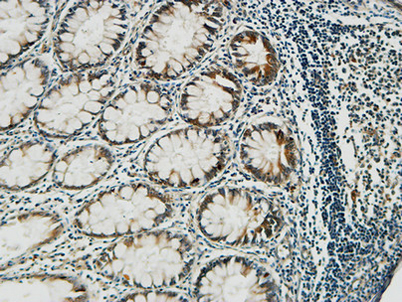
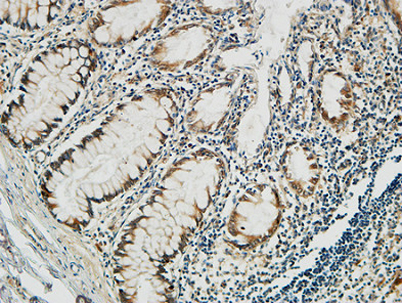
| Dilution | IHC-p: 100-300.Western Blot: 1/500 - 1/2000. ELISA: 1/5000. Not yet tested in other applications. |
| Purification | The antibody was affinity-purified from rabbit antiserum by affinity-chromatography using epitope-specific immunogen. |
| Concentration | 1 mg/ml |
| Storage stability | -20°C/1 year |
| Molecular Weight (Da) | |
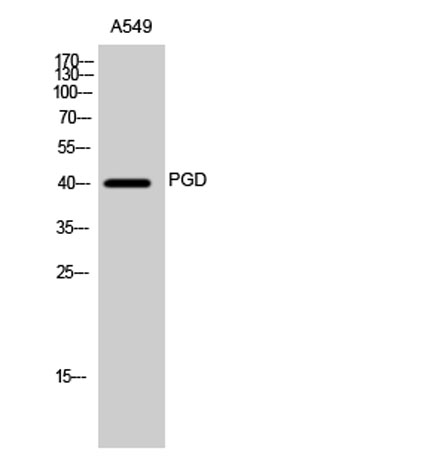
| Observed band (KD) | 40kD |
| Background | 6-phosphogluconate dehydrogenase is the second dehydrogenase in the pentose phosphate shunt. Deficiency of this enzyme is generally asymptomatic, and the inheritance of this disorder is autosomal dominant. Hemolysis results from combined deficiency of 6-phosphogluconate dehydrogenase and 6-phosphogluconolactonase suggesting a synergism of the two enzymopathies. Several transcript variants encoding different isoforms have been found for this gene. [provided by RefSeq, Jan 2015], |
| Function | catalytic activity:6-phospho-D-gluconate + NADP(+) = D-ribulose 5-phosphate + CO(2) + NADPH.,pathway:Carbohydrate degradation; pentose phosphate pathway; D-ribulose 5-phosphate from D-glucose 6-phosphate (oxidative stage): step 3/3.,similarity:Belongs to the 6-phosphogluconate dehydrogenase family.,subunit:Homodimer., |
| Subcellular location | Cytoplasm . |
| Expression | Heart,Lung, |

Use collapsible tabs for more detailed information that will help customers make a purchasing decision.
Ex: Shipping and return policies, size guides, and other common questions.