 Français
 English

| ELK.No | ES6589 |
| Product name | Pim-1 rabbit pAb |
| Reactivity | Human;Mouse;Rat |
| Applications | WB;IHC |
| Other name | PIM1; Serine/threonine-protein kinase pim-1 |
| Size | 100μL |
| Unit price ($) | 248 |
| Human gene ID | 5292 |
| Human Swiss-Prot | P11309 |
| Source | Rabbit |
| Isotype | IgG |
| Target | Pim-1 |
| Fields | >>JAK-STAT signaling pathway;>>AGE-RAGE signaling pathway in diabetic complications;>>Pathways in cancer;>>MicroRNAs in cancer;>>Acute myeloid leukemia |
| Gene name | PIM1 |
| Protein name | Serine/threonine-protein kinase pim-1 |
| Human gene link | View Human Gene |
| Human Swiss link | View Human Swiss-Prot |
| Mouse gene ID | |
| Mouse gene link | |
| Mouse Swiss-Prot | P06803 |
| Mouse Swiss link | View Mouse Swiss-Prot |
| Rat gene ID | 24649 |
| Rat gene link | View Rat Gene |
| Rat Swiss-Prot | P26794 |
| Rat Swiss link | View Rat Swiss-Prot |
| Immunogen | The antiserum was produced against synthesized peptide derived from human Pim-1. AA range:281-330 |
| Specificity | Pim-1 Polyclonal Antibody detects endogenous levels of Pim-1 protein. |
| Formulation | Liquid in PBS containing 50% glycerol, 0.5% BSA and 0.02% sodium azide. |
| Clonality | Polyclonal |
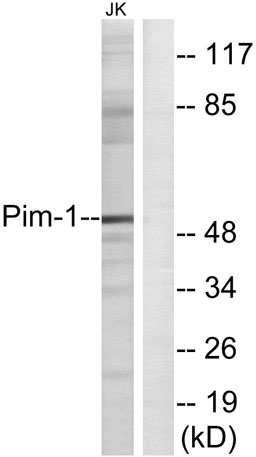
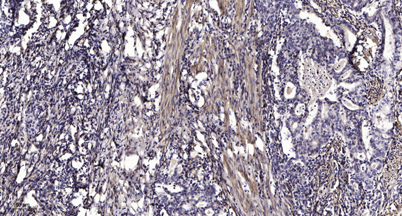
| Dilution | WB 1:500-2000;IHC-p 1:50-300 |
| Purification | The antibody was affinity-purified from rabbit antiserum by affinity-chromatography using epitope-specific immunogen. |
| Concentration | 1 mg/ml |
| Storage stability | -20°C/1 year |
| Molecular Weight (Da) | |
| Observed band (KD) | 50kD |
| Background | The protein encoded by this gene belongs to the Ser/Thr protein kinase family, and PIM subfamily. This gene is expressed primarily in B-lymphoid and myeloid cell lines, and is overexpressed in hematopoietic malignancies and in prostate cancer. It plays a role in signal transduction in blood cells, contributing to both cell proliferation and survival, and thus provides a selective advantage in tumorigenesis. Both the human and orthologous mouse genes have been reported to encode two isoforms (with preferential cellular localization) resulting from the use of alternative in-frame translation initiation codons, the upstream non-AUG (CUG) and downstream AUG codons (PMIDs:16186805, 1825810).[provided by RefSeq, Aug 2011], |
| Function | catalytic activity:ATP + a protein = ADP + a phosphoprotein.,cofactor:Manganese.,function:Plays a role in signal transduction in blood cells. Contributes to both cell proliferation and survival and thus provide a selective advantage in tumorigenesis. May affect the structure or silencing of chromatin by phosphorylating HP1 gamma/CBX3.,induction:Strongly induced in leukocytes by the JAK/STAT pathway in response to cytokines.,PTM:Autophosphorylated on both serine/threonine and tyrosine residues.,similarity:Belongs to the protein kinase superfamily. CAMK Ser/Thr protein kinase family. PIM subfamily.,similarity:Contains 1 protein kinase domain.,subunit:Binds to RP9. Isoform 2 is isolated as a monomer whereas isoform 1 complexes with other proteins. Isoform 1, but not isoform 2, binds BMX.,tissue specificity:Expressed primarily in cells of the hematopoietic and germline lineages. Isoform 1 an |
| Subcellular location | [Isoform 1]: Cytoplasm. Nucleus.; [Isoform 2]: Cell membrane. |
| Expression | Expressed primarily in cells of the hematopoietic and germline lineages. Isoform 1 and isoform 2 are both expressed in prostate cancer cell lines. |

Use collapsible tabs for more detailed information that will help customers make a purchasing decision.
Ex: Shipping and return policies, size guides, and other common questions.