 Français
 English

| ELK.No | ES6726 |
| Product name | AVP Receptor V2 rabbit pAb |
| Reactivity | Human;Rat;Mouse; |
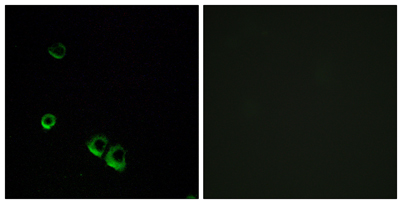
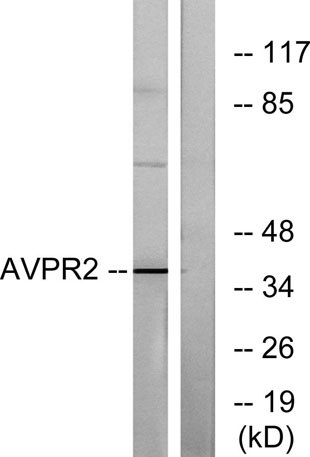
| Applications | WB;IF;ELISA |
| Other name | AVPR2; ADHR; DIR; DIR3; V2R; Vasopressin V2 receptor; V2R; AVPR V2; Antidiuretic hormone receptor; Renal-type arginine vasopressin receptor |
| Size | 100μL |
| Unit price ($) | 248 |
| Human gene ID | 554 |
| Human Swiss-Prot | P30518 |
| Source | Rabbit |
| Isotype | IgG |
| Target | AVP Receptor V2 |
| Fields | >>Phospholipase D signaling pathway;>>Neuroactive ligand-receptor interaction;>>Vasopressin-regulated water reabsorption |
| Gene name | AVPR2 |
| Protein name | Vasopressin V2 receptor |
| Human gene link | View Human Gene |
| Human Swiss link | View Human Swiss-Prot |
| Mouse gene ID | |
| Mouse gene link | |
| Mouse Swiss-Prot | O88721 |
| Mouse Swiss link | View Mouse Swiss-Prot |
| Rat gene ID | |
| Rat gene link | |
| Rat Swiss-Prot | |
| Rat Swiss link | |
| Immunogen | The antiserum was produced against synthesized peptide derived from human AVPR2. AA range:72-121 |
| Specificity | AVP Receptor V2 Polyclonal Antibody detects endogenous levels of AVP Receptor V2 protein. |
| Formulation | Liquid in PBS containing 50% glycerol, 0.5% BSA and 0.02% sodium azide. |
| Clonality | Polyclonal |
| Dilution | Western Blot: 1/500 - 1/2000. Immunofluorescence: 1/200 - 1/1000. ELISA: 1/10000. Not yet tested in other applications. |
| Purification | The antibody was affinity-purified from rabbit antiserum by affinity-chromatography using epitope-specific immunogen. |
| Concentration | 1 mg/ml |
| Storage stability | -20°C/1 year |
| Molecular Weight (Da) | |
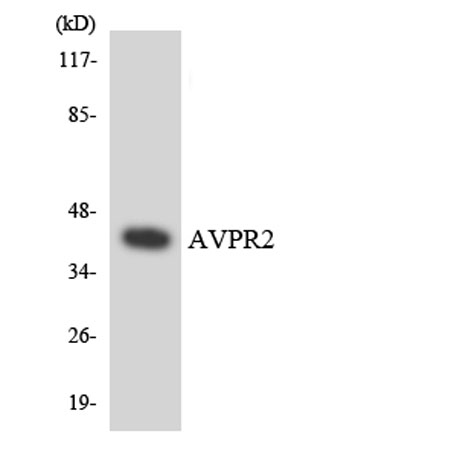
| Observed band (KD) | 38kD |
| Background | This gene encodes the vasopressin receptor, type 2, also known as the V2 receptor, which belongs to the seven-transmembrane-domain G protein-coupled receptor (GPCR) superfamily, and couples to Gs thus stimulating adenylate cyclase. The subfamily that includes the V2 receptor, the V1a and V1b vasopressin receptors, the oxytocin receptor, and isotocin and mesotocin receptors in non-mammals, is well conserved, though several members signal via other G proteins. All bind similar cyclic nonapeptide hormones. The V2 receptor is expressed in the kidney tubule, predominantly in the distal convoluted tubule and collecting ducts, where its primary property is to respond to the pituitary hormone arginine vasopressin (AVP) by stimulating mechanisms that concentrate the urine and maintain water homeostasis in the organism. When the function of this gene is lost, the disease Nephrogenic Diabetes Insipidus |
| Function | disease:Defects in AVPR2 are the cause of diabetes insipidus nephrogenic X-linked (XNDI) [MIM:304800]; also known as diabetes insipidus nephrogenic type 1. XNDI is caused by the inability of the renal collecting ducts to absorb water in response to arginine vasopressin. It is characterized by excessive water drinking (polydypsia), excessive urine excretion (polyuria), persistent hypotonic urine, and hypokalemia.,disease:Defects in AVPR2 are the cause of nephrogenic syndrome of inappropriate antidiuresis (NSIAD) [MIM:300539]. This disorder is characterized by an inability to excrete a free water load, with inappropriately concentrated urine and resultant hyponatremia, hypoosmolarity, and natriuresis.,function:Receptor for arginine vasopressin. The activity of this receptor is mediated by G proteins which activate adenylate cyclase.,online information:AVPR2 pages,similarity:Belongs to the |
| Subcellular location | Cell membrane ; Multi-pass membrane protein . |
| Expression | Kidney. |

Use collapsible tabs for more detailed information that will help customers make a purchasing decision.
Ex: Shipping and return policies, size guides, and other common questions.