 Français
 English
PKD1 (phospho Ser205) rabbit pAb
AO-06-ES6786-100

| ELK.No | ES6786 |
| Product name | PKD1 (phospho Ser205) rabbit pAb |
| Reactivity | Human;Mouse;Rat |
| Applications | WB;IHC;IF;ELISA |
| Other name | PRKD1; PKD; PKD1; PRKCM; Serine/threonine-protein kinase D1; Protein kinase C mu type; Protein kinase D; nPKC-D1; nPKC-mu |
| Size | 100μL |
| Unit price ($) | 248 |
| Human gene ID | 5587 |
| Human Swiss-Prot | Q15139 |
| Source | Rabbit |
| Isotype | IgG |
| Target | PKD1 |
| Fields | >>Rap1 signaling pathway;>>Aldosterone synthesis and secretion;>>Chemical carcinogenesis - reactive oxygen species |
| Gene name | PRKD1 |
| Protein name | Serine/threonine-protein kinase D1 |
| Human gene link | View Human Gene |
| Human Swiss link | View Human Swiss-Prot |
| Mouse gene ID | 18760 |
| Mouse gene link | View Mouse Gene |
| Mouse Swiss-Prot | Q62101 |
| Mouse Swiss link | View Mouse Swiss-Prot |
| Rat gene ID | 85421 |
| Rat gene link | View Rat Gene |
| Rat Swiss-Prot | Q9WTQ1 |
| Rat Swiss link | View Rat Swiss-Prot |
| Immunogen | The antiserum was produced against synthesized peptide derived from human PKD1/PKC mu around the phosphorylation site of Ser205. AA range:171-220 |
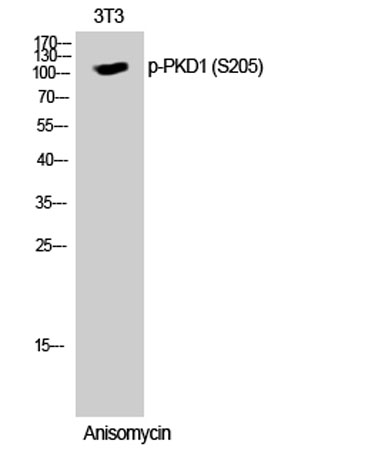
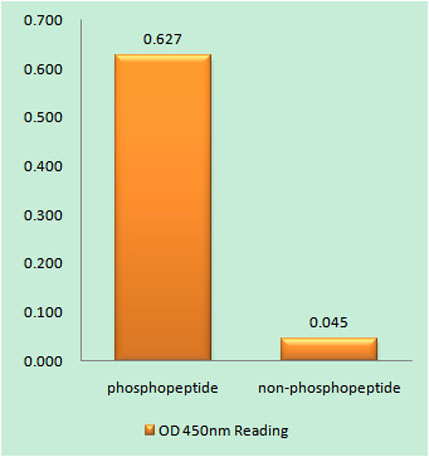
| Specificity | Phospho-PKD1 (S205) Polyclonal Antibody detects endogenous levels of PKD1 protein only when phosphorylated at S205. |
| Formulation | Liquid in PBS containing 50% glycerol, 0.5% BSA and 0.02% sodium azide. |
| Clonality | Polyclonal |
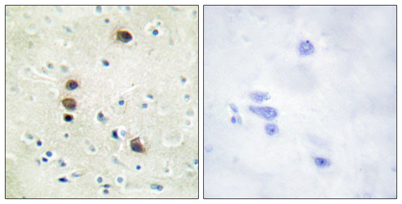
| Dilution | Western Blot: 1/500 - 1/2000. Immunohistochemistry: 1/100 - 1/300. ELISA: 1/40000. Not yet tested in other applications. |
| Purification | The antibody was affinity-purified from rabbit antiserum by affinity-chromatography using epitope-specific immunogen. |
| Concentration | 1 mg/ml |
| Storage stability | -20°C/1 year |
| Molecular Weight (Da) | |
| Observed band (KD) | 110kD |
| Background | PRKD1 is a serine/threonine kinase that regulates a variety of cellular functions, including membrane receptor signaling, transport at the Golgi, protection from oxidative stress at the mitochondria, gene transcription, and regulation of cell shape, motility, and adhesion (summary by Eiseler et al., 2009 [PubMed 19329994]).[supplied by OMIM, Nov 2010], |
| Function | catalytic activity:ATP + a protein = ADP + a phosphoprotein.,enzyme regulation:Activated by diacylglycerol and phorbol esters.,function:Calcium-independent, phospholipid-dependent, serine- and threonine-specific kinase involved in resistance to oxidative stress.,PTM:Phosphorylation of Ser-738 and/or Ser-742 in activated PKD is mediated by transphosphorylation (By similarity). Phosphorylation of Tyr-463 mediated by the Src/Abl pathway in response to oxidative stress activates the kinase.,similarity:Belongs to the protein kinase superfamily.,similarity:Belongs to the protein kinase superfamily. CAMK Ser/Thr protein kinase family. PKD subfamily.,similarity:Contains 1 PH domain.,similarity:Contains 1 protein kinase domain.,similarity:Contains 2 phorbol-ester/DAG-type zinc fingers.,subunit:Interacts (via N-terminus) with ADAP1/CENTA1. Interacts with Src., |
| Subcellular location | Cytoplasm . Cell membrane . Golgi apparatus, trans-Golgi network . Translocation to the cell membrane is required for kinase activation. |
| Expression | Placenta,Testis, |

Use collapsible tabs for more detailed information that will help customers make a purchasing decision.
Ex: Shipping and return policies, size guides, and other common questions.