 Français
 English

| ELK.No | ES6843 |
| Product name | KCNQ5 rabbit pAb |
| Reactivity | Human;Mouse |
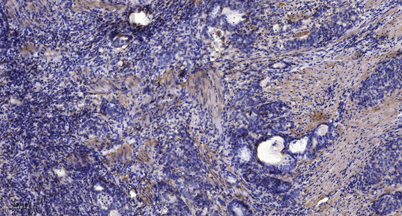
| Applications | WB;ELISA;IHC |
| Other name | KCNQ5; Potassium voltage-gated channel subfamily KQT member 5; KQT-like 5; Potassium channel subunit alpha KvLQT5; Voltage-gated potassium channel subunit Kv7.5 |
| Size | 50μL |
| Unit price ($) | 148 |
| Human gene ID | 56479 |
| Human Swiss-Prot | Q9NR82 |
| Source | Rabbit |
| Isotype | IgG |
| Target | KCNQ5 |
| Fields | >>Cholinergic synapse |
| Gene name | KCNQ5 |
| Protein name | Potassium voltage-gated channel subfamily KQT member 5 |
| Human gene link | View Human Gene |
| Human Swiss link | View Human Swiss-Prot |
| Mouse gene ID | 226922 |
| Mouse gene link | View Mouse Gene |
| Mouse Swiss-Prot | Q9JK45 |
| Mouse Swiss link | View Mouse Swiss-Prot |
| Rat gene ID | |
| Rat gene link | |
| Rat Swiss-Prot | |
| Rat Swiss link | |
| Immunogen | The antiserum was produced against synthesized peptide derived from human KCNQ5. AA range:637-686 |
| Specificity | KCNQ5 Polyclonal Antibody detects endogenous levels of KCNQ5 protein. |
| Formulation | Liquid in PBS containing 50% glycerol, 0.5% BSA and 0.02% sodium azide. |
| Clonality | Polyclonal |
| Dilution | WB 1:500-2000;IHC-p 1:50-300; ELISA 2000-20000 |
| Purification | The antibody was affinity-purified from rabbit antiserum by affinity-chromatography using epitope-specific immunogen. |
| Concentration | 1 mg/ml |
| Storage stability | -20°C/1 year |
| Molecular Weight (Da) | |
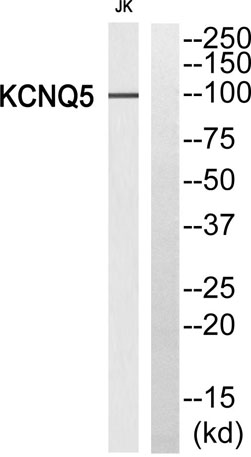
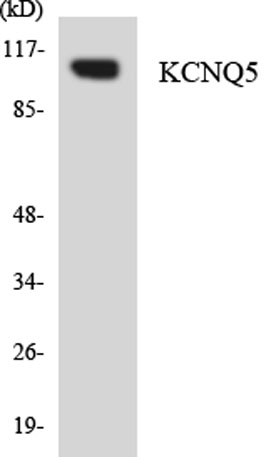
| Observed band (KD) | 100-110kD |
| Background | This gene is a member of the KCNQ potassium channel gene family that is differentially expressed in subregions of the brain and in skeletal muscle. The protein encoded by this gene yields currents that activate slowly with depolarization and can form heteromeric channels with the protein encoded by the KCNQ3 gene. Currents expressed from this protein have voltage dependences and inhibitor sensitivities in common with M-currents. They are also inhibited by M1 muscarinic receptor activation. Multiple transcript variants encoding different isoforms have been found for this gene. [provided by RefSeq, May 2009], |
| Function | domain:The segment S4 is probably the voltage-sensor and is characterized by a series of positively charged amino acids at every third position.,function:Probably important in the regulation of neuronal excitability. Associates with KCNQ3 to form a potassium channel which contributes to M-type current, a slowly activating and deactivating potassium conductance which plays a critical role in determining the subthreshold electrical excitability of neurons. May contribute, with other potassium channels, to the molecular diversity of an heterogeneous population of M-channels, varying in kinetic and pharmacological properties, which underlie this physiologically important current. Insensitive to tetraethylammonium, but inhibited by barium, linopirdine and XE991. Activated by niflumic acid and the anticonvulsant retigabine. Muscarine suppresses KCNQ5 current in Xenopus oocytes in which cloned |
| Subcellular location | Cell membrane ; Multi-pass membrane protein . |
| Expression | Strongly expressed in brain and skeletal muscle. In brain, expressed in cerebral cortex, occipital pole, frontal lobe and temporal lobe. Lower levels in hippocampus and putamen. Low to undetectable levels in medulla, cerebellum and thalamus. |

Use collapsible tabs for more detailed information that will help customers make a purchasing decision.
Ex: Shipping and return policies, size guides, and other common questions.