 Français
 English
Histamine H4 Receptor rabbit pAb
AO-06-ES7014-50

| ELK.No | ES7014 |
| Product name | Histamine H4 Receptor rabbit pAb |
| Reactivity | Human;Rat;Mouse; |
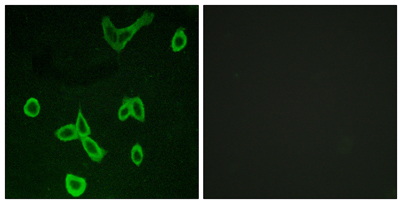
| Applications | WB;IF;ELISA |
| Other name | HRH4; GPCR105; Histamine H4 receptor; H4R; HH4R; AXOR35; G-protein coupled receptor 105; GPRv53; Pfi-013; SP9144 |
| Size | 50μL |
| Unit price ($) | 148 |
| Human gene ID | 59340 |
| Human Swiss-Prot | Q9H3N8 |
| Source | Rabbit |
| Isotype | IgG |
| Target | Histamine H4 Receptor |
| Fields | >>Neuroactive ligand-receptor interaction |
| Gene name | HRH4 |
| Protein name | Histamine H4 receptor |
| Human gene link | View Human Gene |
| Human Swiss link | View Human Swiss-Prot |
| Mouse gene ID | |
| Mouse gene link | |
| Mouse Swiss-Prot | Q91ZY2 |
| Mouse Swiss link | View Mouse Swiss-Prot |
| Rat gene ID | |
| Rat gene link | |
| Rat Swiss-Prot | |
| Rat Swiss link | |
| Immunogen | The antiserum was produced against synthesized peptide derived from human HRH4. AA range:221-270 |
| Specificity | Histamine H4 Receptor Polyclonal Antibody detects endogenous levels of Histamine H4 Receptor protein. |
| Formulation | Liquid in PBS containing 50% glycerol, 0.5% BSA and 0.02% sodium azide. |
| Clonality | Polyclonal |
| Dilution | Western Blot: 1/500 - 1/2000. Immunofluorescence: 1/200 - 1/1000. ELISA: 1/5000. Not yet tested in other applications. |
| Purification | The antibody was affinity-purified from rabbit antiserum by affinity-chromatography using epitope-specific immunogen. |
| Concentration | 1 mg/ml |
| Storage stability | -20°C/1 year |
| Molecular Weight (Da) | |
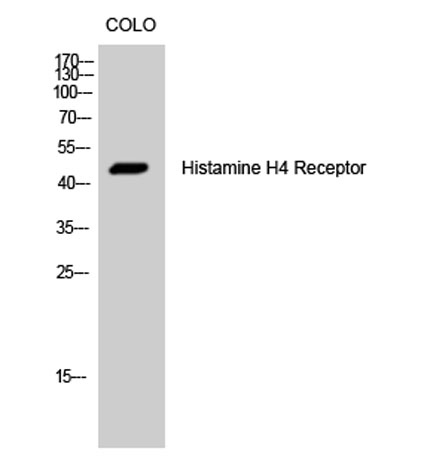
| Observed band (KD) | 45kD |
| Background | Histamine is a ubiquitous messenger molecule released from mast cells, enterochromaffin-like cells, and neurons. Its various actions are mediated by a family of histamine receptors, which are a subset of the G-protein coupled receptor superfamily. This gene encodes a histamine receptor that is predominantly expressed in haematopoietic cells. The protein is thought to play a role in inflammation and allergy reponses. Multiple transcript variants encoding different isoforms have been found for this gene. [provided by RefSeq, May 2009], |
| Function | function:The H4 subclass of histamine receptors could mediate the histamine signals in peripheral tissues. Displays a significant level of constitutive activity (spontaneous activity in the absence of agonist).,induction:Expression is either up-regulated or down-regulated upon activation of the lymphoid tissues and this regulation may depend on the presence of IL-10 or IL-13.,miscellaneous:Does not bind diphenhydramine, loratadine, ranitidine, cimetidine and chlorpheniramine. Shows modest affinity for dimaprit, impromidine, clobenpropit, thioperamide, burimamide clozapine, immepip and imetit. The order of inhibitory activity was imetit > clobenpropit > burimamide > thioperamide. Clobenpropit behaves as a partial agonist, dimaprit and impromidine show some agonist activity while clozapine behaves as a full agonist. Thioperamide shows inverse agonism (enhances cAMP activity). The order of |
| Subcellular location | Cell membrane; Multi-pass membrane protein. |
| Expression | Expressed primarily in the bone marrow and eosinophils. Shows preferential distribution in cells of immunological relevance such as T-cells, dendritic cells, monocytes, mast cells, neutrophils. Also expressed in a wide variety of peripheral tissues, including the heart, kidney, liver, lung, pancreas, skeletal muscle, prostate, small intestine, spleen, testis, colon, fetal liver and lymph node. |

Use collapsible tabs for more detailed information that will help customers make a purchasing decision.
Ex: Shipping and return policies, size guides, and other common questions.