 Français
 English
Cleaved-Factor B Bb (K260) rabbit pAb
AO-06-ES7117-100

| ELK.No | ES7117 |
| Product name | Cleaved-Factor B Bb (K260) rabbit pAb |
| Reactivity | Human;Mouse |
| Applications | WB;ELISA |
| Other name | CFB; BF; BFD; Complement factor B; C3/C5 convertase; Glycine-rich beta glycoprotein; GBG; PBF2; Properdin factor B |
| Size | 100μL |
| Unit price ($) | 248 |
| Human gene ID | 629 |
| Human Swiss-Prot | P00751 |
| Source | Rabbit |
| Isotype | IgG |
| Target | Factor B |
| Fields | >>Complement and coagulation cascades;>>Staphylococcus aureus infection;>>Coronavirus disease - COVID-19 |
| Gene name | CFB |
| Protein name | Complement factor B |
| Human gene link | View Human Gene |
| Human Swiss link | View Human Swiss-Prot |
| Mouse gene ID | |
| Mouse gene link | |
| Mouse Swiss-Prot | P04186 |
| Mouse Swiss link | View Mouse Swiss-Prot |
| Rat gene ID | |
| Rat gene link | |
| Rat Swiss-Prot | |
| Rat Swiss link | |
| Immunogen | The antiserum was produced against synthesized peptide derived from human CFAB Bb. AA range:241-290 |
| Specificity | Cleaved-Factor B Bb (K260) Polyclonal Antibody detects endogenous levels of fragment of activated Factor B Bb protein resulting from cleavage adjacent to K260. |
| Formulation | Liquid in PBS containing 50% glycerol, 0.5% BSA and 0.02% sodium azide. |
| Clonality | Polyclonal |
| Dilution | Western Blot: 1/500 - 1/2000. ELISA: 1/20000. Not yet tested in other applications. |
| Purification | The antibody was affinity-purified from rabbit antiserum by affinity-chromatography using epitope-specific immunogen. |
| Concentration | 1 mg/ml |
| Storage stability | -20°C/1 year |
| Molecular Weight (Da) | |
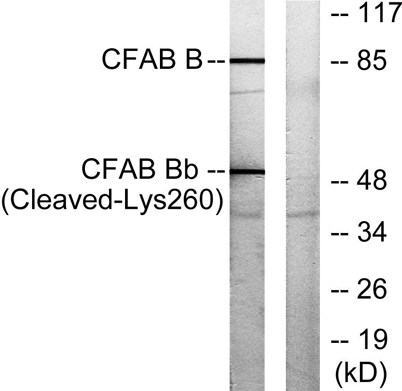
| Observed band (KD) | 57+85kD |
| Background | This gene encodes complement factor B, a component of the alternative pathway of complement activation. Factor B circulates in the blood as a single chain polypeptide. Upon activation of the alternative pathway, it is cleaved by complement factor D yielding the noncatalytic chain Ba and the catalytic subunit Bb. The active subunit Bb is a serine protease which associates with C3b to form the alternative pathway C3 convertase. Bb is involved in the proliferation of preactivated B lymphocytes, while Ba inhibits their proliferation. This gene localizes to the major histocompatibility complex (MHC) class III region on chromosome 6. This cluster includes several genes involved in regulation of the immune reaction. Polymorphisms in this gene are associated with a reduced risk of age-related macular degeneration. The polyadenylation site of this gene is 421 bp from the 5' end of the gene for complemen |
| Function | catalytic activity:Cleavage of Arg-|-Ser bond in complement component C3 alpha-chain to yield C3a and C3b, and Arg-|-Xaa bond in complement component C5 alpha-chain to yield C5a and C5b.,function:Factor B which is part of the alternate pathway of the complement system is cleaved by factor D into 2 fragments: Ba and Bb. Bb, a serine protease, then combines with complement factor 3b to generate the C3 or C5 convertase. It has also been implicated in proliferation and differentiation of preactivated B-lymphocytes, rapid spreading of peripheral blood monocytes, stimulation of lymphocyte blastogenesis and lysis of erythrocytes. Ba inhibits the proliferation of preactivated B-lymphocytes.,polymorphism:Two major variants, F and S, and 2 minor variants, as well as at least 14 very rare variants, have been identified. The variants His-9 and Gln-32 are associated with a reduced risk of age-related |
| Subcellular location | Secreted. |
| Expression | Blood,Colon,Liver,Plasma, |

Use collapsible tabs for more detailed information that will help customers make a purchasing decision.
Ex: Shipping and return policies, size guides, and other common questions.