 Français
 English

| ELK.No | ES7147 |
| Product name | Cadherin-23 rabbit pAb |
| Reactivity | Human;Mouse;Rat |
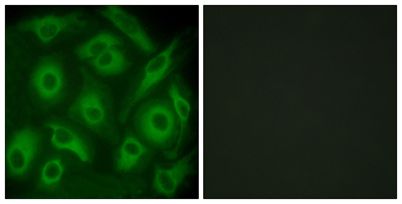
| Applications | IF;ELISA |
| Other name | CDH23; KIAA1774; KIAA1812; Cadherin-23; Otocadherin |
| Size | 50μL |
| Unit price ($) | 148 |
| Human gene ID | 64072 |
| Human Swiss-Prot | Q9H251 |
| Source | Rabbit |
| Isotype | IgG |
| Target | Cadherin-23 |
| Fields | |
| Gene name | CDH23 |
| Protein name | Cadherin-23 |
| Human gene link | View Human Gene |
| Human Swiss link | View Human Swiss-Prot |
| Mouse gene ID | 22295 |
| Mouse gene link | View Mouse Gene |
| Mouse Swiss-Prot | Q99PF4 |
| Mouse Swiss link | View Mouse Swiss-Prot |
| Rat gene ID | 114102 |
| Rat gene link | View Rat Gene |
| Rat Swiss-Prot | P58365 |
| Rat Swiss link | View Rat Swiss-Prot |
| Immunogen | The antiserum was produced against synthesized peptide derived from human CDH23. AA range:61-110 |
| Specificity | Cadherin-23 Polyclonal Antibody detects endogenous levels of Cadherin-23 protein. |
| Formulation | Liquid in PBS containing 50% glycerol, 0.5% BSA and 0.02% sodium azide. |
| Clonality | Polyclonal |
| Dilution | Immunofluorescence: 1/200 - 1/1000. ELISA: 1/10000. Not yet tested in other applications. |
| Purification | The antibody was affinity-purified from rabbit antiserum by affinity-chromatography using epitope-specific immunogen. |
| Concentration | 1 mg/ml |
| Storage stability | -20°C/1 year |
| Molecular Weight (Da) | 370kD |
| Observed band (KD) | |
| Background | This gene is a member of the cadherin superfamily, whose genes encode calcium dependent cell-cell adhesion glycoproteins. The encoded protein is thought to be involved in stereocilia organization and hair bundle formation. The gene is located in a region containing the human deafness loci DFNB12 and USH1D. Usher syndrome 1D and nonsyndromic autosomal recessive deafness DFNB12 are caused by allelic mutations of this cadherin-like gene. Upregulation of this gene may also be associated with breast cancer. Alternative splice variants encoding different isoforms have been described. [provided by RefSeq, May 2013], |
| Function | alternative products:Additional isoforms seem to exist,disease:Defects in CDH23 are a cause of Usher syndrome type 1D/F (USH1DF) [MIM:601067]. USH1DF patients are heterozygous for mutations in CDH23 and PCDH15, indicating a digenic inheritance pattern.,disease:Defects in CDH23 are the cause of non-syndromic sensorineural deafness autosomal recessive type 12 (DFNB12) [MIM:601386]. DFNB12 is a form of sensorineural hearing loss. Sensorineural deafness results from damage to the neural receptors of the inner ear, the nerve pathways to the brain, or the area of the brain that receives sound information.,disease:Defects in CDH23 are the cause of Usher syndrome type 1D (USH1D) [MIM:601067]. USH is a genetically heterogeneous condition characterized by the association of retinitis pigmentosa and sensorineural deafness. Age at onset and differences in auditory and vestibular function distinguish |
| Subcellular location | Cell membrane ; Single-pass type I membrane protein . |
| Expression | Particularly strong expression in the retina (PubMed:11138009). Found also in the cochlea. |

Use collapsible tabs for more detailed information that will help customers make a purchasing decision.
Ex: Shipping and return policies, size guides, and other common questions.