 Français
 English
BLM (phospho Thr99) rabbit pAb
AO-06-ES7149-100

| ELK.No | ES7149 |
| Product name | BLM (phospho Thr99) rabbit pAb |
| Reactivity | Human;Rat;Mouse; |
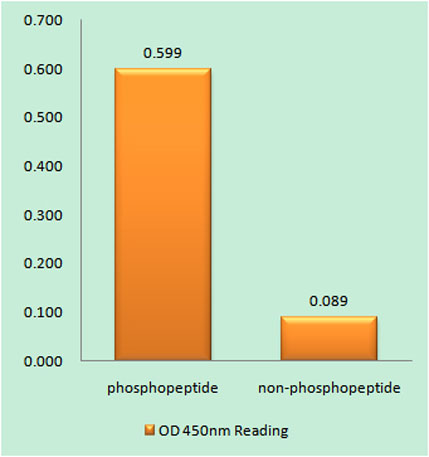
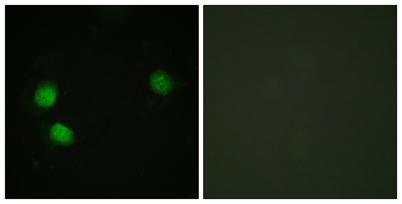
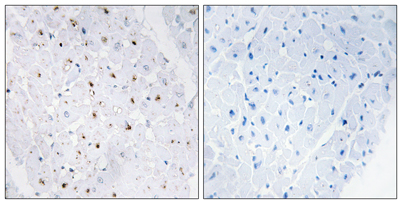
| Applications | WB;IHC;IF;ELISA |
| Other name | BLM; RECQ2; RECQL3; Bloom syndrome protein; DNA helicase; RecQ-like type 2; RecQ2; RecQ protein-like 3 |
| Size | 100μL |
| Unit price ($) | 248 |
| Human gene ID | 641 |
| Human Swiss-Prot | P54132 |
| Source | Rabbit |
| Isotype | IgG |
| Target | BLM |
| Fields | >>Homologous recombination;>>Fanconi anemia pathway |
| Gene name | BLM |
| Protein name | Bloom syndrome protein |
| Human gene link | View Human Gene |
| Human Swiss link | View Human Swiss-Prot |
| Mouse gene ID | |
| Mouse gene link | |
| Mouse Swiss-Prot | O88700 |
| Mouse Swiss link | View Mouse Swiss-Prot |
| Rat gene ID | |
| Rat gene link | |
| Rat Swiss-Prot | |
| Rat Swiss link | |
| Immunogen | The antiserum was produced against synthesized peptide derived from human Bloom Syndrome around the phosphorylation site of Thr99. AA range:65-114 |
| Specificity | Phospho-BLM (T99) Polyclonal Antibody detects endogenous levels of BLM protein only when phosphorylated at T99. |
| Formulation | Liquid in PBS containing 50% glycerol, 0.5% BSA and 0.02% sodium azide. |
| Clonality | Polyclonal |
| Dilution | Western Blot: 1/500 - 1/2000. Immunohistochemistry: 1/100 - 1/300. Immunofluorescence: 1/200 - 1/1000. ELISA: 1/5000. Not yet tested in other applications. |
| Purification | The antibody was affinity-purified from rabbit antiserum by affinity-chromatography using epitope-specific immunogen. |
| Concentration | 1 mg/ml |
| Storage stability | -20°C/1 year |
| Molecular Weight (Da) | |
| Observed band (KD) | 159kD |
| Background | The Bloom syndrome gene product is related to the RecQ subset of DExH box-containing DNA helicases and has both DNA-stimulated ATPase and ATP-dependent DNA helicase activities. Mutations causing Bloom syndrome delete or alter helicase motifs and may disable the 3'-5' helicase activity. The normal protein may act to suppress inappropriate recombination. [provided by RefSeq, Jul 2008], |
| Function | disease:Defects in BLM are the cause of Bloom syndrome (BLM) [MIM:210900]. BLM is an autosomal recessive disorder characterized by proportionate pre- and postnatal growth deficiency, sun-sensitive telangiectatic hypo- and hyperpigmented skin, predisposition to malignancy, and chromosomal instability.,function:Participates in DNA replication and repair. Exhibits a magnesium-dependent ATP-dependent DNA-helicase activity that unwinds single- and double-stranded DNA in a 3'-5' direction.,online information:BLM mutation db,PTM:Phosphorylated in response to DNA damage. Phosphorylation requires the FANCA-FANCC-FANCE-FANCF-FANCG protein complex, as well as the presence of RMI1.,similarity:Belongs to the helicase family. RecQ subfamily.,similarity:Contains 1 helicase ATP-binding domain.,similarity:Contains 1 helicase C-terminal domain.,similarity:Contains 1 HRDC domain.,subunit:Part of the BRCA1- |
| Subcellular location | Nucleus . Together with SPIDR, is redistributed in discrete nuclear DNA damage-induced foci following hydroxyurea (HU) or camptothecin (CPT) treatment. Accumulated at sites of DNA damage in a RMI complex- and SPIDR-dependent manner. |
| Expression | B-cell,Epithelium,Testis, |

Use collapsible tabs for more detailed information that will help customers make a purchasing decision.
Ex: Shipping and return policies, size guides, and other common questions.