 Français
 English
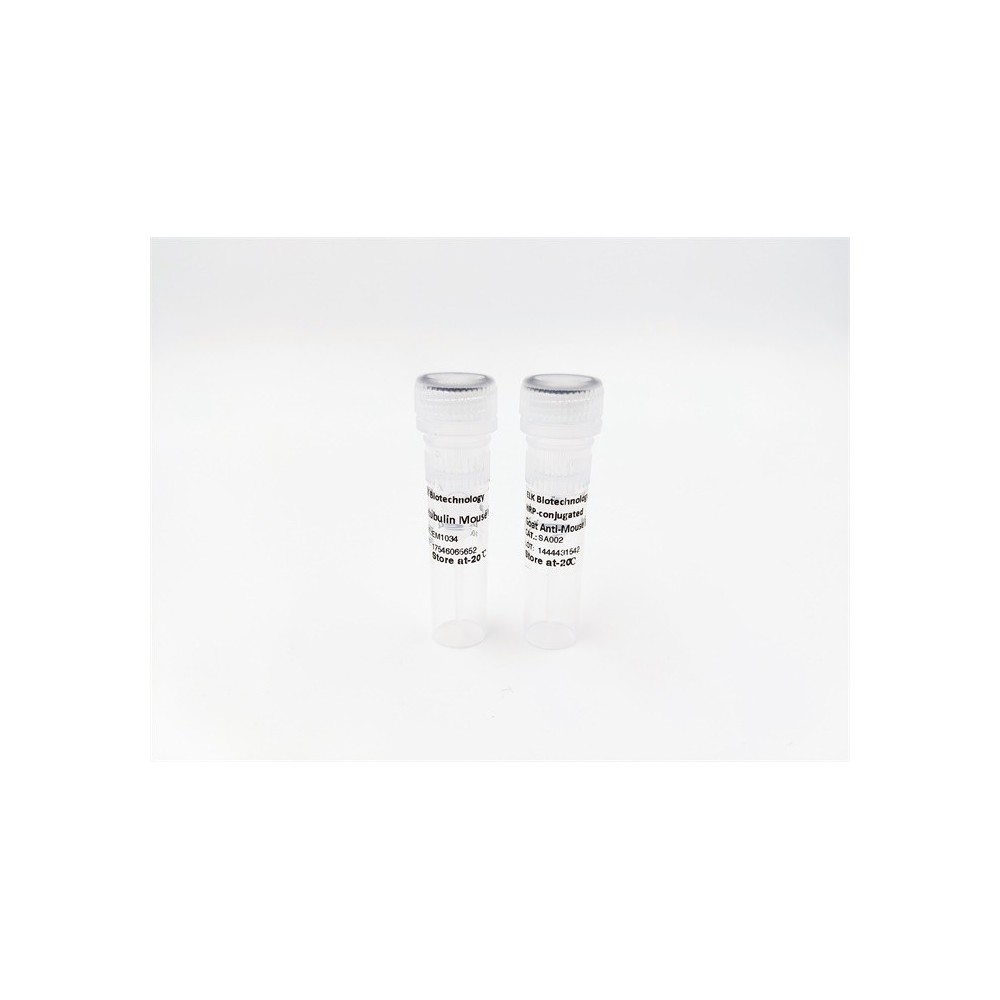
SGK1 (phospho Ser78) rabbit pAb
AO-06-ES7180-100

| ELK.No | ES7180 |
| Product name | SGK1 (phospho Ser78) rabbit pAb |
| Reactivity | Human;Mouse;Rat |
| Applications | WB;ELISA;IHC |
| Other name | SGK1; SGK; Serine/threonine-protein kinase Sgk1; Serum/glucocorticoid-regulated kinase 1 |
| Size | 100μL |
| Unit price ($) | 248 |
| Human gene ID | 6446 |
| Human Swiss-Prot | O00141 |
| Source | Rabbit |
| Isotype | IgG |
| Target | SGK1 |
| Fields | >>FoxO signaling pathway;>>mTOR signaling pathway;>>PI3K-Akt signaling pathway;>>Aldosterone-regulated sodium reabsorption |
| Gene name | SGK1 |
| Protein name | Serine/threonine-protein kinase Sgk1 |
| Human gene link | View Human Gene |
| Human Swiss link | View Human Swiss-Prot |
| Mouse gene ID | 20393 |
| Mouse gene link | View Mouse Gene |
| Mouse Swiss-Prot | Q9WVC6 |
| Mouse Swiss link | View Mouse Swiss-Prot |
| Rat gene ID | |
| Rat gene link | |
| Rat Swiss-Prot | Q06226 |
| Rat Swiss link | View Rat Swiss-Prot |
| Immunogen | The antiserum was produced against synthesized peptide derived from human SGK around the phosphorylation site of Ser78. AA range:41-90 |
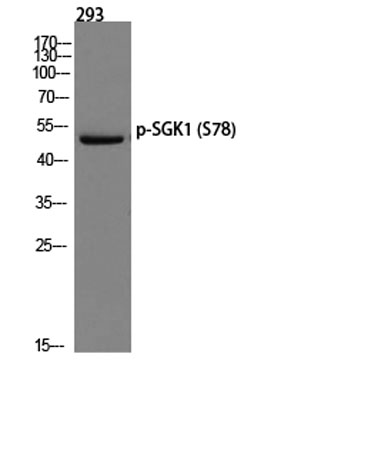
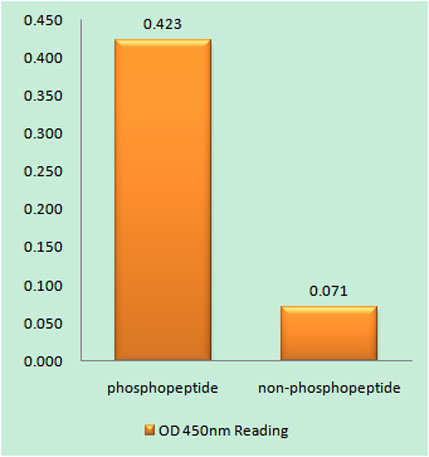
| Specificity | Phospho-SGK1 (S78) Polyclonal Antibody detects endogenous levels of SGK1 protein only when phosphorylated at S78. |
| Formulation | Liquid in PBS containing 50% glycerol, 0.5% BSA and 0.02% sodium azide. |
| Clonality | Polyclonal |
| Dilution | WB 1:500-2000;IHC-p 1:50-300; ELISA 2000-20000 |
| Purification | The antibody was affinity-purified from rabbit antiserum by affinity-chromatography using epitope-specific immunogen. |
| Concentration | 1 mg/ml |
| Storage stability | -20°C/1 year |
| Molecular Weight (Da) | |
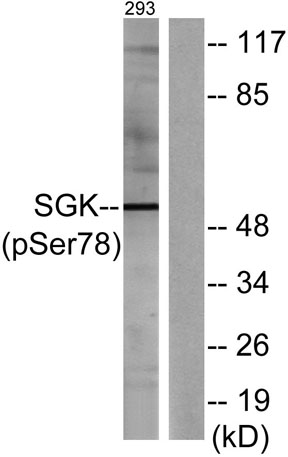
| Observed band (KD) | 54kD |
| Background | This gene encodes a serine/threonine protein kinase that plays an important role in cellular stress response. This kinase activates certain potassium, sodium, and chloride channels, suggesting an involvement in the regulation of processes such as cell survival, neuronal excitability, and renal sodium excretion. High levels of expression of this gene may contribute to conditions such as hypertension and diabetic nephropathy. Several alternatively spliced transcript variants encoding different isoforms have been noted for this gene. [provided by RefSeq, Jan 2009], |
| Function | catalytic activity:ATP + a protein = ADP + a phosphoprotein.,enzyme regulation:Two specific sites, one in the kinase domain (Thr-256) and the other in the C-terminal regulatory region (Ser-422), need to be phosphorylated for its full activation.,function:Protein kinase that plays an important role in cellular stress response. Activates certain potassium, sodium, and chloride channels, suggesting an involvement in the regulation of processes such as cell survival, neuronal excitability, and renal sodium excretion. Sustained high levels and activity may contribute to conditions such as hypertension and diabetic nephropathy. Mediates cell survival signals, phosphorylates and negatively regulates pro-apoptotic FOXO3A. Phosphorylates NEDD4L, which leads to its inactivation and to the subsequent activation of various channels and transporters such as ENaC, Kv1.3, or EAAT1.,induction:By serum a |
| Subcellular location | Cytoplasm. Nucleus. Endoplasmic reticulum membrane. Cell membrane. Mitochondrion. The subcellular localization is controlled by the cell cycle, as well as by exposure to specific hormones and environmental stress stimuli. In proliferating cells, it shuttles between the nucleus and cytoplasm in synchrony with the cell cycle, and in serum/growth factor-stimulated cells it resides in the nucleus. In contrast, after exposure to environmental stress or treatment with glucocorticoids, it is detected in the cytoplasm and with certain stress conditions is associated with the mitochondria. In osmoregulation through the epithelial sodium channel, it can be localized to the cytoplasmic surface of the cell membrane. Nuclear, upon phosphorylation.; [Isoform 2]: Cell membrane. |
| Expression | Expressed in most tissues with highest levels in the pancreas, followed by placenta, kidney and lung. Isoform 2 is strongly expressed in brain and pancreas, weaker in heart, placenta, lung, liver and skeletal muscle. |

Use collapsible tabs for more detailed information that will help customers make a purchasing decision.
Ex: Shipping and return policies, size guides, and other common questions.