 Français
 English
CD318 (phospho Tyr707) rabbit pAb
AO-06-ES7202-50

| ELK.No | ES7202 |
| Product name | CD318 (phospho Tyr707) rabbit pAb |
| Reactivity | Human;Mouse |
| Applications | WB;ELISA |
| Other name | CDCP1; TRASK; CUB domain-containing protein 1; Membrane glycoprotein gp140; Subtractive immunization M plus HEp3-associated 135 kDa protein; SIMA135; Transmembrane and associated with src kinases; CD antigen CD318 |
| Size | 50μL |
| Unit price ($) | 148 |
| Human gene ID | 64866 |
| Human Swiss-Prot | Q9H5V8 |
| Source | Rabbit |
| Isotype | IgG |
| Target | CDCP1 |
| Fields | |
| Gene name | CDCP1 |
| Protein name | CUB domain-containing protein 1 |
| Human gene link | View Human Gene |
| Human Swiss link | View Human Swiss-Prot |
| Mouse gene ID | 109332 |
| Mouse gene link | View Mouse Gene |
| Mouse Swiss-Prot | Q5U462 |
| Mouse Swiss link | View Mouse Swiss-Prot |
| Rat gene ID | |
| Rat gene link | |
| Rat Swiss-Prot | |
| Rat Swiss link | |
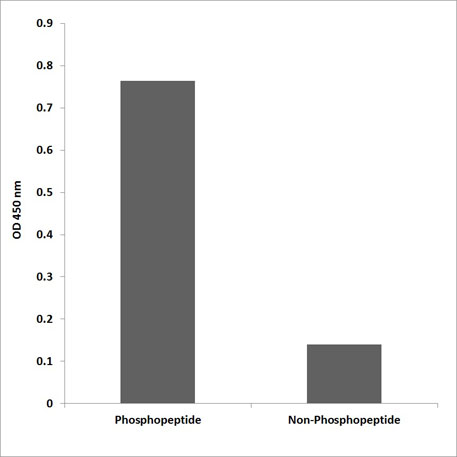
| Immunogen | Synthesized phospho-peptide around the phosphorylation site of human CD318 (phospho Tyr707) |
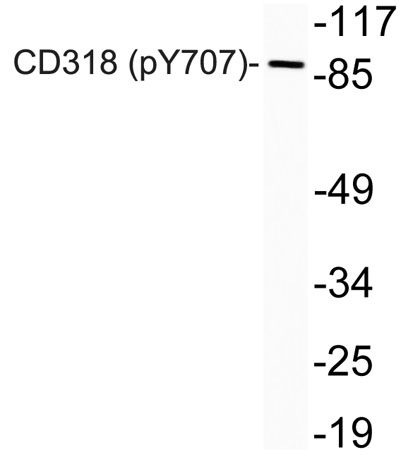
| Specificity | Phospho-CD318 (Y707) Polyclonal Antibody detects endogenous levels of CD318 protein only when phosphorylated at Y707. |
| Formulation | Liquid in PBS containing 50% glycerol, 0.5% BSA and 0.02% sodium azide. |
| Clonality | Polyclonal |
| Dilution | Western Blot: 1/500 - 1/2000. ELISA: 1/10000. Not yet tested in other applications. |
| Purification | The antibody was affinity-purified from rabbit antiserum by affinity-chromatography using epitope-specific immunogen. |
| Concentration | 1 mg/ml |
| Storage stability | -20°C/1 year |
| Molecular Weight (Da) | |
| Observed band (KD) | 140,80kD |
| Background | This gene encodes a transmembrane protein which contains three extracellular CUB domains and acts as a substrate for Src family kinases. The protein plays a role in the tyrosine phosphorylation-dependent regulation of cellular events that are involved in tumor invasion and metastasis. Alternative splicing results in multiple transcript variants of this gene. [provided by RefSeq, May 2013], |
| Function | function:May be involved in cell adhesion and cell matrix association. May play a role in the regulation of anchorage versus migration or proliferation versus differentiation via its phosphorylation. May be a novel marker for leukemia diagnosis and for immature hematopoietic stem cell subsets. Belongs to the tetraspanin web involved in tumor progression and metastasis.,PTM:A soluble form may also be produced by proteolytic cleavage at the cell surface (shedding). Another peptide of 80 kDa (p80) is present in cultured keratinocytes probably due to tryptic cleavage at an unidentified site on its N-terminal side. Converted to p80 by plasmin, a trypsin-like protease.,PTM:N-glycosylated.,PTM:Phosphorylated on tyrosine by kinases of the SRC family such as SRC and YES as well as by the protein kinase C gamma/PRKCG. Dephosphorylated by phosphotyrosine phosphatases. Also phosphorylated by suramin |
| Subcellular location | [Isoform 1]: Cell membrane ; Single-pass membrane protein . Shedding may also lead to a soluble peptide.; [Isoform 3]: Secreted. |
| Expression | Highly expressed in mitotic cells with low expression during interphase. Detected at highest levels in skeletal muscle and colon with lower levels in kidney, small intestine, placenta and lung. Up-regulated in a number of human tumor cell lines, as well as in colorectal cancer, breast carcinoma and lung cancer. Also expressed in cells with phenotypes reminiscent of mesenchymal stem cells and neural stem cells. |

Use collapsible tabs for more detailed information that will help customers make a purchasing decision.
Ex: Shipping and return policies, size guides, and other common questions.