 Français
 English

| ELK.No | ES7206 |
| Product name | Six1 rabbit pAb |
| Reactivity | Human;Mouse |
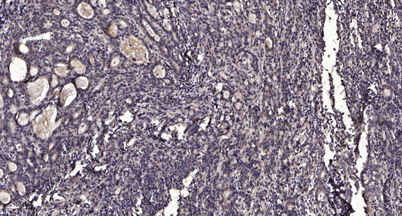
| Applications | WB;ELISA;IHC |
| Other name | SIX1; Homeobox protein SIX1; Sine oculis homeobox homolog 1 |
| Size | 100μL |
| Unit price ($) | 248 |
| Human gene ID | 6495 |
| Human Swiss-Prot | Q15475 |
| Source | Rabbit |
| Isotype | IgG |
| Target | Six1 |
| Fields | >>Transcriptional misregulation in cancer |
| Gene name | SIX1 |
| Protein name | Homeobox protein SIX1 |
| Human gene link | View Human Gene |
| Human Swiss link | View Human Swiss-Prot |
| Mouse gene ID | 20471 |
| Mouse gene link | View Mouse Gene |
| Mouse Swiss-Prot | Q62231 |
| Mouse Swiss link | View Mouse Swiss-Prot |
| Rat gene ID | |
| Rat gene link | |
| Rat Swiss-Prot | |
| Rat Swiss link | |
| Immunogen | The antiserum was produced against synthesized peptide derived from human SIX1. AA range:111-160 |
| Specificity | Six1 Polyclonal Antibody detects endogenous levels of Six1 protein. |
| Formulation | Liquid in PBS containing 50% glycerol, 0.5% BSA and 0.02% sodium azide. |
| Clonality | Polyclonal |
| Dilution | WB 1:500-2000;IHC-p 1:50-300; ELISA 2000-20000 |
| Purification | The antibody was affinity-purified from rabbit antiserum by affinity-chromatography using epitope-specific immunogen. |
| Concentration | 1 mg/ml |
| Storage stability | -20°C/1 year |
| Molecular Weight (Da) | |
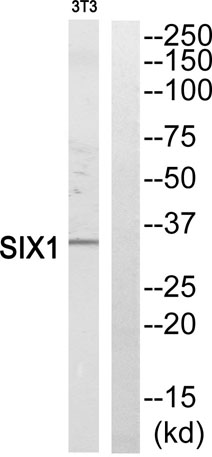
| Observed band (KD) | 33kD |
| Background | The protein encoded by this gene is a homeobox protein that is similar to the Drosophila 'sine oculis' gene product. This gene is found in a cluster of related genes on chromosome 14 and is thought to be involved in limb development. Defects in this gene are a cause of autosomal dominant deafness type 23 (DFNA23) and branchiootic syndrome type 3 (BOS3). [provided by RefSeq, Jul 2008], |
| Function | disease:Defects in SIX1 are the cause of autosomal dominant deafness type 23 (DFNA23) [MIM:605192].,disease:Defects in SIX1 are the cause of branchiootic syndrome type 3 (BOS3) [MIM:608389]. Urinary tract malformations constitute the most frequent cause of chronic renal failure in the first two decades of life. Branchio-oto-renal syndrome (BOR) is an autosomal dominant developmental disorder of kidney and urinary tract malformations with hearing loss. The major feature of BOR is hearing loss (93% of patients), which can be conductive, sensorineural, or both and varies in age of onset.,function:May be involved in limb tendon and ligament development.,similarity:Belongs to the SIX/Sine oculis homeobox family.,similarity:Contains 1 homeobox DNA-binding domain.,tissue specificity:Specifically expressed in skeletal muscle., |
| Subcellular location | Nucleus . Cytoplasm. |
| Expression | Specifically expressed in skeletal muscle. |

Use collapsible tabs for more detailed information that will help customers make a purchasing decision.
Ex: Shipping and return policies, size guides, and other common questions.