 Français
 English

| ELK.No | ES7234 |
| Product name | MCT8 rabbit pAb |
| Reactivity | Human;Mouse;Rat |
| Applications | WB;ELISA |
| Other name | SLC16A2; MCT8; XPCT; Monocarboxylate transporter 8; MCT 8; Monocarboxylate transporter 7; MCT 7; Solute carrier family 16 member 2; X-linked PEST-containing transporter |
| Size | 100μL |
| Unit price ($) | 248 |
| Human gene ID | 6567 |
| Human Swiss-Prot | P36021 |
| Source | Rabbit |
| Isotype | IgG |
| Target | MCT8 |
| Fields | >>Thyroid hormone signaling pathway |
| Gene name | SLC16A2 |
| Protein name | Monocarboxylate transporter 8 |
| Human gene link | View Human Gene |
| Human Swiss link | View Human Swiss-Prot |
| Mouse gene ID | 20502 |
| Mouse gene link | View Mouse Gene |
| Mouse Swiss-Prot | O70324 |
| Mouse Swiss link | View Mouse Swiss-Prot |
| Rat gene ID | 259248 |
| Rat gene link | View Rat Gene |
| Rat Swiss-Prot | Q8K1P8 |
| Rat Swiss link | View Rat Swiss-Prot |
| Immunogen | The antiserum was produced against synthesized peptide derived from human SLC16A2. AA range:112-161 |
| Specificity | MCT8 Polyclonal Antibody detects endogenous levels of MCT8 protein. |
| Formulation | Liquid in PBS containing 50% glycerol, 0.5% BSA and 0.02% sodium azide. |
| Clonality | Polyclonal |
| Dilution | Western Blot: 1/500 - 1/2000. ELISA: 1/40000. Not yet tested in other applications. |
| Purification | The antibody was affinity-purified from rabbit antiserum by affinity-chromatography using epitope-specific immunogen. |
| Concentration | 1 mg/ml |
| Storage stability | -20°C/1 year |
| Molecular Weight (Da) | |
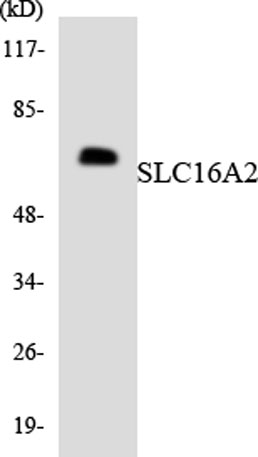
| Observed band (KD) | 60kD |
| Background | This gene encodes an integral membrane protein that functions as a transporter of thyroid hormone. The encoded protein facilitates the cellular importation of thyroxine (T4), triiodothyronine (T3), reverse triiodothyronine (rT3) and diidothyronine (T2). This gene is expressed in many tissues and likely plays an important role in the development of the central nervous system. Loss of function mutations in this gene are associated with psychomotor retardation in males while females exhibit no neurological defects and more moderate thyroid-deficient phenotypes. This gene is subject to X-chromosome inactivation. Mutations in this gene are the cause of Allan-Herndon-Dudley syndrome. [provided by RefSeq, Mar 2012], |
| Function | disease:Defects in SLC16A2 are the cause of monocarboxylate transporter 8 deficiency (MCT8 deficiency) [MIM:300523]. MCT8 deficiency consists of a severe form of X-linked psychomotor retardation combined with abnormal thyroid hormone (TH) levels. Thyroid hormone deficiency can be caused by defects of hormone synthesis and action, but it has also been linked to a defect in cellular hormone transport. Affected patients are males with abnormal relative concentrations of three circulating iodothyronines, as well as severe neurological abnormalities, including global developmental delay, central hypotonia, spastic quadriplegia, dystonic movements, rotary nystagmus, and impaired gaze and hearing. Heterozygous females had a milder thyroid phenotype and no neurological defects.,function:Very active and specific thyroid hormone transporter. Stimulates cellular uptake of thyroxine (T4), triiodothy |
| Subcellular location | Cell membrane ; Multi-pass membrane protein . |
| Expression | Highly expressed in liver and heart. |

Use collapsible tabs for more detailed information that will help customers make a purchasing decision.
Ex: Shipping and return policies, size guides, and other common questions.