 Français
 English
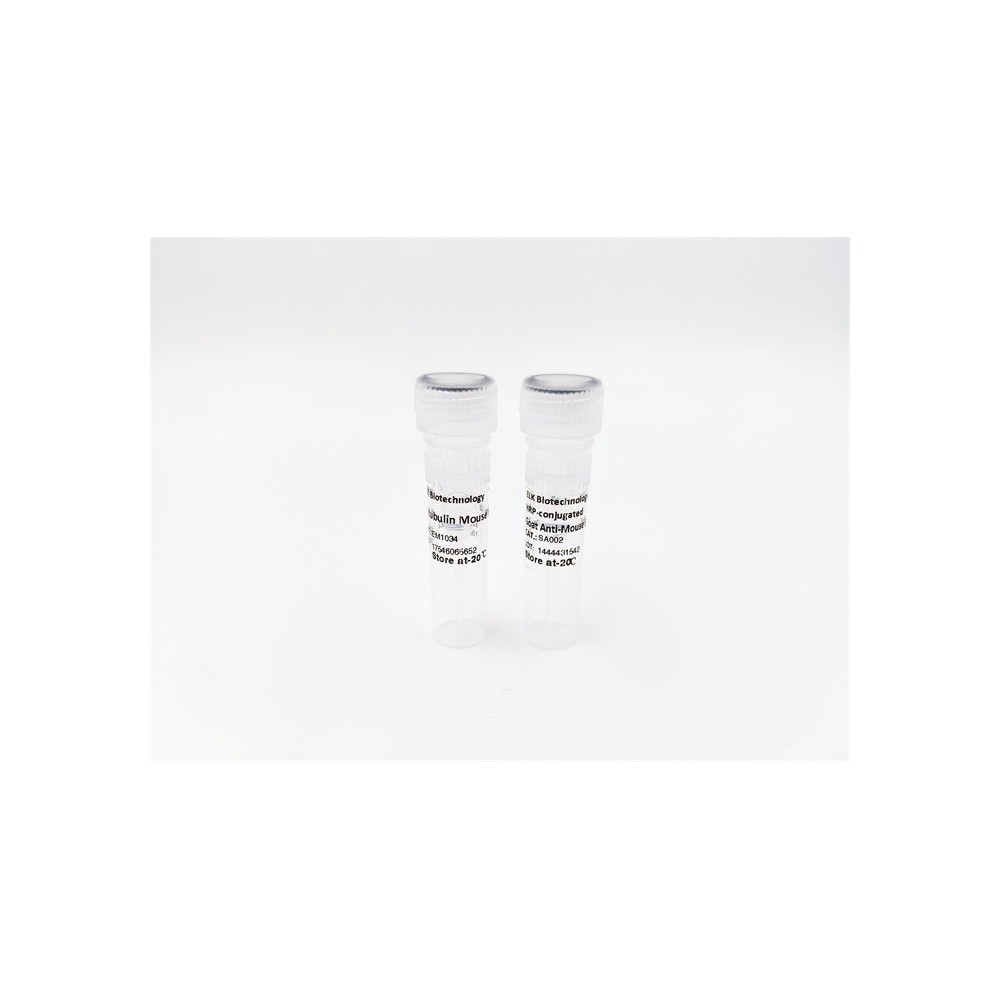

| ELK.No | ES7235 |
| Product name | OCTN2 rabbit pAb |
| Reactivity | Human;Rat;Mouse; |
| Applications | WB;ELISA |
| Other name | SLC22A5; OCTN2; Solute carrier family 22 member 5; High-affinity sodium-dependent carnitine cotransporter; Organic cation/carnitine transporter 2 |
| Size | 50μL |
| Unit price ($) | 148 |
| Human gene ID | 6584 |
| Human Swiss-Prot | O76082 |
| Source | Rabbit |
| Isotype | IgG |
| Target | OCTN2 |
| Fields | >>Choline metabolism in cancer |
| Gene name | SLC22A5 |
| Protein name | Solute carrier family 22 member 5 |
| Human gene link | View Human Gene |
| Human Swiss link | View Human Swiss-Prot |
| Mouse gene ID | |
| Mouse gene link | |
| Mouse Swiss-Prot | Q9Z0E8 |
| Mouse Swiss link | View Mouse Swiss-Prot |
| Rat gene ID | |
| Rat gene link | |
| Rat Swiss-Prot | |
| Rat Swiss link | |
| Immunogen | The antiserum was produced against synthesized peptide derived from human SLC22A5. AA range:300-349 |
| Specificity | OCTN2 Polyclonal Antibody detects endogenous levels of OCTN2 protein. |
| Formulation | Liquid in PBS containing 50% glycerol, 0.5% BSA and 0.02% sodium azide. |
| Clonality | Polyclonal |
| Dilution | Western Blot: 1/500 - 1/2000. ELISA: 1/20000. Not yet tested in other applications. |
| Purification | The antibody was affinity-purified from rabbit antiserum by affinity-chromatography using epitope-specific immunogen. |
| Concentration | 1 mg/ml |
| Storage stability | -20°C/1 year |
| Molecular Weight (Da) | |
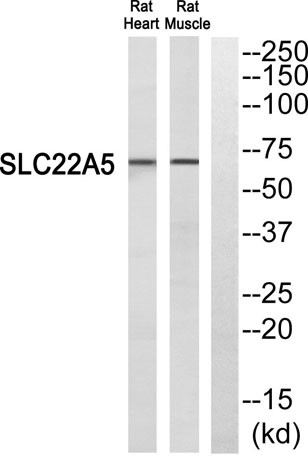
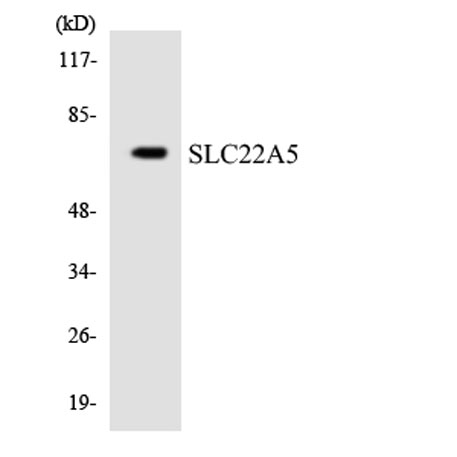
| Observed band (KD) | 65kD |
| Background | Polyspecific organic cation transporters in the liver, kidney, intestine, and other organs are critical for elimination of many endogenous small organic cations as well as a wide array of drugs and environmental toxins. The encoded protein is a plasma integral membrane protein which functions both as an organic cation transporter and as a sodium-dependent high affinity carnitine transporter. The encoded protein is involved in the active cellular uptake of carnitine. Mutations in this gene are the cause of systemic primary carnitine deficiency (CDSP), an autosomal recessive disorder manifested early in life by hypoketotic hypoglycemia and acute metabolic decompensation, and later in life by skeletal myopathy or cardiomyopathy. Alternative splicing of this gene results in multiple transcript variants. [provided by RefSeq, Apr 2015], |
| Function | disease:Defects in SLC22A5 are the cause of systemic primary carnitine deficiency (CDSP) [MIM:212140]. CDSP is an autosomal recessive disorder of fatty acid oxidation caused by defective carnitine transport. Present early in life with hypoketotic hypoglycemia and acute metabolic decompensation, or later in life with skeletal myopathy or cardiomyopathy.,disease:Defects in SLC22A5 may be a cause of susceptibility to Crohn disease (CD) [MIM:266600]. CD is a form of remitting inflammatory bowel disease (IBD). CD may involve any part of the gastrointestinal tract, but most frequently the terminal ileum and colon. Bowel inflammation is transmural and discontinuous. CD is commonly classified as an autoimmune disease.,function:Sodium-ion dependent, high affinity carnitine transporter. Involved in the active cellular uptake of carnitine. Transports one sodium ion with one molecule of carnitine. A |
| Subcellular location | Membrane ; Multi-pass membrane protein . |
| Expression | Strongly expressed in kidney, skeletal muscle, heart and placenta. Highly expressed in intestinal cell types affected by Crohn disease, including epithelial cells. Expressed in CD68 macrophage and CD43 T-cells but not in CD20 B-cells. |

Use collapsible tabs for more detailed information that will help customers make a purchasing decision.
Ex: Shipping and return policies, size guides, and other common questions.