 Français
 English
FoxL2 (phospho Ser263) rabbit pAb
AO-06-ES7261-50

| ELK.No | ES7261 |
| Product name | FoxL2 (phospho Ser263) rabbit pAb |
| Reactivity | Human;Mouse |
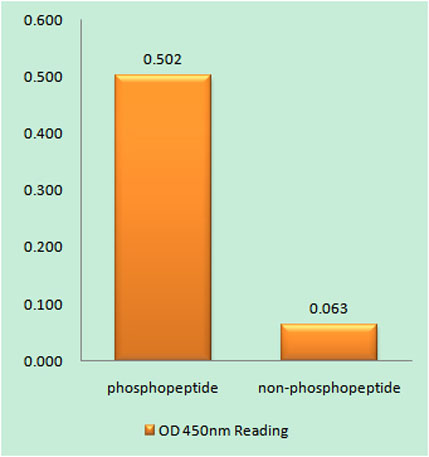
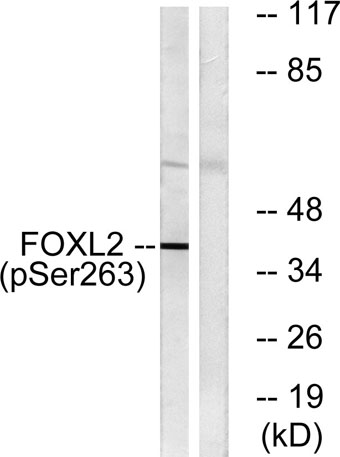
| Applications | WB;ELISA |
| Other name | FOXL2; Forkhead box protein L2 |
| Size | 50μL |
| Unit price ($) | 148 |
| Human gene ID | 668 |
| Human Swiss-Prot | P58012 |
| Source | Rabbit |
| Isotype | IgG |
| Target | FoxL2 |
| Fields | |
| Gene name | FOXL2 |
| Protein name | Forkhead box protein L2 |
| Human gene link | View Human Gene |
| Human Swiss link | View Human Swiss-Prot |
| Mouse gene ID | 26927 |
| Mouse gene link | View Mouse Gene |
| Mouse Swiss-Prot | O88470 |
| Mouse Swiss link | View Mouse Swiss-Prot |
| Rat gene ID | |
| Rat gene link | |
| Rat Swiss-Prot | |
| Rat Swiss link | |
| Immunogen | The antiserum was produced against synthesized peptide derived from human FOXL2 around the phosphorylation site of Ser263. AA range:229-278 |
| Specificity | Phospho-FoxL2 (S263) Polyclonal Antibody detects endogenous levels of FoxL2 protein only when phosphorylated at S263. |
| Formulation | Liquid in PBS containing 50% glycerol, 0.5% BSA and 0.02% sodium azide. |
| Clonality | Polyclonal |
| Dilution | Western Blot: 1/500 - 1/2000. ELISA: 1/20000. Not yet tested in other applications. |
| Purification | The antibody was affinity-purified from rabbit antiserum by affinity-chromatography using epitope-specific immunogen. |
| Concentration | 1 mg/ml |
| Storage stability | -20°C/1 year |
| Molecular Weight (Da) | |
| Observed band (KD) | 40kD |
| Background | This gene encodes a forkhead transcription factor. The protein contains a fork-head DNA-binding domain and may play a role in ovarian development and function. Expansion of a polyalanine repeat region and other mutations in this gene are a cause of blepharophimosis syndrome and premature ovarian failure 3. [provided by RefSeq, Jul 2016], |
| Function | disease:Defects in FOXL2 are a cause of blepharophimosis, ptosis, and epicanthus inversus syndrome (BPES) [MIM:110100]; also known as blepharophimosis syndrome. It is an autosomal dominant disorder characterized by eyelid dysplasia, small palpebral fissures, drooping eyelids and a skin fold running inward and upward from the lower lid. In type I BPSE (BPES1) eyelid abnormalities are associated with female infertility. Affected females show an ovarian deficit due to primary amenorrhea or to premature ovarian failure (POF). In type II BPSE (BPES2) affected individuals show only the eyelid defects. There is a mutational hotspot in the region coding for the poly-Ala domain, since 30% of all mutations in the ORF lead to poly-Ala expansions, resulting mainly in BPES type II.,disease:Defects in FOXL2 are a cause of premature ovarian failure 3 (POF3) [MIM:608996]. Premature ovarian failure (POF) |
| Subcellular location | Nucleus . |
| Expression | In addition to its expression in the developing eyelid, it is transcribed very early in somatic cells of the developing gonad (before sex determination) and its expression persists in the follicular cells of the adult ovary. |

Use collapsible tabs for more detailed information that will help customers make a purchasing decision.
Ex: Shipping and return policies, size guides, and other common questions.