 Français
 English

| ELK.No | ES7292 |
| Product name | SSTR4 rabbit pAb |
| Reactivity | Human;Mouse;Rat |
| Applications | WB;ELISA |
| Other name | SSTR4; Somatostatin receptor type 4; SS-4-R; SS4-R; SS4R |
| Size | 50μL |
| Unit price ($) | 148 |
| Human gene ID | 6754 |
| Human Swiss-Prot | P31391 |
| Source | Rabbit |
| Isotype | IgG |
| Target | SSTR4 |
| Fields | >>Neuroactive ligand-receptor interaction |
| Gene name | SSTR4 |
| Protein name | Somatostatin receptor type 4 |
| Human gene link | View Human Gene |
| Human Swiss link | View Human Swiss-Prot |
| Mouse gene ID | |
| Mouse gene link | |
| Mouse Swiss-Prot | P49660 |
| Mouse Swiss link | View Mouse Swiss-Prot |
| Rat gene ID | 25555 |
| Rat gene link | View Rat Gene |
| Rat Swiss-Prot | P30937 |
| Rat Swiss link | View Rat Swiss-Prot |
| Immunogen | The antiserum was produced against synthesized peptide derived from human SSTR4. AA range:155-204 |
| Specificity | SSTR4 Polyclonal Antibody detects endogenous levels of SSTR4 protein. |
| Formulation | Liquid in PBS containing 50% glycerol, 0.5% BSA and 0.02% sodium azide. |
| Clonality | Polyclonal |
| Dilution | Western Blot: 1/500 - 1/2000. ELISA: 1/20000. Not yet tested in other applications. |
| Purification | The antibody was affinity-purified from rabbit antiserum by affinity-chromatography using epitope-specific immunogen. |
| Concentration | 1 mg/ml |
| Storage stability | -20°C/1 year |
| Molecular Weight (Da) | |
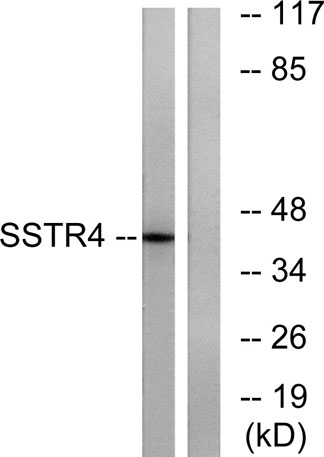
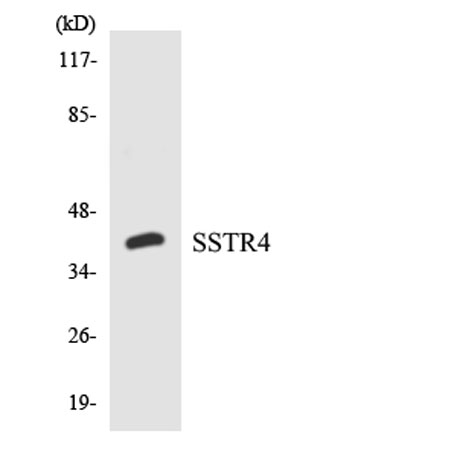
| Observed band (KD) | 42kD |
| Background | Somatostatin acts at many sites to inhibit the release of many hormones and other secretory proteins. The biologic effects of somatostatin are probably mediated by a family of G protein-coupled receptors that are expressed in a tissue-specific manner. SSTR4 is a member of the superfamily of receptors having seven transmembrane segments and is expressed in highest levels in fetal and adult brain and lung. [provided by RefSeq, Jul 2008], |
| Function | function:Receptor for somatostatin-14. The activity of this receptor is mediated by G proteins which inhibits adenylyl cyclase. It is functionally coupled not only to inhibition of adenylate cyclase, but also to activation of both arachidonate release and mitogen-activated protein (MAP) kinase cascade. Mediates antiproliferative action of somatostatin in tumor cells.,similarity:Belongs to the G-protein coupled receptor 1 family.,tissue specificity:Specifically expressed in fetal and adult brain, lung tissue, stomach, and in lesser quantities in the kidney, pituitary and adrenals., |
| Subcellular location | Cell membrane; Multi-pass membrane protein. |
| Expression | Specifically expressed in fetal and adult brain, lung tissue, stomach, and in lesser quantities in the kidney, pituitary and adrenals. |

Use collapsible tabs for more detailed information that will help customers make a purchasing decision.
Ex: Shipping and return policies, size guides, and other common questions.