 Français
 English
Unc18-1 (phospho Ser313) rabbit pAb
AO-06-ES7315-100

| ELK.No | ES7315 |
| Product name | Unc18-1 (phospho Ser313) rabbit pAb |
| Reactivity | Human;Mouse;Rat;Monkey |
| Applications | WB;ELISA |
| Other name | STXBP1; UNC18A; Syntaxin-binding protein 1; MUNC18-1; N-Sec1; Protein unc-18 homolog 1; Unc18-1; Protein unc-18 homolog A; Unc-18A; p67 |
| Size | 100μL |
| Unit price ($) | 248 |
| Human gene ID | 6812 |
| Human Swiss-Prot | P61764 |
| Source | Rabbit |
| Isotype | IgG |
| Target | Unc18-1 |
| Fields | >>Synaptic vesicle cycle |
| Gene name | STXBP1 |
| Protein name | Syntaxin-binding protein 1 |
| Human gene link | View Human Gene |
| Human Swiss link | View Human Swiss-Prot |
| Mouse gene ID | 20910 |
| Mouse gene link | View Mouse Gene |
| Mouse Swiss-Prot | O08599 |
| Mouse Swiss link | View Mouse Swiss-Prot |
| Rat gene ID | 25558 |
| Rat gene link | View Rat Gene |
| Rat Swiss-Prot | P61765 |
| Rat Swiss link | View Rat Swiss-Prot |
| Immunogen | The antiserum was produced against synthesized peptide derived from human MUNC-18a around the phosphorylation site of Ser313. AA range:279-328 |
| Specificity | Phospho-Unc18-1 (S313) Polyclonal Antibody detects endogenous levels of Unc18-1 protein only when phosphorylated at S313. |
| Formulation | Liquid in PBS containing 50% glycerol, 0.5% BSA and 0.02% sodium azide. |
| Clonality | Polyclonal |
| Dilution | Western Blot: 1/500 - 1/2000. ELISA: 1/5000. Not yet tested in other applications. |
| Purification | The antibody was affinity-purified from rabbit antiserum by affinity-chromatography using epitope-specific immunogen. |
| Concentration | 1 mg/ml |
| Storage stability | -20°C/1 year |
| Molecular Weight (Da) | |
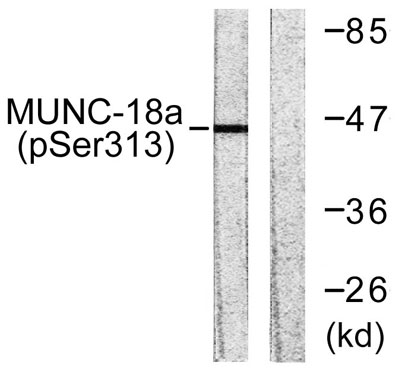
| Observed band (KD) | 65kD |
| Background | This gene encodes a syntaxin-binding protein. The encoded protein appears to play a role in release of neurotransmitters via regulation of syntaxin, a transmembrane attachment protein receptor. Mutations in this gene have been associated with infantile epileptic encephalopathy-4. Alternatively spliced transcript variants have been described. [provided by RefSeq, Feb 2010], |
| Function | disease:Defects in STXBP1 are the cause of early infantile epileptic encephalopathy type 4 (EIEE4) [MIM:612164]. Affected individuals have neonatal or infantile onset of seizures, suppression-burst pattern on EEG, profound mental retardation, and MRI evidence of hypomyelination.,function:May participate in the regulation of synaptic vesicle docking and fusion, possibly through interaction with GTP-binding proteins. Essential for neurotransmission and binds syntaxin, a component of the synaptic vesicle fusion machinery probably in a 1:1 ratio. Can interact with syntaxins 1, 2, and 3 but not syntaxin 4. May play a role in determining the specificity of intracellular fusion reactions.,similarity:Belongs to the STXBP/unc-18/SEC1 family.,subunit:Binds SYTL4 and STX1A.,tissue specificity:Brain and spinal cord. Highly enriched in axons., |
| Subcellular location | Cytoplasm, cytosol . Membrane; Peripheral membrane protein. |
| Expression | Brain and spinal cord. Highly enriched in axons. |

Use collapsible tabs for more detailed information that will help customers make a purchasing decision.
Ex: Shipping and return policies, size guides, and other common questions.