 Français
 English
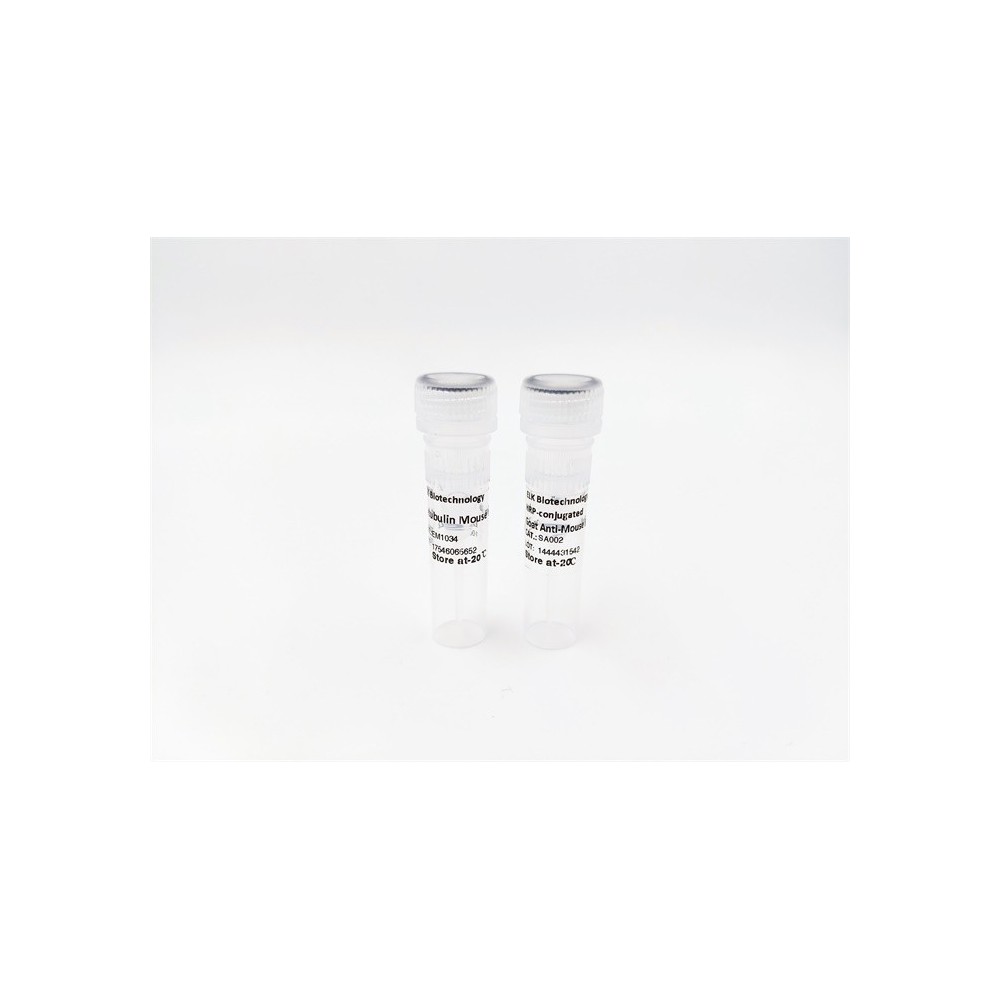

| ELK.No | ES7356 |
| Product name | BUB1 rabbit pAb |
| Reactivity | Human;Rat;Mouse; |
| Applications | WB;ELISA |
| Other name | BUB1; BUB1L; Mitotic checkpoint serine/threonine-protein kinase BUB1; hBUB1; BUB1A |
| Size | 50μL |
| Unit price ($) | 148 |
| Human gene ID | 699 |
| Human Swiss-Prot | O43683 |
| Source | Rabbit |
| Isotype | IgG |
| Target | BUB1 |
| Fields | >>Cell cycle;>>Oocyte meiosis;>>Progesterone-mediated oocyte maturation |
| Gene name | BUB1 |
| Protein name | Mitotic checkpoint serine/threonine-protein kinase BUB1 |
| Human gene link | View Human Gene |
| Human Swiss link | View Human Swiss-Prot |
| Mouse gene ID | |
| Mouse gene link | |
| Mouse Swiss-Prot | O08901 |
| Mouse Swiss link | View Mouse Swiss-Prot |
| Rat gene ID | |
| Rat gene link | |
| Rat Swiss-Prot | |
| Rat Swiss link | |
| Immunogen | The antiserum was produced against synthesized peptide derived from human BUB1. AA range:781-830 |
| Specificity | BUB1 Polyclonal Antibody detects endogenous levels of BUB1 protein. |
| Formulation | Liquid in PBS containing 50% glycerol, 0.5% BSA and 0.02% sodium azide. |
| Clonality | Polyclonal |
| Dilution | Western Blot: 1/500 - 1/2000. ELISA: 1/40000. Not yet tested in other applications. |
| Purification | The antibody was affinity-purified from rabbit antiserum by affinity-chromatography using epitope-specific immunogen. |
| Concentration | 1 mg/ml |
| Storage stability | -20°C/1 year |
| Molecular Weight (Da) | |
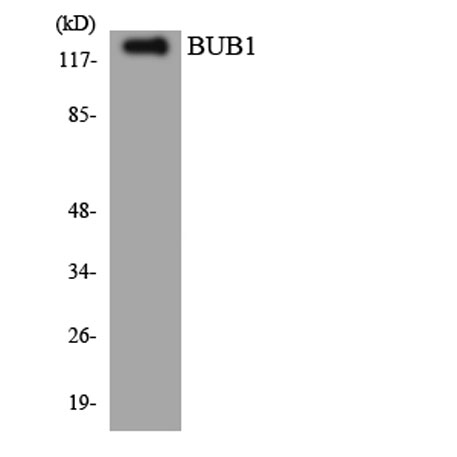
| Observed band (KD) | 120kD |
| Background | This gene encodes a serine/threonine-protein kinase that play a central role in mitosis. The encoded protein functions in part by phosphorylating members of the mitotic checkpoint complex and activating the spindle checkpoint. This protein also plays a role in inhibiting the activation of the anaphase promoting complex/cyclosome. This protein may also function in the DNA damage response. Mutations in this gene have been associated with aneuploidy and several forms of cancer. Alternate splicing results in multiple transcript variants. [provided by RefSeq, Jul 2013], |
| Function | catalytic activity:ATP + a protein = ADP + a phosphoprotein.,disease:Defects in BUB1 are associated with tumor formation.,domain:CD1 domain directs kinetochore localization and binding to BUB3.,enzyme regulation:Autophosphorylated when the cells enters mitosis.,function:Involved in cell cycle checkpoint enforcement. Can interact and phosphorylate BUB3.,induction:Inhibited by phorbol 12-myristate 13-acetate (PMA).,PTM:Phosphorylated upon DNA damage, probably by ATM or ATR.,similarity:Belongs to the protein kinase superfamily.,similarity:Belongs to the protein kinase superfamily. Ser/Thr protein kinase family. BUB1 subfamily.,similarity:Contains 1 CD1 domain.,similarity:Contains 1 protein kinase domain.,subcellular location:Nuclear in interphase cells. Kinetochore localization is required for normal mitotic timing and checkpoint response to spindle damage.,tissue specificity:High expressio |
| Subcellular location | Nucleus. Chromosome, centromere, kinetochore. Nuclear in interphase cells. Accumulates gradually during G1 and S phase of the cell cycle, peaks at G2/M, and drops dramatically after mitosis. Localizes to the outer kinetochore. Kinetochore localization is required for normal mitotic timing and checkpoint response to spindle damage and occurs very early in prophase. AURKB, KNL1 and INCENP are required for kinetochore localization (By similarity). . |
| Expression | High expression in testis and thymus, less in colon, spleen, lung and small intestine. Expressed in fetal thymus, bone marrow, heart, liver, spleen and thymus. Expression is associated with cells/tissues with a high mitotic index. |

Use collapsible tabs for more detailed information that will help customers make a purchasing decision.
Ex: Shipping and return policies, size guides, and other common questions.