 Français
 English
Wee1 (phospho Ser642) rabbit pAb
AO-06-ES7515-50

| ELK.No | ES7515 |
| Product name | Wee1 (phospho Ser642) rabbit pAb |
| Reactivity | Human;Mouse;Rat |
| Applications | WB;ELISA |
| Other name | WEE1; Wee1-like protein kinase; WEE1hu; Wee1A kinase |
| Size | 50μL |
| Unit price ($) | 148 |
| Human gene ID | 7465 |
| Human Swiss-Prot | P30291 |
| Source | Rabbit |
| Isotype | IgG |
| Target | WEE1 |
| Fields | >>Cell cycle;>>Human immunodeficiency virus 1 infection |
| Gene name | WEE1 |
| Protein name | Wee1-like protein kinase |
| Human gene link | View Human Gene |
| Human Swiss link | View Human Swiss-Prot |
| Mouse gene ID | 22390 |
| Mouse gene link | View Mouse Gene |
| Mouse Swiss-Prot | P47810 |
| Mouse Swiss link | View Mouse Swiss-Prot |
| Rat gene ID | 308937 |
| Rat gene link | View Rat Gene |
| Rat Swiss-Prot | Q63802 |
| Rat Swiss link | View Rat Swiss-Prot |
| Immunogen | The antiserum was produced against synthesized peptide derived from human WEE1 around the phosphorylation site of Ser642. AA range:597-646 |
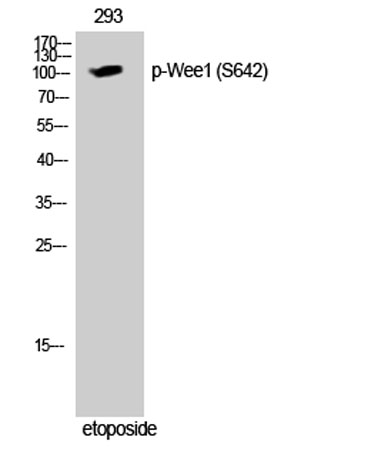
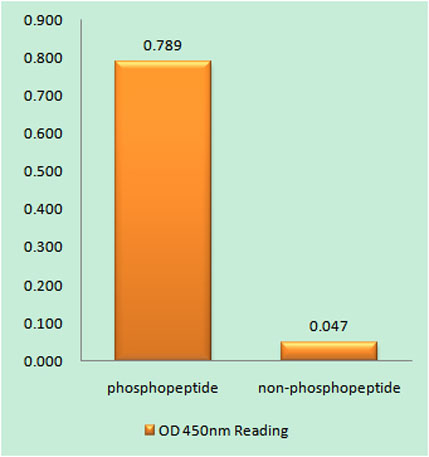
| Specificity | Phospho-Wee1 (S642) Polyclonal Antibody detects endogenous levels of Wee1 protein only when phosphorylated at S642. |
| Formulation | Liquid in PBS containing 50% glycerol, 0.5% BSA and 0.02% sodium azide. |
| Clonality | Polyclonal |
| Dilution | Western Blot: 1/500 - 1/2000. ELISA: 1/5000. Not yet tested in other applications. |
| Purification | The antibody was affinity-purified from rabbit antiserum by affinity-chromatography using epitope-specific immunogen. |
| Concentration | 1 mg/ml |
| Storage stability | -20°C/1 year |
| Molecular Weight (Da) | |
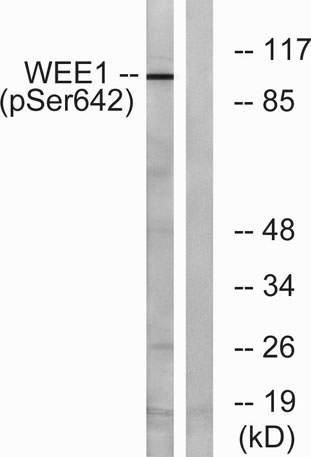
| Observed band (KD) | 100kD |
| Background | WEE1 G2 checkpoint kinase(WEE1) Homo sapiens This gene encodes a nuclear protein, which is a tyrosine kinase belonging to the Ser/Thr family of protein kinases. This protein catalyzes the inhibitory tyrosine phosphorylation of CDC2/cyclin B kinase, and appears to coordinate the transition between DNA replication and mitosis by protecting the nucleus from cytoplasmically activated CDC2 kinase. [provided by RefSeq, Jul 2008], |
| Function | catalytic activity:ATP + a [protein]-L-tyrosine = ADP + a [protein]-L-tyrosine phosphate.,cofactor:Binds 2 magnesium ions per subunit.,enzyme regulation:Synthesis is increased during S and G2 phases, presumably by an increase in transcription; activity is decreased by phosphorylation during m phase. Protein levels fall in M phase as a result of decreased synthesis combined with degradation. Activity seems to be negatively regulated by phosphorylation upon entry into mitosis, although N-terminal phosphorylation might also regulate the protein stability via protection from proteolysis or might regulate the subcellular location.,function:May act as a negative regulator of entry into mitosis (G2 to M transition) by protecting the nucleus from cytoplasmically activated cyclin B1-complexed CDC2 before the onset of mitosis. Its activity increases during S and G2 phases and decreases at M phase |
| Subcellular location | Nucleus. |
| Expression | Amygdala,Blood,Epithelium,Human uterus endothel primary cell culture,Placenta,Skin, |

Use collapsible tabs for more detailed information that will help customers make a purchasing decision.
Ex: Shipping and return policies, size guides, and other common questions.