 Français
 English

| ELK.No | ES7522 |
| Product name | 14-3-3 γ rabbit pAb |
| Reactivity | Human;Mouse;Rat |
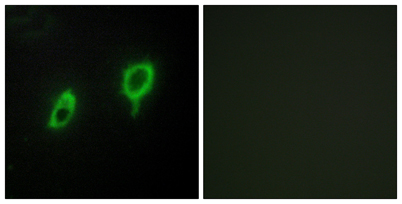
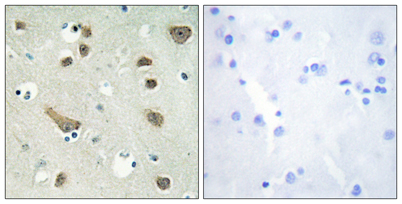
| Applications | WB;IHC;IF;ELISA |
| Other name | YWHAG; 14-3-3 protein gamma; Protein kinase C inhibitor protein 1; KCIP-1 |
| Size | 100μL |
| Unit price ($) | 248 |
| Human gene ID | 7532 |
| Human Swiss-Prot | P61981 |
| Source | Rabbit |
| Isotype | IgG |
| Target | 14-3-3 γ |
| Fields | >>Cell cycle;>>Oocyte meiosis;>>PI3K-Akt signaling pathway;>>Hippo signaling pathway;>>Hepatitis C;>>Viral carcinogenesis |
| Gene name | YWHAG |
| Protein name | 14-3-3 protein gamma |
| Human gene link | View Human Gene |
| Human Swiss link | View Human Swiss-Prot |
| Mouse gene ID | 22628 |
| Mouse gene link | View Mouse Gene |
| Mouse Swiss-Prot | P61982 |
| Mouse Swiss link | View Mouse Swiss-Prot |
| Rat gene ID | 56010 |
| Rat gene link | View Rat Gene |
| Rat Swiss-Prot | P61983 |
| Rat Swiss link | View Rat Swiss-Prot |
| Immunogen | The antiserum was produced against synthesized peptide derived from human 14-3-3 gamma. AA range:51-100 |
| Specificity | 14-3-3 γ Polyclonal Antibody detects endogenous levels of 14-3-3 γ protein. |
| Formulation | Liquid in PBS containing 50% glycerol, 0.5% BSA and 0.02% sodium azide. |
| Clonality | Polyclonal |
| Dilution | Western Blot: 1/500 - 1/2000. Immunohistochemistry: 1/100 - 1/300. Immunofluorescence: 1/200 - 1/1000. ELISA: 1/10000. Not yet tested in other applications. |
| Purification | The antibody was affinity-purified from rabbit antiserum by affinity-chromatography using epitope-specific immunogen. |
| Concentration | 1 mg/ml |
| Storage stability | -20°C/1 year |
| Molecular Weight (Da) | |
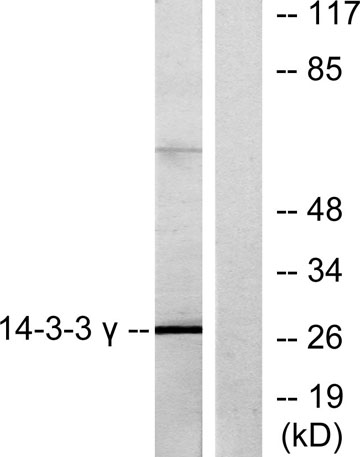
| Observed band (KD) | 28kD |
| Background | This gene product belongs to the 14-3-3 family of proteins which mediate signal transduction by binding to phosphoserine-containing proteins. This highly conserved protein family is found in both plants and mammals, and this protein is 100% identical to the rat ortholog. It is induced by growth factors in human vascular smooth muscle cells, and is also highly expressed in skeletal and heart muscles, suggesting an important role for this protein in muscle tissue. It has been shown to interact with RAF1 and protein kinase C, proteins involved in various signal transduction pathways. [provided by RefSeq, Jul 2008], |
| Function | function:Adapter protein implicated in the regulation of a large spectrum of both general and specialized signaling pathway. Binds to a large number of partners, usually by recognition of a phosphoserine or phosphothreonine motif. Binding generally results in the modulation of the activity of the binding partner.,PTM:Phosphorylated by various PKC isozymes.,similarity:Belongs to the 14-3-3 family.,subunit:Homodimer. Interacts with RAF1, SSH1 and CRTC2/TORC2. Interacts with ABL1 (phosphorylated form); the interaction retains it in the cytoplasm.,tissue specificity:Highly expressed in brain, skeletal muscle, and heart., |
| Subcellular location | Cytoplasm . |
| Expression | Highly expressed in brain, skeletal muscle, and heart. |

Use collapsible tabs for more detailed information that will help customers make a purchasing decision.
Ex: Shipping and return policies, size guides, and other common questions.