 Français
 English

| ELK.No | ES7523 |
| Product name | 14-3-3 η rabbit pAb |
| Reactivity | Human;Mouse;Rat |
| Applications | WB;IHC;IF;ELISA |
| Other name | YWHAH; YWHA1; 14-3-3 protein eta; Protein AS1 |
| Size | 100μL |
| Unit price ($) | 248 |
| Human gene ID | 7533 |
| Human Swiss-Prot | Q04917 |
| Source | Rabbit |
| Isotype | IgG |
| Target | 14-3-3 η |
| Fields | >>Cell cycle;>>Oocyte meiosis;>>PI3K-Akt signaling pathway;>>Hippo signaling pathway;>>Hepatitis C;>>Viral carcinogenesis |
| Gene name | YWHAH |
| Protein name | 14-3-3 protein eta |
| Human gene link | View Human Gene |
| Human Swiss link | View Human Swiss-Prot |
| Mouse gene ID | 22629 |
| Mouse gene link | View Mouse Gene |
| Mouse Swiss-Prot | P68510 |
| Mouse Swiss link | View Mouse Swiss-Prot |
| Rat gene ID | 25576 |
| Rat gene link | View Rat Gene |
| Rat Swiss-Prot | P68511 |
| Rat Swiss link | View Rat Swiss-Prot |
| Immunogen | The antiserum was produced against synthesized peptide derived from human 14-3-3 eta. AA range:51-100 |
| Specificity | 14-3-3 η Polyclonal Antibody detects endogenous levels of 14-3-3 η protein. |
| Formulation | Liquid in PBS containing 50% glycerol, 0.5% BSA and 0.02% sodium azide. |
| Clonality | Polyclonal |
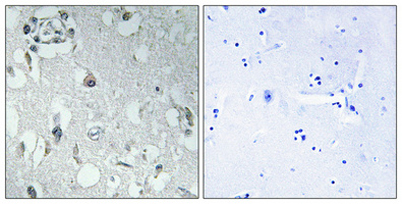
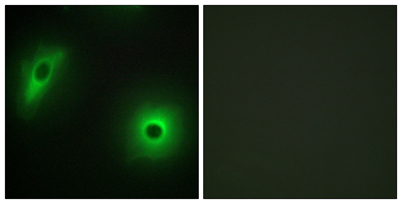
| Dilution | Western Blot: 1/500 - 1/2000. Immunohistochemistry: 1/100 - 1/300. Immunofluorescence: 1/200 - 1/1000. ELISA: 1/5000. Not yet tested in other applications. |
| Purification | The antibody was affinity-purified from rabbit antiserum by affinity-chromatography using epitope-specific immunogen. |
| Concentration | 1 mg/ml |
| Storage stability | -20°C/1 year |
| Molecular Weight (Da) | |
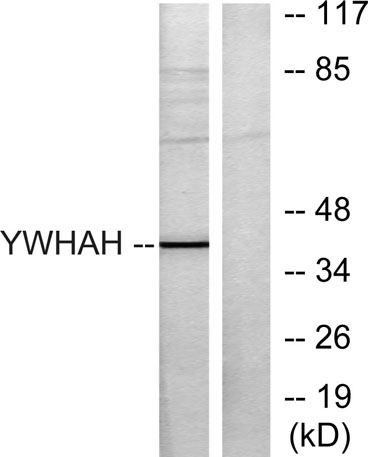
| Observed band (KD) | 42kD |
| Background | This gene product belongs to the 14-3-3 family of proteins which mediate signal transduction by binding to phosphoserine-containing proteins. This highly conserved protein family is found in both plants and mammals, and this protein is 99% identical to the mouse, rat and bovine orthologs. This gene contains a 7 bp repeat sequence in its 5' UTR, and changes in the number of this repeat have been associated with early-onset schizophrenia and psychotic bipolar disorder. [provided by RefSeq, Jun 2009], |
| Function | function:Adapter protein implicated in the regulation of a large spectrum of both general and specialized signaling pathway. Binds to a large number of partners, usually by recognition of a phosphoserine or phosphothreonine motif. Binding generally results in the modulation of the activity of the binding partner.,similarity:Belongs to the 14-3-3 family.,subunit:Homodimer (By similarity). Interacts with many nuclear hormone receptors and cofactors including AR, ESR1, ESR2, MC2R, NR3C1, NRIP1, PPARBP and THRA. Interacts with ABL1 (phosphorylated form); the interaction retains it in the cytoplasm. Interacts with RGNEF and PCTK1 (By similarity). Weakly interacts with CDKN1B.,tissue specificity:Expressed mainly in the brain and present in other tissues albeit at lower levels., |
| Subcellular location | cytoplasm,mitochondrion,cytosol,plasma membrane,intercalated disc,cytoplasmic vesicle membrane,extracellular exosome, |
| Expression | Expressed mainly in the brain and present in other tissues albeit at lower levels. |

Use collapsible tabs for more detailed information that will help customers make a purchasing decision.
Ex: Shipping and return policies, size guides, and other common questions.