 Français
 English

| ELK.No | ES7525 |
| Product name | 14-3-3 ζ/δ rabbit pAb |
| Reactivity | Human;Mouse;Rat |
| Applications | WB;IHC;IF;ELISA |
| Other name | YWHAZ; 14-3-3 protein zeta/delta; Protein kinase C inhibitor protein 1; KCIP-1 |
| Size | 50μL |
| Unit price ($) | 148 |
| Human gene ID | 7534 |
| Human Swiss-Prot | P63104 |
| Source | Rabbit |
| Isotype | IgG |
| Target | 14-3-3 ζ/δ |
| Fields | >>Cell cycle;>>Oocyte meiosis;>>PI3K-Akt signaling pathway;>>Hippo signaling pathway;>>Hepatitis C;>>Hepatitis B;>>Viral carcinogenesis |
| Gene name | YWHAZ |
| Protein name | 14-3-3 protein zeta/delta |
| Human gene link | View Human Gene |
| Human Swiss link | View Human Swiss-Prot |
| Mouse gene ID | 22631 |
| Mouse gene link | View Mouse Gene |
| Mouse Swiss-Prot | P63101 |
| Mouse Swiss link | View Mouse Swiss-Prot |
| Rat gene ID | 25578 |
| Rat gene link | View Rat Gene |
| Rat Swiss-Prot | P63102 |
| Rat Swiss link | View Rat Swiss-Prot |
| Immunogen | The antiserum was produced against synthesized peptide derived from human 14-3-3 zeta/delta. AA range:196-245 |
| Specificity | 14-3-3 ζ/δ Polyclonal Antibody detects endogenous levels of 14-3-3 ζ/δ protein. |
| Formulation | Liquid in PBS containing 50% glycerol, 0.5% BSA and 0.02% sodium azide. |
| Clonality | Polyclonal |
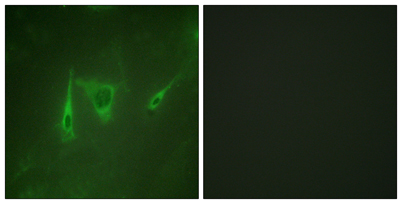
| Dilution | Western Blot: 1/500 - 1/2000. Immunohistochemistry: 1/100 - 1/300. Immunofluorescence: 1/200 - 1/1000. ELISA: 1/10000. Not yet tested in other applications. |
| Purification | The antibody was affinity-purified from rabbit antiserum by affinity-chromatography using epitope-specific immunogen. |
| Concentration | 1 mg/ml |
| Storage stability | -20°C/1 year |
| Molecular Weight (Da) | |
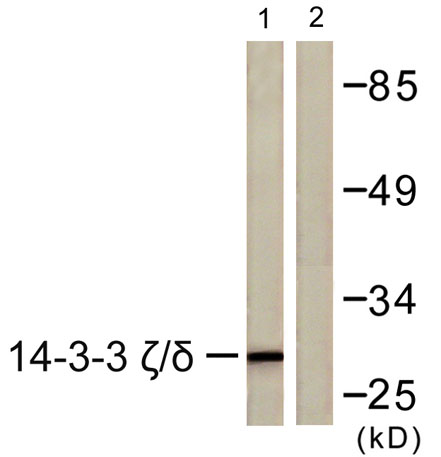
| Observed band (KD) | 28kD |
| Background | This gene product belongs to the 14-3-3 family of proteins which mediate signal transduction by binding to phosphoserine-containing proteins. This highly conserved protein family is found in both plants and mammals, and this protein is 99% identical to the mouse, rat and sheep orthologs. The encoded protein interacts with IRS1 protein, suggesting a role in regulating insulin sensitivity. Several transcript variants that differ in the 5' UTR but that encode the same protein have been identified for this gene. [provided by RefSeq, Oct 2008], |
| Function | caution:Was originally (PubMed:1577711) thought to have phospholipase A2 activity.,function:Adapter protein implicated in the regulation of a large spectrum of both general and specialized signaling pathway. Binds to a large number of partners, usually by recognition of a phosphoserine or phosphothreonine motif. Binding generally results in the modulation of the activity of the binding partner.,PTM:The delta, brain-specific form differs from the zeta form in being phosphorylated (By similarity). Phosphorylation on Ser-184 by MAPK8; promotes dissociation of BAX and translocation of BAX to mitochondria. Phosphorylation on Ser-58 by PKA; disrupts homodimerization and heterodimerization with YHAE and TP53. This phosphorylation appears to be activated by sphingosine. Phosphorylation on Thr-232; inhibits binding of RAF1.,similarity:Belongs to the 14-3-3 family.,subcellular location:Located to |
| Subcellular location | Cytoplasm . Melanosome . Located to stage I to stage IV melanosomes. |
| Expression | B-cell lymphoma,Bone marrow |


Use collapsible tabs for more detailed information that will help customers make a purchasing decision.
Ex: Shipping and return policies, size guides, and other common questions.