 Français
 English

| ELK.No | ES7620 |
| Product name | FGF-23 rabbit pAb |
| Reactivity | Human;Mouse;Rat |
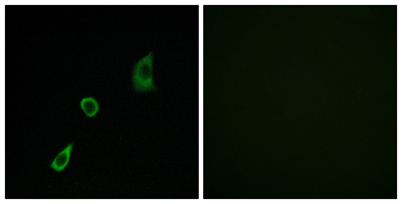
| Applications | WB;IF;ELISA |
| Other name | FGF23; HYPF; Fibroblast growth factor 23; FGF-23; Phosphatonin; Tumor-derived hypophosphatemia-inducing factor |
| Size | 50μL |
| Unit price ($) | 148 |
| Human gene ID | 8074 |
| Human Swiss-Prot | Q9GZV9 |
| Source | Rabbit |
| Isotype | IgG |
| Target | FGF-23 |
| Fields | >>MAPK signaling pathway;>>Ras signaling pathway;>>Rap1 signaling pathway;>>Calcium signaling pathway;>>PI3K-Akt signaling pathway;>>Regulation of actin cytoskeleton;>>Parathyroid hormone synthesis, secretion and action;>>Pathways in cancer;>>Melanoma;>>Breast cancer;>>Gastric cancer |
| Gene name | FGF23 |
| Protein name | Fibroblast growth factor 23 |
| Human gene link | View Human Gene |
| Human Swiss link | View Human Swiss-Prot |
| Mouse gene ID | 64654 |
| Mouse gene link | View Mouse Gene |
| Mouse Swiss-Prot | Q9EPC2 |
| Mouse Swiss link | View Mouse Swiss-Prot |
| Rat gene ID | 170583 |
| Rat gene link | View Rat Gene |
| Rat Swiss-Prot | Q8VI82 |
| Rat Swiss link | View Rat Swiss-Prot |
| Immunogen | The antiserum was produced against synthesized peptide derived from human FGF23. AA range:151-200 |
| Specificity | FGF-23 Polyclonal Antibody detects endogenous levels of FGF-23 protein. |
| Formulation | Liquid in PBS containing 50% glycerol, 0.5% BSA and 0.02% sodium azide. |
| Clonality | Polyclonal |
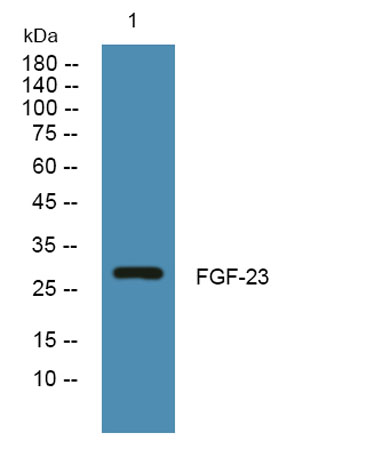
| Dilution | Western Blot: 1/500 - 1/2000. IHC-p: 1:100-300 ELISA: 1/20000. IF 1:100-300 Not yet tested in other applications. |
| Purification | The antibody was affinity-purified from rabbit antiserum by affinity-chromatography using epitope-specific immunogen. |
| Concentration | 1 mg/ml |
| Storage stability | -20°C/1 year |
| Molecular Weight (Da) | |
| Observed band (KD) | 27kD |
| Background | This gene encodes a member of the fibroblast growth factor family of proteins, which possess broad mitogenic and cell survival activities and are involved in a variety of biological processes. The product of this gene regulates phosphate homeostasis and transport in the kidney. The full-length, functional protein may be deactivated via cleavage into N-terminal and C-terminal chains. Mutation of this cleavage site causes autosomal dominant hypophosphatemic rickets (ADHR). Mutations in this gene are also associated with hyperphosphatemic familial tumoral calcinosis (HFTC). [provided by RefSeq, Feb 2013], |
| Function | disease:Defects in FGF23 are a cause of hyperphosphatemic familial tumoral calcinosis (HFTC) [MIM:211900]. HFTC is a severe autosomal recessive metabolic disorder that manifests with hyperphosphatemia and massive calcium deposits in the skin and subcutaneous tissues.,disease:Defects in FGF23 are the cause of autosomal dominant hypophosphataemic rickets (ADHR) [MIM:193100]. ADHR is characterized by low serum phosphorus concentrations, rickets, osteomalacia, leg deformities, short stature, bone pain and dental abscesses.,PTM:After secretion it is processed into a N-terminal fragment and a C-terminal fragment. The processing is effected by the proprotein convertases.,similarity:Belongs to the heparin-binding growth factors family., |
| Subcellular location | Secreted . Secretion is dependent on O-glycosylation. |
| Expression | Expressed in osteogenic cells particularly during phases of active bone remodeling. In adult trabecular bone, expressed in osteocytes and flattened bone-lining cells (inactive osteoblasts). |


Use collapsible tabs for more detailed information that will help customers make a purchasing decision.
Ex: Shipping and return policies, size guides, and other common questions.