 Français
 English
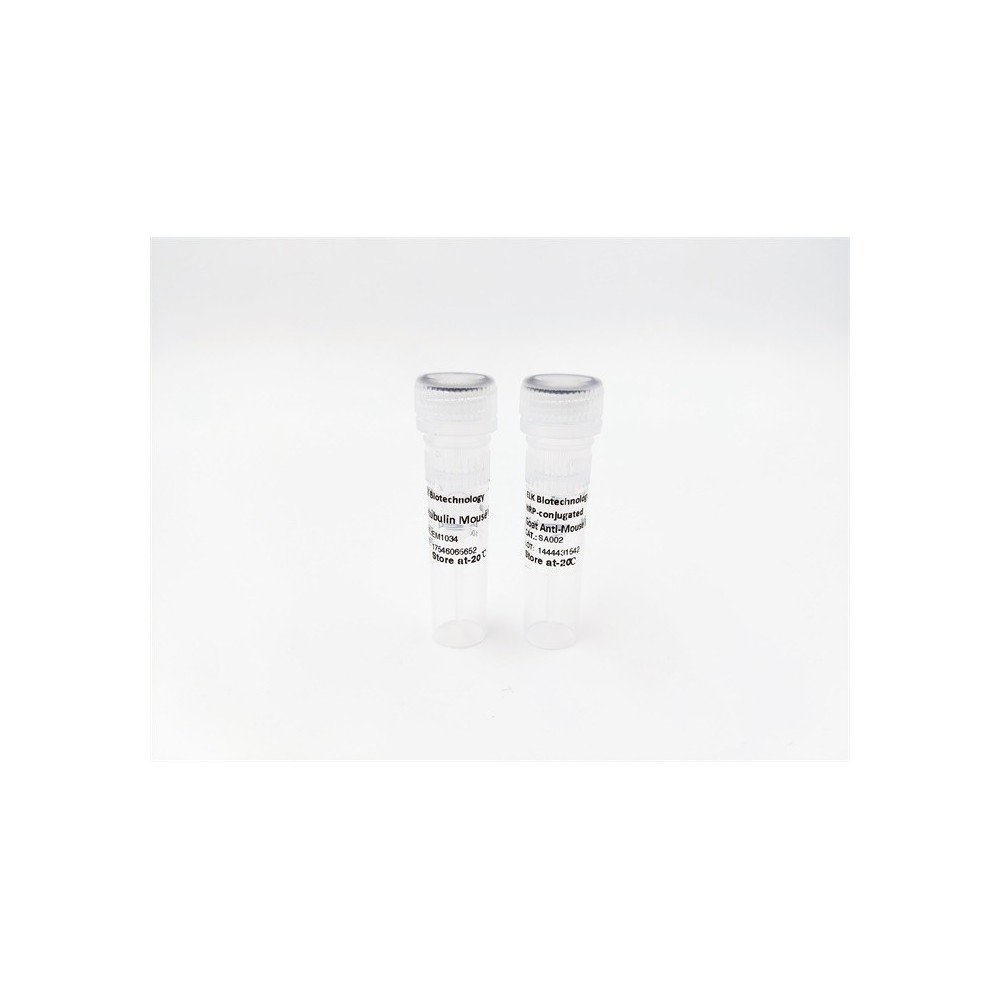

| ELK.No | ES7668 |
| Product name | Frizzled-6 rabbit pAb |
| Reactivity | Human;Rat;Mouse; |
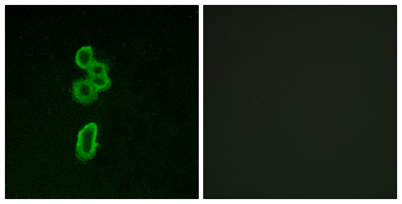
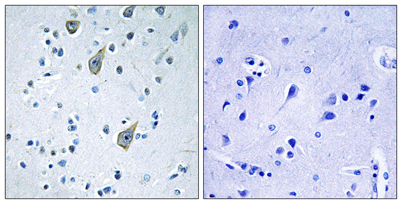
| Applications | WB;IHC;IF;ELISA |
| Other name | FZD6; Frizzled-6; Fz-6; hFz6 |
| Size | 50μL |
| Unit price ($) | 148 |
| Human gene ID | 8323 |
| Human Swiss-Prot | O60353 |
| Source | Rabbit |
| Isotype | IgG |
| Target | Frizzled-6 |
| Fields | >>mTOR signaling pathway;>>Wnt signaling pathway;>>Hippo signaling pathway;>>Signaling pathways regulating pluripotency of stem cells;>>Melanogenesis;>>Cushing syndrome;>>Alzheimer disease;>>Pathways of neurodegeneration - multiple diseases;>>Human papillomavirus infection;>>Pathways in cancer;>>Proteoglycans in cancer;>>Basal cell carcinoma;>>Breast cancer;>>Hepatocellular carcinoma;>>Gastric cancer |
| Gene name | FZD6 |
| Protein name | Frizzled-6 |
| Human gene link | View Human Gene |
| Human Swiss link | View Human Swiss-Prot |
| Mouse gene ID | |
| Mouse gene link | |
| Mouse Swiss-Prot | Q61089 |
| Mouse Swiss link | View Mouse Swiss-Prot |
| Rat gene ID | |
| Rat gene link | |
| Rat Swiss-Prot | |
| Rat Swiss link | |
| Immunogen | The antiserum was produced against synthesized peptide derived from human FZD6. AA range:116-165 |
| Specificity | Frizzled-6 Polyclonal Antibody detects endogenous levels of Frizzled-6 protein. |
| Formulation | Liquid in PBS containing 50% glycerol, 0.5% BSA and 0.02% sodium azide. |
| Clonality | Polyclonal |
| Dilution | Western Blot: 1/500 - 1/2000. Immunohistochemistry: 1/100 - 1/300. Immunofluorescence: 1/200 - 1/1000. ELISA: 1/5000. Not yet tested in other applications. |
| Purification | The antibody was affinity-purified from rabbit antiserum by affinity-chromatography using epitope-specific immunogen. |
| Concentration | 1 mg/ml |
| Storage stability | -20°C/1 year |
| Molecular Weight (Da) | |
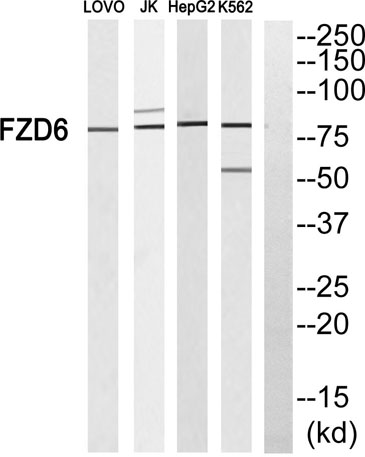
| Observed band (KD) | 79kD |
| Background | frizzled class receptor 6(FZD6) Homo sapiens This gene represents a member of the 'frizzled' gene family, which encode 7-transmembrane domain proteins that are receptors for Wnt signaling proteins. The protein encoded by this family member contains a signal peptide, a cysteine-rich domain in the N-terminal extracellular region, and seven transmembrane domains, but unlike other family members, this protein does not contain a C-terminal PDZ domain-binding motif. This protein functions as a negative regulator of the canonical Wnt/beta-catenin signaling cascade, thereby inhibiting the processes that trigger oncogenic transformation, cell proliferation, and inhibition of apoptosis. Alternative splicing results in multiple transcript variants, some of which do not encode a protein with a predicted signal peptide.[provided by RefSeq, Aug 2011], |
| Function | domain:Lys-Thr-X-X-X-Trp motif is involved in the activation of the Wnt/beta-catenin signaling pathway.,domain:The FZ domain is involved in binding with Wnt ligands.,function:Receptor for Wnt proteins. Most of frizzled receptors are coupled to the beta-catenin canonical signaling pathway, which leads to the activation of disheveled proteins, inhibition of GSK-3 kinase, nuclear accumulation of beta-catenin and activation of Wnt target genes. A second signaling pathway involving PKC and calcium fluxes has been seen for some family members, but it is not yet clear if it represents a distinct pathway or if it can be integrated in the canonical pathway, as PKC seems to be required for Wnt-mediated inactivation of GSK-3 kinase. Both pathways seem to involve interactions with G-proteins. May be involved in transduction and intercellular transmission of polarity information during tissue morphog |
| Subcellular location | Membrane ; Multi-pass membrane protein . Cell membrane ; Multi-pass membrane protein . Cell surface . Apical cell membrane; Multi-pass membrane protein . Cytoplasmic vesicle membrane ; Multi-pass membrane protein . Endoplasmic reticulum membrane ; Multi-pass membrane protein . Colocalizes with FZD3 at the apical face of cells (By similarity). Localizes to the endoplasmic reticulum membrane in the presence of LMBR1L (By similarity). . |
| Expression | Detected in adult heart, brain, placenta, lung, liver, skeletal muscle, kidney, pancreas, thymus, prostate, testis, ovary, small intestine and colon. In the fetus, expressed in brain, lung, liver and kidney. |

Use collapsible tabs for more detailed information that will help customers make a purchasing decision.
Ex: Shipping and return policies, size guides, and other common questions.