 Français
 English
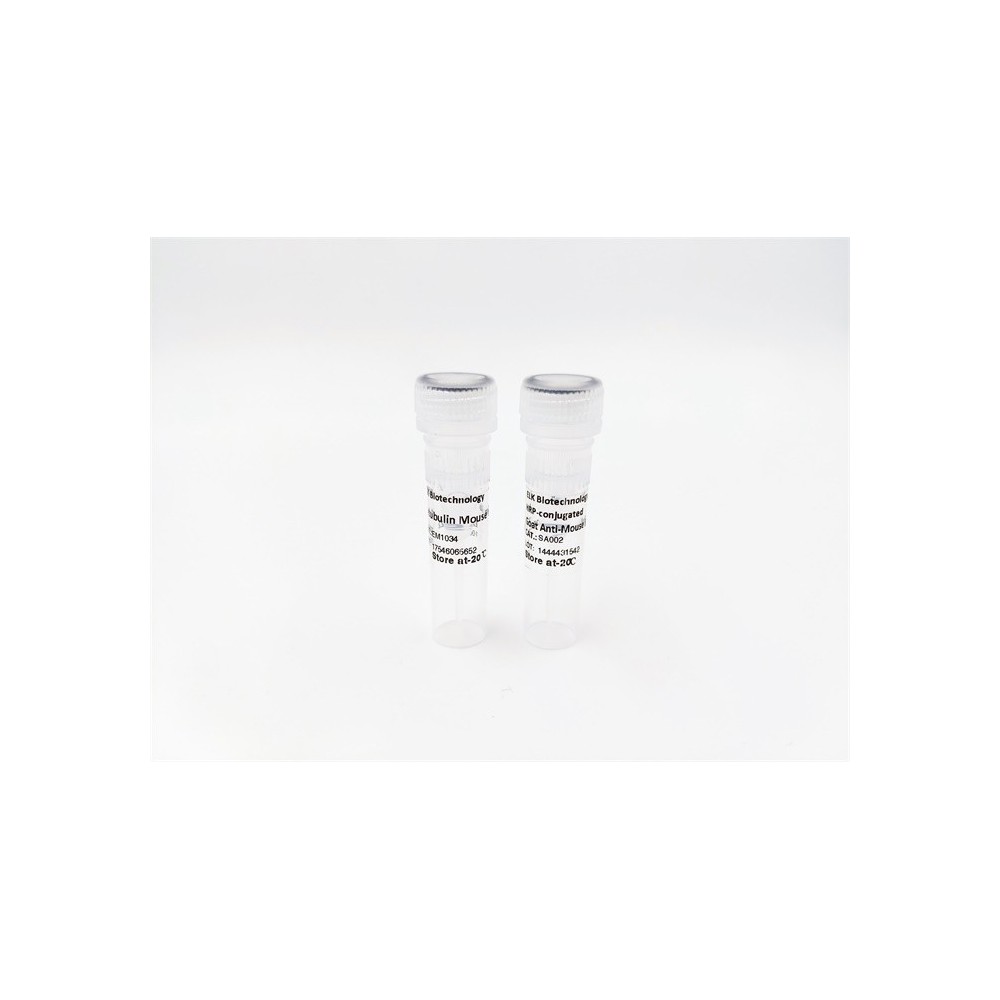
Cleaved-Caspase-4/5 p20 (D270/D311) rabbit pAb
AO-06-ES7702-50

| ELK.No | ES7702 |
| Product name | Cleaved-Caspase-4/5 p20 (D270/D311) rabbit pAb |
| Reactivity | Human |
| Applications | WB;ELISA |
| Other name | CASP4; ICH2; Caspase-4; CASP-4; ICE(rel)-II; Protease ICH-2; Protease TX; CASP5; ICH3; Caspase-5; CASP-5; ICE(rel)-III; Protease ICH-3; Protease TY |
| Size | 50μL |
| Unit price ($) | 148 |
| Human gene ID | 837 |
| Human Swiss-Prot | P49662/P51878 |
| Source | Rabbit |
| Isotype | IgG |
| Target | Caspase-4/5 |
| Fields | >>Neutrophil extracellular trap formation;>>NOD-like receptor signaling pathway;>>Pathogenic Escherichia coli infection;>>Shigellosis;>>Salmonella infection |
| Gene name | CASP4 |
| Protein name | Caspase4 |
| Human gene link | View Human Gene |
| Human Swiss link | View Human Swiss-Prot |
| Mouse gene ID | |
| Mouse gene link | |
| Mouse Swiss-Prot | |
| Mouse Swiss link | |
| Rat gene ID | |
| Rat gene link | |
| Rat Swiss-Prot | |
| Rat Swiss link | |
| Immunogen | The antiserum was produced against synthesized peptide derived from human Caspase 4/5. AA range:221-270 |
| Specificity | Cleaved-Caspase-4/5 p20 (D270/D311) Polyclonal Antibody detects endogenous levels of fragment of activated Caspase-4/5 p20 protein resulting from cleavage adjacent to D270/D311. |
| Formulation | Liquid in PBS containing 50% glycerol, 0.5% BSA and 0.02% sodium azide. |
| Clonality | Polyclonal |
| Dilution | Western Blot: 1/500 - 1/2000. ELISA: 1/40000. Not yet tested in other applications. |
| Purification | The antibody was affinity-purified from rabbit antiserum by affinity-chromatography using epitope-specific immunogen. |
| Concentration | 1 mg/ml |
| Storage stability | -20°C/1 year |
| Molecular Weight (Da) | |
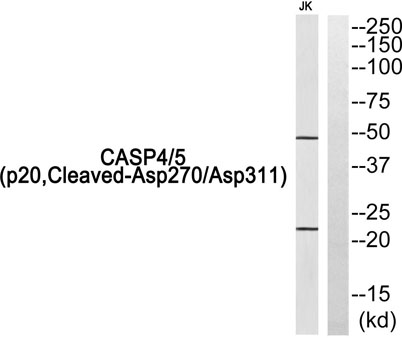
| Observed band (KD) | 47,22kD |
| Background | This gene encodes a protein that is a member of the cysteine-aspartic acid protease (caspase) family. Sequential activation of caspases plays a central role in the execution-phase of cell apoptosis. Caspases exist as inactive proenzymes composed of a prodomain and a large and small protease subunit. Activation of caspases requires proteolytic processing at conserved internal aspartic residues to generate a heterodimeric enzyme consisting of the large and small subunits. This caspase is able to cleave and activate its own precursor protein, as well as caspase 1 precursor. When overexpressed, this gene induces cell apoptosis. Alternative splicing results in transcript variants encoding distinct isoforms. [provided by RefSeq, Jul 2008], |
| Function | catalytic activity:Strict requirement for Asp at the P1 position. It has a preferred cleavage sequence of Tyr-Val-Ala-Asp-|- but also cleaves at Asp-Glu-Val-Asp-|-.,function:Involved in the activation cascade of caspases responsible for apoptosis execution. Cleaves caspase-1.,PTM:The two subunits are derived from the precursor sequence by an autocatalytic mechanism or by cleavage by Caspase-8.,similarity:Belongs to the peptidase C14A family.,similarity:Contains 1 CARD domain.,subunit:Heterotetramer that consists of two anti-parallel arranged heterodimers, each one formed by a small and a large subunit.,tissue specificity:Widely expressed, with highest levels in spleen and lung. Moderate expression in heart and liver, low expression in skeletal muscle, kidney and testis. Not found in the brain., |
| Subcellular location | Cytoplasm, cytosol . Endoplasmic reticulum membrane ; Peripheral membrane protein ; Cytoplasmic side . Mitochondrion . Inflammasome . Secreted . Predominantly localizes to the endoplasmic reticulum (ER). Association with the ER membrane requires TMEM214 (PubMed:15123740). Released in the extracellular milieu by keratinocytes following UVB irradiation (PubMed:22246630). . |
| Expression | Widely expressed, including in keratinocytes and colonic and small intestinal epithelial cells (at protein level). Not detected in brain. |

Use collapsible tabs for more detailed information that will help customers make a purchasing decision.
Ex: Shipping and return policies, size guides, and other common questions.