 Français
 English
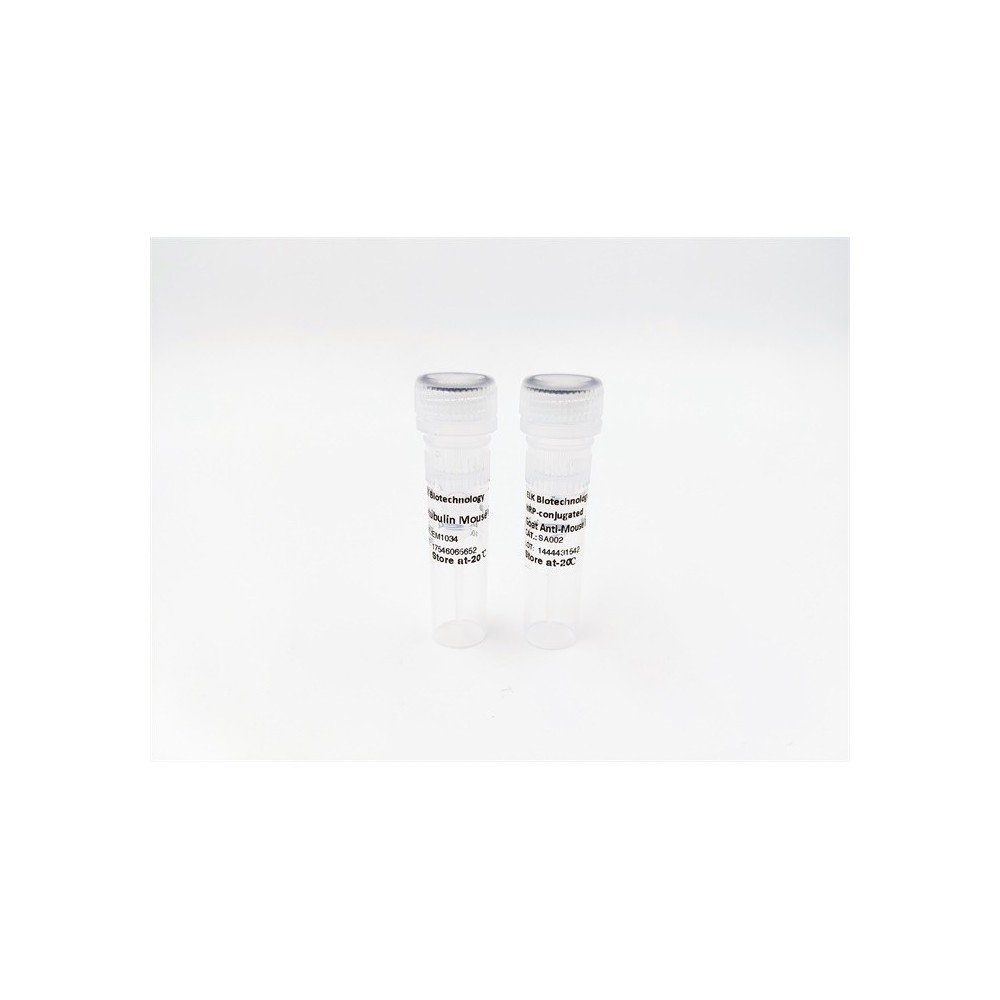

| ELK.No | ES7707 |
| Product name | AIP4 rabbit pAb |
| Reactivity | Human;Mouse |
| Applications | WB;ELISA |
| Other name | ITCH; E3 ubiquitin-protein ligase Itchy homolog; Itch; Atrophin-1-interacting protein 4; AIP4; NFE2-associated polypeptide 1; NAPP1 |
| Size | 50μL |
| Unit price ($) | 148 |
| Human gene ID | 83737 |
| Human Swiss-Prot | Q96J02 |
| Source | Rabbit |
| Isotype | IgG |
| Target | AIP4 |
| Fields | >>Ubiquitin mediated proteolysis;>>Endocytosis;>>TNF signaling pathway;>>Non-alcoholic fatty liver disease |
| Gene name | ITCH |
| Protein name | E3 ubiquitin-protein ligase Itchy homolog |
| Human gene link | View Human Gene |
| Human Swiss link | View Human Swiss-Prot |
| Mouse gene ID | 16396 |
| Mouse gene link | View Mouse Gene |
| Mouse Swiss-Prot | Q8C863 |
| Mouse Swiss link | View Mouse Swiss-Prot |
| Rat gene ID | |
| Rat gene link | |
| Rat Swiss-Prot | |
| Rat Swiss link | |
| Immunogen | The antiserum was produced against synthesized peptide derived from human ITCH. AA range:386-435 |
| Specificity | AIP4 Polyclonal Antibody detects endogenous levels of AIP4 protein. |
| Formulation | Liquid in PBS containing 50% glycerol, 0.5% BSA and 0.02% sodium azide. |
| Clonality | Polyclonal |
| Dilution | Western Blot: 1/500 - 1/2000. ELISA: 1/40000. Not yet tested in other applications. |
| Purification | The antibody was affinity-purified from rabbit antiserum by affinity-chromatography using epitope-specific immunogen. |
| Concentration | 1 mg/ml |
| Storage stability | -20°C/1 year |
| Molecular Weight (Da) | |
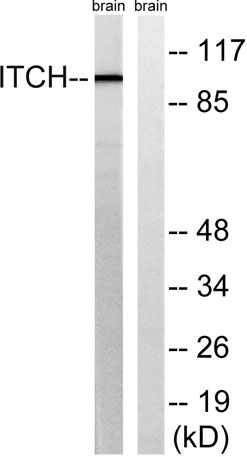
| Observed band (KD) | 103kD |
| Background | itchy E3 ubiquitin protein ligase(ITCH) Homo sapiens This gene encodes a member of the Nedd4 family of HECT domain E3 ubiquitin ligases. HECT domain E3 ubiquitin ligases transfer ubiquitin from E2 ubiquitin-conjugating enzymes to protein substrates, thus targeting specific proteins for lysosomal degradation. The encoded protein plays a role in multiple cellular processes including erythroid and lymphoid cell differentiation and the regulation of immune responses. Mutations in this gene are a cause of syndromic multisystem autoimmune disease. Alternatively spliced transcript variants encoding multiple isoforms have been observed for this gene. [provided by RefSeq, Mar 2012], |
| Function | function:E3 ubiquitin-protein ligase which accepts ubiquitin from an E2 ubiquitin-conjugating enzyme in the form of a thioester and then directly transfers the ubiquitin to targeted substrates. Regulates the transcriptional activity of several transcription factors, and probably plays an important role in the regulation of immune response.,pathway:Protein modification; protein ubiquitination.,PTM:Phosphorylated on tyrosine residues.,similarity:Contains 1 C2 domain.,similarity:Contains 1 HECT (E6AP-type E3 ubiquitin-protein ligase) domain.,similarity:Contains 4 WW domains.,subunit:Interacts via its WW domains with DRPLA, NFE2 and CBLC. Interacts with Epstein-Barr virus LMP2A. Interacts with NOTCH1, OCLN, JUN and JUNB. Interacts with NDFIP1 in vitro (By similarity). Interacts with ARHGEF7.,tissue specificity:Widely expressed., |
| Subcellular location | Cell membrane ; Peripheral membrane protein ; Cytoplasmic side . Cytoplasm . Nucleus . Early endosome membrane ; Peripheral membrane protein ; Cytoplasmic side . Endosome membrane ; Peripheral membrane protein ; Cytoplasmic side . May be recruited to exosomes by NDFIP1 (PubMed:18819914). Localizes to plasma membrane upon CXCL12 stimulation where it co-localizes with CXCL4 (PubMed:14602072). Localization to early endosomes is increased upon CXCL12 stimulation where it co-localizes with DTX3L and CXCL4 (PubMed:24790097). . |
| Expression | Widely expressed. |

Use collapsible tabs for more detailed information that will help customers make a purchasing decision.
Ex: Shipping and return policies, size guides, and other common questions.