 Français
 English
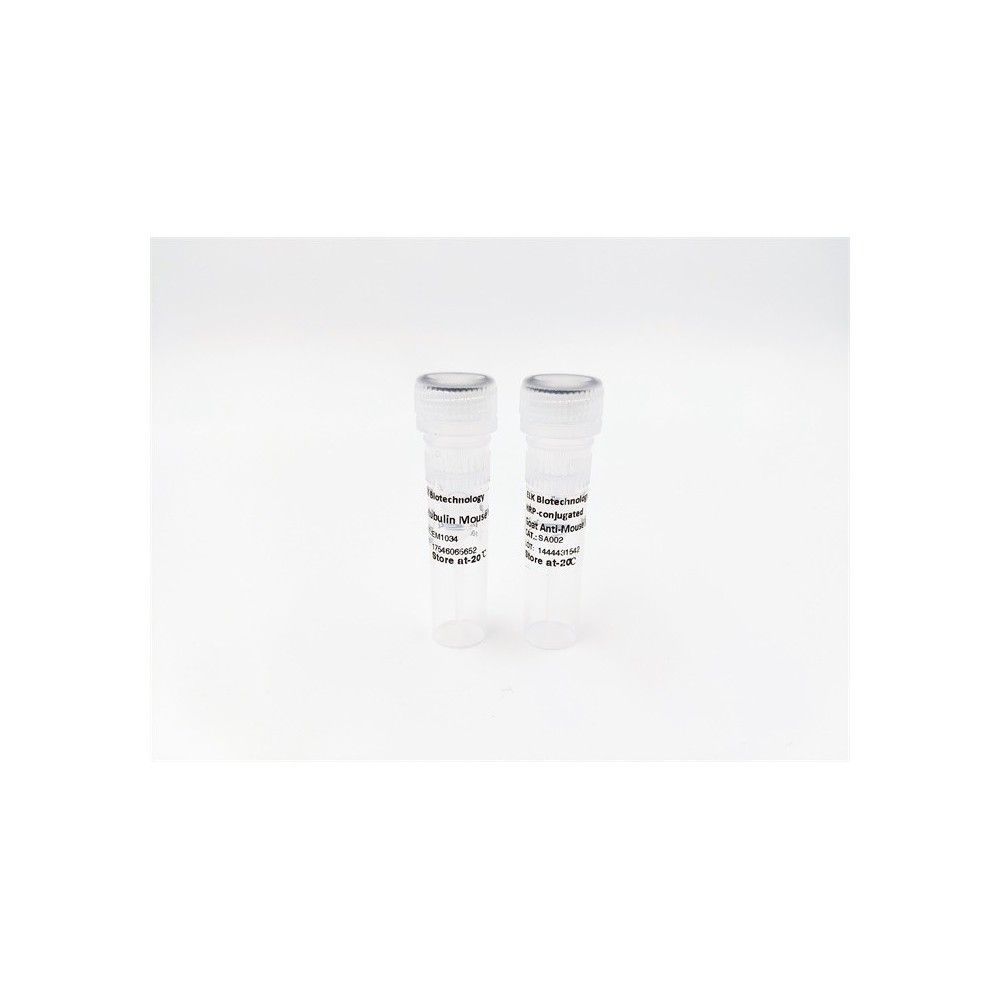

| ELK.No | ES7777 |
| Product name | COX4I2 rabbit pAb |
| Reactivity | Human;Mouse;Rat |
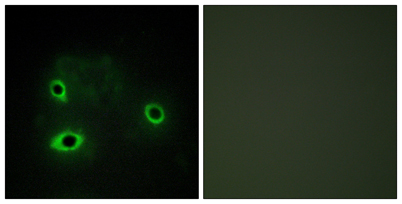
| Applications | WB;IHC;IF;ELISA |
| Other name | COX4I2; COX4L2; Cytochrome c oxidase subunit 4 isoform 2; mitochondrial; Cytochrome c oxidase subunit IV isoform 2; COX IV-2 |
| Size | 100μL |
| Unit price ($) | 248 |
| Human gene ID | 84701 |
| Human Swiss-Prot | Q96KJ9 |
| Source | Rabbit |
| Isotype | IgG |
| Target | COX4I2 |
| Fields | >>Oxidative phosphorylation;>>Metabolic pathways;>>Cardiac muscle contraction;>>Thermogenesis;>>Non-alcoholic fatty liver disease;>>Alzheimer disease;>>Parkinson disease;>>Amyotrophic lateral sclerosis;>>Huntington disease;>>Prion disease;>>Pathways of neurodegeneration - multiple diseases;>>Chemical carcinogenesis - reactive oxygen species;>>Diabetic cardiomyopathy |
| Gene name | COX4I2 |
| Protein name | Cytochrome c oxidase subunit 4 isoform 2 mitochondrial |
| Human gene link | View Human Gene |
| Human Swiss link | View Human Swiss-Prot |
| Mouse gene ID | 84682 |
| Mouse gene link | View Mouse Gene |
| Mouse Swiss-Prot | Q91W29 |
| Mouse Swiss link | View Mouse Swiss-Prot |
| Rat gene ID | 84683 |
| Rat gene link | View Rat Gene |
| Rat Swiss-Prot | Q91Y94 |
| Rat Swiss link | View Rat Swiss-Prot |
| Immunogen | The antiserum was produced against synthesized peptide derived from human COX42. AA range:31-80 |
| Specificity | COX4I2 Polyclonal Antibody detects endogenous levels of COX4I2 protein. |
| Formulation | Liquid in PBS containing 50% glycerol, 0.5% BSA and 0.02% sodium azide. |
| Clonality | Polyclonal |
| Dilution | Western Blot: 1/500 - 1/2000. Immunohistochemistry: 1/100 - 1/300. Immunofluorescence: 1/200 - 1/1000. ELISA: 1/10000. Not yet tested in other applications. |
| Purification | The antibody was affinity-purified from rabbit antiserum by affinity-chromatography using epitope-specific immunogen. |
| Concentration | 1 mg/ml |
| Storage stability | -20°C/1 year |
| Molecular Weight (Da) | |
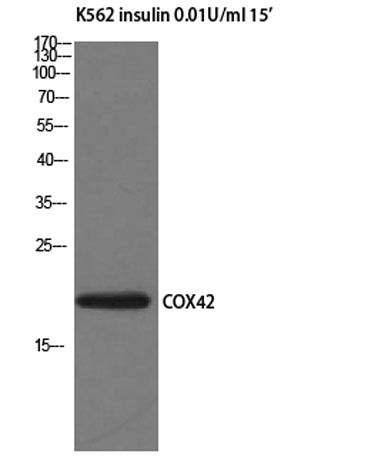
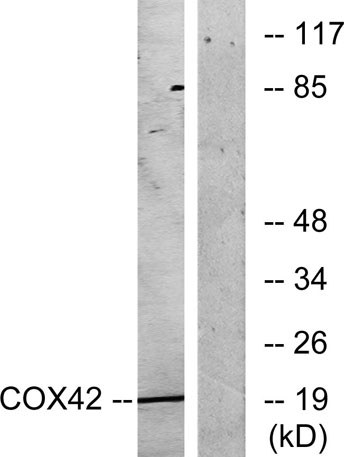
| Observed band (KD) | 20kD |
| Background | Cytochrome c oxidase (COX), the terminal enzyme of the mitochondrial respiratory chain, catalyzes the electron transfer from reduced cytochrome c to oxygen. It is a heteromeric complex consisting of 3 catalytic subunits encoded by mitochondrial genes and multiple structural subunits encoded by nuclear genes. The mitochondrially-encoded subunits function in electron transfer, and the nuclear-encoded subunits may be involved in the regulation and assembly of the complex. This nuclear gene encodes isoform 2 of subunit IV. Isoform 1 of subunit IV is encoded by a different gene, however, the two genes show a similar structural organization. Subunit IV is the largest nuclear encoded subunit which plays a pivotal role in COX regulation. [provided by RefSeq, Jul 2008], |
| Function | function:This protein is one of the nuclear-coded polypeptide chains of cytochrome c oxidase, the terminal oxidase in mitochondrial electron transport.,similarity:Belongs to the cytochrome c oxidase IV family.,tissue specificity:Highly expressed in lung., |
| Subcellular location | Mitochondrion inner membrane ; Single-pass membrane protein . |
| Expression | Highly expressed in lung. |

Use collapsible tabs for more detailed information that will help customers make a purchasing decision.
Ex: Shipping and return policies, size guides, and other common questions.